
This Standard sets out the accounting for not-for-profit private sector entities that elect or are required to prepare general purpose financial statements that comply with Tier 3: Australian Accounting Standards – Simplified Accounting reporting requirements. This Standard does not apply to public sector entities.
(Note – links in this version to another pronouncement will not work as the compilations of the pronouncements incorporating the amendments in Appendix C of this Standard and in AASB 2026-2 have not yet been published on this portal. New compilations of those other pronouncements will be published in due course.)
Preamble
Pronouncement
Obtaining a copy of this Accounting Standard
This Standard is available on the AASB Digital Standards Portal (standards.aasb.gov.au), which can also be accessed from aasb.gov.au.
Australian Accounting Standards Board
PO Box 204
Collins Street West
Victoria 8007
AUSTRALIA
Phone: (03) 9617 7600
E-mail: [email protected]
Website: www.aasb.gov.au
Other enquiries
Phone: (03) 9617 7600
E-mail: [email protected]
Copyright
© Commonwealth of Australia 2026
This work contains copyright material of the INPAS, the CIPFA, the IFRS® Foundation, the IFAC and the External Reporting Board (New Zealand), in respect of which all rights are reserved. Apart from any use as permitted under the Copyright Act 1968, no part may be reproduced by any process without prior written permission from the copyright owners. Requests and enquiries concerning reproduction and rights should be addressed to The Managing Director, Australian Accounting Standards Board, PO Box 204, Collins Street West, Victoria 8007.
This work is issued by the Australian Accounting Standards Board and has not been prepared or endorsed by CIPFA, the IFRS® Foundation, IFAC or the NZ External Reporting Board.
Rubric
Australian Accounting Standard AASB 1061 General Purpose Financial Statements – Not-for-Profit Private Sector Tier 3 Entities is set out in paragraphs 1.1–28.18 and Appendices A–C. All the paragraphs have equal authority. Other Australian Accounting Standards may also be relevant, as set out in paragraph 1.5. In the absence of explicit guidance, Section 9: Accounting Policies, Estimates and Errors in this Standard provides a basis for selecting and applying accounting policies.
Preface
Introduction
The Australian Accounting Standards Board (AASB) develops, issues and maintains Australian Accounting Standards, including Interpretations. The AASB is a Commonwealth entity under the Australian Securities and Investments Commission Act 2001.
AASB 1057 Application of Australian Accounting Standards identifies the application of Standards to entities and financial statements. AASB 1053 Application of Tiers of Australian Accounting Standards establishes a differential reporting framework consisting of three tiers of reporting requirements for preparing general purpose financial statements.
Main features of this Standard
Background
This Standard is issued in response to the review of the financial reporting framework for not-for-profit private sector entities. By introducing a new reporting tier of general purpose financial statements, AASB 1061 aims to provide a proportionate financial reporting response for smaller not-for-profit private sector entities required to prepare financial statements that comply with Australian Accounting Standards.
This Standard responds to stakeholder feedback that the original Australian reporting entity concept is not working, and acknowledges stakeholder concerns that:
(a) the existing Tier 1 and Tier 2 reporting requirements for preparing general purpose financial statements may be overly complex for application by smaller not-for-profit private sector entities; and
(b) financial reporting requirements should continue to complement other government initiatives aimed at reducing red tape and lessening the reporting burden for entities
Main requirements
This Standard sets out new, separate recognition (recording), measurement, presentation and disclosure requirements for a new tier of reporting requirements (Tier 3), which is applicable to certain not-for-profit private sector entities. This Standard has been developed through applying a new approach and principles based on considering preparer costs and the information needs of users of general purpose financial statements to determine the modified recognition, measurement, presentation and disclosure requirements that are appropriate for Tier 3 entities. Tier 3 entities are not-for-profit private sector entities that are not publicly accountable and are not prohibited from applying this Standard by legislation or their constituting document or another document. The approach and principles applied are outlined in the Basis for Conclusions accompanying this Standard.
This Standard does not specify which entities are permitted to apply Tier 3 reporting requirements. That is a matter for regulatory authorities to determine. This Standard sets out only the recognition, measurement, presentation and disclosure requirements that are relevant to general purpose financial statements of Tier 3 entities as determined by those authorities.
Application date
This Standard applies to annual reporting periods beginning on or after 1 July 2029 (see paragraph B1). Earlier application is permitted.
Accounting Standard AASB 1061
The Australian Accounting Standards Board makes Accounting Standard AASB 1061 General Purpose Financial Statements – Not-for-Profit Private Sector Tier 3 Entities under section 334 of the Corporations Act 2001.
Keith Kendall
Chair – AASB
Dated 21 April 2026
Section 1: Objective, Scope and Application
Objective
1.1
The objective of this Standard is to specify proportionate, simplified financial reporting requirements for general purpose financial statements prepared by Tier 3 entities, to require the reporting of useful, consistent and transparent information by those entities in a manner that achieves an appropriate balance of costs and benefits.
Scope of this Standard
1.2
This Standard sets out the accounting for not-for-profit private sector entities that elect or are required to prepare general purpose financial statements that comply with Tier 3: Australian Accounting Standards – Simplified Accounting reporting requirements. This Standard does not apply to public sector entities.
1.3
AASB 1053 Application of Tiers of Australian Accounting Standards sets out the application of Tiers of Australian Accounting Standards for entities preparing general purpose financial statements. AASB 1053 requires not-for-profit private sector entities that do not have public accountability and that are not prohibited from applying Tier 3 reporting requirements by legislation or their constituting document or another document to, as a minimum, apply Tier 3: Australian Accounting Standards – Simplified Accounting reporting requirements in preparing their general purpose financial statements. Such entities include some charitable organisations, co-operatives and incorporated associations. Entities eligible to apply Tier 3 reporting requirements may instead elect to apply Tier 1 or Tier 2 reporting requirements in their entirety in preparing general purpose financial statements.
1.4
Examples of the types of entities to which this Standard does not apply are:
(a) companies listed on a stock exchange;
(b) governments, as defined in AASB 1049 Whole of Government and General Government Sector Financial Reporting;
(c) local governments; and
(d) entities, including departments, controlled by those governments or local governments.
Application of this Standard
1.5
A not-for-profit private sector entity that applies the Tier 3 reporting requirements under AASB 1053 shall apply this Standard. In addition, the entity shall apply the recording, measurement, presentation and transition requirements of the following Australian Accounting Standards, and any related disclosure requirements (other than transition) in AASB 1060 General Purpose Financial Statements – Simplified Disclosures for For-Profit and Not-for-Profit Tier 2 Entities:
(a) AASB 2 Share-based Payment, in relation to share-based payment arrangements;
(b) AASB 5 Non-current Assets Held for Sale and Discontinued Operations, in relation to non-current assets held for sale except for:
(i) financial assets within the scope of Section 10 of this Standard; and
(ii) investment properties measured using the fair value model in Section 14 of this Standard;
(c) AASB 6 Exploration for and Evaluation of Mineral Resources, in relation to exploration for, and evaluation of, mineral resources;
(d) AASB 9 Financial Instruments and other applicable Australian Accounting Standards, in relation to the financial instruments listed in paragraph 10.4 of this Standard;
(e) AASB 17 Insurance Contracts, in relation to insurance contracts issued by the entity;
(f) AASB 119 Employee Benefits, in relation to obligations arising under a defined benefit plan; and
(g) AASB 141 Agriculture, in relation to biological assets except for bearer plants, and agricultural produce at the point of harvest.
Commencement of the legislative instrument
1.6
For legal purposes, this legislative instrument commences on 30 June 2029.
Section 2: Financial Statement Presentation
Scope of this section
2.1
This section explains fair presentation of financial statements, what compliance with this Standard requires and what a complete set of financial statements is.
Fair presentation
2.2
Financial statements shall present fairly the financial position, financial performance and cash flows of an entity. Fair presentation requires the faithful representation of the effects of transactions, other events and conditions in accordance with the definitions and recognition (recording) criteria for assets, liabilities, income and expenses set out in the Conceptual Framework for Financial Reporting (as identified in AASB 1048 Interpretation of Standards) (Conceptual Framework). The application of the recording, measurement, presentation and disclosure requirements in this Standard, with additional disclosure when necessary, is presumed to result in financial statements that achieve a fair presentation of the financial position, financial performance and cash flows of Tier 3 entities. The additional disclosures referred to above are necessary when compliance with the specific requirements in this Standard is insufficient to enable users of the financial statements to understand the effects of particular transactions, other events and conditions on the entity’s financial position, financial performance and cash flows.
Compliance with this Standard
2.3
An entity whose financial statements comply with the recording, measurement, presentation and disclosure requirements in this Standard shall make an explicit and unreserved statement of such compliance in the notes. Financial statements shall not be described as complying with this Standard unless they comply with all these requirements.
2.4
An entity shall disclose in the notes:
(a) the statutory basis or other reporting framework, if any, under which the financial statements are prepared; and
(b) that it is a not-for-profit entity.
2.5
Even if an entity’s management considers that compliance with a requirement in this Standard would be misleading, entities applying this Standard shall not depart from any of its requirements. In the extremely rare circumstances in which management concludes that compliance with a requirement in this Standard would be so misleading that it would conflict with the objective of financial statements set out in the Conceptual Framework, the entity shall, to the maximum extent possible, reduce the perceived misleading aspects of compliance by disclosing:
(a) the nature of the requirement in this Standard and the reason why management has concluded that complying with that requirement is so misleading in the circumstances that it conflicts with the objective of financial statements set out in the Conceptual Framework; and
(b) for each period presented, the adjustments to each item in the financial statements that management has concluded would be necessary to achieve a fair presentation.
Going concern
2.6
When preparing financial statements, an entity’s management shall assess the entity’s ability and willingness to continue as a going concern. An entity is a going concern unless management either intends to liquidate the entity or to cease its operations, or has no realistic alternative to doing so. In assessing whether the going concern assumption is appropriate, management takes into account all information available about the future, looking forward at least twelve months from the end of the reporting period.
Disclosures of material uncertainties affecting the going concern assumption
2.7
When management is aware of material uncertainties about future events or conditions that might cast significant doubt upon the entity’s ability or willingness to continue as a going concern, the entity shall disclose those uncertainties. When an entity does not prepare financial statements on a going concern basis, it shall also disclose:
(a) that fact, together with the reason(s) why it is not regarded as a going concern; and
(b) the basis on which the financial statements were prepared.
2.8
The effect of a change in an entity’s ability to continue as a going concern on the amounts of the entity’s assets and liabilities at the end of the reporting period will depend upon the entity’s particular circumstances. For example, that effect will depend upon whether operations are to be transferred to another entity, sold in an orderly manner or liquidated in a rushed sale. Judgement is required in determining whether a change in the carrying amounts of assets and liabilities is required. It is also necessary to consider whether the change in circumstances leads to additional liabilities or triggers clauses in debt contracts that will lead to the reclassification of those debts as current liabilities.
Frequency of reporting
2.9
An entity shall present a complete set of financial statements (including comparative information – see paragraph 2.12) at least annually. When the end of an entity’s reporting period changes and the annual financial statements are presented for a period longer or shorter than one year, the entity shall disclose the following:
(a) that fact;
(b) the reason for using a longer or shorter period; and
(c) the fact that comparative amounts presented in the financial statements (including the related notes) are not entirely comparable.
Consistency of presentation
2.10
An entity shall retain the presentation and classification of items in the financial statements from one period to the next unless:
(a) it is apparent, following a significant change in the nature of the entity’s operations or a review of its financial statements, that another presentation or classification would be more appropriate having regard to the criteria for the selection and application of accounting policies in Section 9; or
(b) this Standard requires a change in presentation or classification.
2.11
When the presentation or classification of items in the financial statements is changed, an entity shall reclassify comparative amounts unless the reclassification is impracticable.
Comparative information
2.12
Except when this Standard permits or requires otherwise, an entity shall disclose comparative information for the previous comparable period for all amounts presented in the current period’s financial statements. An entity shall include comparative information for narrative and descriptive information when it is relevant to an understanding of the current period’s financial statements.
Materiality and aggregation
2.13
An entity shall present separately each material class of similar items. An entity shall present separately items of a dissimilar nature or function unless they are immaterial.
2.14
When applying this Standard an entity shall decide, having regard to its circumstances, how it aggregates information in the financial statements, which include the notes. An entity shall not reduce the understandability of its financial statements by obscuring material information with immaterial information or by aggregating material items that have different natures or functions.
2.15
Information is material if omitting, misstating or obscuring it could reasonably be expected to influence decisions that the primary users of general purpose financial statements make on the basis of those financial statements, which provide financial information about a specific reporting entity. Materiality depends on the nature or magnitude of information, or both. An entity assesses whether information, either individually or in combination with other information, is material in the context of its financial statements taken as a whole.
2.16
This Standard specifies information that is required to be included in the financial statements, which include the notes. An entity need not provide a specific disclosure if the information resulting from that disclosure is not material. This is the case even if this Standard contains a list of specific requirements or describes them as minimum requirements.
Offsetting
2.17
Users of financial statements should be given as much relevant information as possible about an entity’s transactions and balances. Therefore, unless required or permitted to do so by this Standard, an entity shall not offset (net off) assets and liabilities or income and expenses.
2.18
The following practices do not involve offsetting:
(a) measuring assets net of valuation adjustments such as obsolescence or impairment write-downs of items of inventory or property, plant and equipment;
(b) netting amounts due from and payable to the same counterparty if the entity is legally entitled to settle the amounts on a net basis;
(c) presenting a gain or loss on the sale of an item of property, plant and equipment or investment by deducting from the asset’s sale consideration the asset’s carrying amount and related selling expenses; and
(d) presenting on a net basis gains and losses arising from transactions or other events of a similar nature (eg foreign exchange gains and losses).
Complete set of financial statements
2.19
A complete set of financial statements includes:
(a) a statement of financial position as at the reporting date;
(b) a statement (or statements) of financial performance for the reporting period, presented as either:
(i) a single statement with profit or loss and other comprehensive income presented in two sections. If this option is chosen, the profit or loss section is presented first, followed directly by the other comprehensive income section; or
(ii) a statement of profit or loss and a separate statement of comprehensive income. If this option is chosen, the statement of comprehensive income begins with profit or loss, followed by the items of other comprehensive income;
(c) a statement of changes in equity for the reporting period;
(d) a statement of cash flows for the reporting period; and
(e) notes, comprising material accounting policy information and other explanatory information.
2.20
If the only changes to equity during the periods for which financial statements are presented arise from profit or loss, corrections of prior period errors and changes in accounting policy, the entity may present a single statement of income and retained earnings in place of the statement(s) of financial performance and statement of changes in equity (see paragraph 5.4).
2.21
If an entity has no items of other comprehensive income in any of the periods for which financial statements are presented, it may present only a statement of profit or loss or it may present a statement(s) of financial performance in which the ‘bottom line’ is labelled ‘profit or loss’.
2.22
Because paragraph 2.12 requires comparative amounts in respect of the previous period for all amounts presented in the financial statements, a complete set of financial statements means that an entity shall present, as a minimum, two of each of the required financial statements and related notes.
2.23
In a complete set of financial statements, an entity shall present each financial statement with equal prominence.
2.24
An entity may use titles for the financial statements other than those used in this Standard as long as they are not misleading. For example, an entity may use ‘statement of surplus or deficit’ instead of ‘statement of profit or loss’.
Identification of the financial statements
2.25
An entity shall clearly identify each of the financial statements and the notes and distinguish them from other information in the same document. In addition, an entity shall display the following information prominently and repeat it when necessary for an understanding of the information presented:
(a) the name of the reporting entity and any change in its name since the end of the preceding reporting period;
(b) whether the financial statements cover the individual entity or a group of entities;
(c) the reporting date and the period covered by the financial statements;
(d) that the amounts in the financial statements are presented in Australian dollars; and
(e) the level of rounding, if any, used in presenting amounts in the financial statements.
2.26
An entity shall disclose the following, if not disclosed elsewhere in information published with the financial statements:
(a) the domicile and legal form of the entity, its country of incorporation and the address of its registered office (or principal place of operations, if different from the registered office); and
(b) a description of the entity’s primary purpose or mission and the nature of the entity’s primary operations or activities.
Section 3: Statement of Financial Position
Scope of this section
3.1
This section sets out the information to be presented in a statement of financial position and how to present it. The statement of financial position (sometimes called the balance sheet) presents an entity’s assets, liabilities and equity as of a specific date – the reporting date.
Information to be presented in the statement of financial position
3.2
The statement of financial position shall include line items that present the following amounts when those amounts are material to an understanding of the entity’s financial position:
(a) cash and cash equivalents;
(b) trade and other receivables (‘debtors’);
(c) financial assets (excluding amounts shown under (a), (b), (h) and (i));
(d) inventories;
(e) property, plant and equipment;
(f) investment property;
(g) intangible assets;
(h) investments in associates;
(i) investments in joint ventures;
(j) trade and other payables (‘creditors’);
(k) financial liabilities (excluding amounts shown under (j) and (m));
(l) liabilities and assets for current tax;
(m) provisions;
(n) non-controlling interests, presented within equity separately from the equity attributable to the owners of the parent; and
(o) equity attributable to the owners of the parent.
3.3
An entity shall present additional line items, headings and subtotals in the statement of financial position when such presentation is relevant to an understanding of the entity’s financial position. An entity that presents investments in notable relationship entities shall include this as a line item instead of the line items noted in paragraphs 3.2(h) and (i).
Current/non-current distinction
3.4
An entity shall present current and non-current assets, and current and non-current liabilities, as separate classifications in its statement of financial position in accordance with paragraphs 3.5 and 3.6.
Current assets
3.5
An entity shall classify an asset as current when:
(a) it expects to convert the asset to cash (eg by selling it), or consume it, within twelve months after the reporting date;
(b) it holds the asset primarily for the purpose of trading; or
(c) the asset is cash or a cash equivalent, unless it is restricted from being exchanged or used to settle a liability for at least twelve months after the reporting date.
An entity shall classify all other assets as non-current.
Current liabilities
3.6
An entity shall classify a liability as current when:
(a) the liability is due to be settled within twelve months after the reporting date;
(b) it holds the liability primarily for the purpose of trading; or
(c) the entity does not have the right to defer settlement of the liability for at least twelve months after the reporting date.
An entity shall classify all other liabilities as non-current.
Sequencing and format of items in the statement of financial position
3.7
This Standard does not prescribe the sequence or format in which items are to be presented. In addition, the descriptions used and the sequencing of items or aggregation of similar items may be amended according to the nature of the entity and its transactions, to provide information relevant to an understanding of the entity’s financial position.
Information to be presented in the statement of financial position or in the notes
3.8
An entity shall disclose, either in the statement of financial position or in the notes, further subclassifications of the line items presented when those amounts are material to an understanding of the entity’s financial position, classified in a manner appropriate to the entity’s operations. This includes, for example:
(a) for property, plant and equipment, showing classifications appropriate to the entity;
(b) for trade and other receivables, showing separately amounts due from related parties from those due from other parties;
(c) for inventories, showing separately amounts of inventories:
(i) held for sale or distribution in the ordinary course of operations;
(ii) in the process of production for such sale or distribution; and
(iii) in the form of materials or supplies to be consumed in the production process or in the rendering of services;
(d) for trade and other payables, showing separately amounts payable to trade suppliers from those payable to related parties;
(e) showing deferred revenue obligations separately from other liabilities;
(f) for provisions, showing provisions for employee benefits separately from other provisions; and
(g) disaggregating equity into its classes, such as contributed capital, retained earnings, reserves and items of income and expense that, as permitted or required by this Standard, are recorded in other comprehensive income and presented separately in equity (including any revaluation surplus).
3.9
An entity shall disclose the amount of contributed capital and changes in its amount during the period, and the rights and any restrictions attaching to contributed capital at the reporting date. These disclosures apply to entities with share capital and entities with any other form of contributed capital, such as partnerships or trusts.
3.10
In applying paragraph 3.6, if an entity classifies liabilities arising from loan arrangements as non-current although the entity’s right to defer settlement of those liabilities is subject to the entity complying with covenants within twelve months after the reporting date, the entity shall disclose information in the notes that enables users of financial statements to understand the risk that the liabilities could become repayable within twelve months after the reporting date, including:
(a) information about the covenants (including the nature of the covenants and when the entity is required to comply with them) and the carrying amount of related liabilities; and
(b) any facts and circumstances that indicate the entity might have difficulty complying with the covenants – for example, the entity having acted during or after the reporting period to avoid or mitigate a potential breach. Such facts and circumstances could also include the fact that the entity would not have complied with the covenants if they were to be assessed for compliance based on the entity’s circumstances at the reporting date.
Section 4: Statement(s) of Financial Performance
Scope of this section
4.1
This section requires an entity to present its total comprehensive income for a reporting period – ie its financial performance for the period – across one or two financial statements. It sets out the information to be presented in those statements and how to present it.
Presentation of total comprehensive income
4.2
An entity shall present its total comprehensive income for a period either:
(a) in a single statement of profit or loss and other comprehensive income, in which case the statement presents all items of income and expense recorded in the period; or
(b) in two statements – a statement of profit or loss and a statement of comprehensive income – in which case the statement of profit or loss presents all items of income and expense recorded in the period except those that are recorded in total comprehensive income outside profit or loss as permitted or required by this Standard.
4.3
An entity’s total comprehensive income for a reporting period is the change in equity during that period resulting from transactions and other events, other than those changes resulting from transactions with owners in their capacity as owners. It comprises all components of ‘profit or loss’ and of ‘other comprehensive income’. This Standard requires different treatment of items of income and expense in the following circumstances:
(a) the effects of corrections of prior period errors and changes in accounting policies are presented as retrospective adjustments of prior periods instead of as part of the total comprehensive income for the current period (see Section 9); and
(b) items of other comprehensive income are recorded outside profit or loss when they arise.
4.4
A change between presenting total comprehensive income using the single-statement approach and the two-statement approach is not a change in accounting policy.
Single-statement approach
4.5
Under the single-statement approach, the statement of profit or loss and other comprehensive income shall include all items of income and expense recorded in a period unless this Standard requires otherwise.
4.6
An entity shall include, in the statement of profit or loss and other comprehensive income, line items that present the following amounts for the period when those amounts are material to an understanding of the entity’s financial performance:
(a) revenue;
(b) finance costs;
(c) share of the profit or loss of investments in associates and joint ventures accounted for using the equity method or, where applicable, the share of the profit or loss of investments in notable relationship entities accounted for using the equity method;
(d) tax expense;
(e) profit or loss (if an entity has no items of other comprehensive income, this line need not be presented);
(f) each item of other comprehensive income classified by nature (excluding amounts in (g)).
(g) share of the other comprehensive income of associates and joint ventures accounted for using the equity method or, where applicable, the share of the other comprehensive income of notable relationship entities accounted for using the equity method; and
(h) total comprehensive income (if an entity has no items of other comprehensive income, it may use another term for this line, such as ‘profit or loss’).
4.7
An entity shall disclose separately the following items in the statement of profit or loss and other comprehensive income as allocations for the period:
(a) profit or loss for the period attributable to:
(i) non-controlling interests; and
(ii) owners of the parent; and
(b) total comprehensive income for the period attributable to:
(i) non-controlling interests; and
(ii) owners of the parent.
Two-statement approach
4.8
Under the two-statement approach, the statement of profit or loss shall present, as a minimum, line items that present the amounts in paragraphs 4.6(a)–(e) for the period, with profit or loss as the last line. The statement of comprehensive income shall begin with profit or loss as its first line and shall present, as a minimum, line items that present the amounts in paragraphs 4.6(f)–(h) and paragraph 4.7 for the period.
Requirements applicable to both approaches
4.9
An entity shall present additional line items, headings and subtotals in the statement(s) of financial performance when such presentation is relevant to an understanding of the entity’s financial performance.
4.10
An entity shall not present or describe any items of income and expense as ‘extraordinary items’ in the statement(s) of financial performance or in the notes.
Structured summary of expenses
4.11
An entity shall present a structured summary of its expenses in the statement of profit or loss and other comprehensive income, or in the notes, classifying expenses by the nature of expenses or the function of expenses within the entity, or both, whichever way provides the most useful structured summary of its expenses.
Classification by nature of expense
(a) Under this method of classification, expenses are aggregated according to their nature (for example, depreciation, materials used, grants and donations made, transport costs, employee benefits, information technology support and advertising costs) and are not reallocated among various functions within the entity.
Classification by function of expense
(b) Under this method of classification, expenses are aggregated according to their function as part of the costs of pursuing the entity’s mission, for example the costs of providing educational services, advice or other community services, the cost of sales and the costs of distribution or administrative activities.
4.12
In determining how to use the characteristics of nature and function to provide the most useful structured summary of expenses, an entity shall consider the main components and drivers of the entity’s financial performance, how the entity’s operations are managed and the classifications commonly used by entities in the same industry. An entity shall not classify expenses to a function if the allocation of expenses to that function would be so arbitrary that the amount presented would not provide a faithful representation of that function.
4.13
If an entity classifies and presents some expenses by nature and other expenses by function, it shall label the resulting items in a way that clearly identifies which expenses are included in each item presented. For example, if an entity includes some employee benefits in a function line item and other employee benefits in a nature line item, the label for the nature line item would clearly identify that it does not include all employee benefits (eg ‘employee benefits excluding those included in cost of sales’).
4.14
An entity that classifies and presents some or all expenses by function within the entity shall nonetheless disclose the items of expense that are required to be disclosed by other sections of this Standard (eg impairment losses).
Section 5: Statement of Changes in Equity and Statement of Income and Retained Earnings
Scope of this section
5.1
This section sets out requirements for presenting the changes in an entity’s equity for a reporting period, either in a statement of changes in equity or, if the conditions specified in paragraph 5.4 are met and an entity so chooses, in a statement of income and retained earnings. It sets out the information to be presented in those statements and how to present it.
Statement of changes in equity
Purpose
5.2
The statement of changes in equity presents an entity’s profit or loss for a reporting period, other comprehensive income for the period, the effects of changes in accounting policies and corrections of prior period errors, and the amounts of investments by, and distributions to, owners acting in their capacity as owners during the period.
Information to be presented in the statement of changes in equity
5.3
The statement of changes in equity shall include the following information:
(a) total comprehensive income for the period, showing separately the total amounts attributable to owners of the parent and to non-controlling interests;
(b) for each component of equity, the effects of retrospective application or retrospective restatement recorded in accordance with Section 9; and
(c) for each component of equity, a reconciliation between the carrying amount at the beginning and the end of the period, separately disclosing changes resulting from:
(i) profit or loss;
(ii) other comprehensive income; and
(iii) amounts of contributions by owners acting in their capacity as owners, and changes in ownership interests in subsidiaries that do not result in a loss of control.
Statement of income and retained earnings
Purpose
5.4
The statement of income and retained earnings presents an entity’s profit or loss and changes in retained earnings for a reporting period. Paragraph 2.20 permits an entity to present a statement of income and retained earnings in place of a statement(s) of financial performance and a statement of changes in equity if the only changes to its equity during the periods for which financial statements are presented arise from profit or loss, corrections of prior period errors and changes in accounting policy. Accordingly, an entity shall not present a statement of income and retained earnings if a transfer between classes of equity (eg between retained earnings and capital reserves) occurs, or items of other comprehensive income (eg a movement in asset revaluation surplus) are recorded, during the reporting period or any comparative period presented.
5.5
A change between presenting a statement of income and retained earnings and presenting both a statement(s) of financial performance and a statement of changes in equity is not a change in accounting policy.
Information to be presented in the statement of income and retained earnings
5.6
An entity shall present in the statement of income and retained earnings, as a minimum, line items that present the amounts in paragraphs 4.6(a)–(e) for the period and the following:
(a) retained earnings as at the beginning of the reporting period;
(b) restatements of retained earnings for corrections of prior period errors;
(c) restatements of retained earnings for changes in accounting policy; and
(d) retained earnings as at the reporting date.
Section 6: Statement of Cash Flows
Scope of this section
6.1
This section sets out the information to be presented in a statement of cash flows and how to present it. The statement of cash flows provides information about the changes in cash and cash equivalents of an entity for a reporting period, showing separately changes from operating activities and changes from other activities.
Cash equivalents
6.2
Cash equivalents are short-term, highly liquid investments that are readily convertible to known amounts of cash and that are subject to an insignificant risk of changes in value. They include at-call deposits with banks, term deposit investments with a maturity not exceeding three months from their date of purchase and bank overdrafts that are repayable on demand and form an integral part of an entity’s cash management.
Information to be presented in the statement of cash flows
6.3
An entity shall present a statement of cash flows that presents, as a minimum, cash flows for a reporting period classified by operating activities and other activities. Other activities comprise the entity’s investing activities and financing activities. An entity may classify and present cash flows from investing activities separately from cash flows from financing activities instead of presenting cash flows from other activities.
Operating activities
6.4
An entity’s operating activities are its principal activities. Consequently, cash flows from operating activities generally result from the transactions and other events and conditions that enter into the determination of profit or loss. Examples of cash flows from operating activities are:
(a) cash receipts from grants and donations, excluding grants and donations that are restricted for the acquisition or construction of long-term assets (eg property, plant and equipment);
(b) cash receipts from the sale of goods and the rendering of services;
(c) cash receipts from membership fees and subscriptions;
(d) cash payments to suppliers for goods and services;
(e) cash payments to and on behalf of employees;
(f) grants and donations paid to beneficiaries; and
(g) cash receipts from investments and cash receipts and payments from loans, when those investments or loans are held for dealing or trading purposes.
Some transactions, such as the sale of a building, may give rise to a gain or loss included in profit or loss. However, the cash flows relating to such transactions are not typically cash flows from operating activities.
Other activities
6.5
Activities other than operating activities are:
(a) the acquisition and disposal of long-term assets and other investments not included in cash equivalents; and
(b) activities that result in changes in the size and composition of the contributed equity and borrowings of an entity.
6.6
Examples of cash flows arising from other activities are:
(a) cash payments to acquire or construct long-term assets such as property, plant and equipment;
(b) cash receipts from sales of long-term assets such as property, plant and equipment;
(c) cash payments to acquire equity or debt instruments of other entities and interests in joint ventures;
(d) cash receipts from sales of equity or debt instruments of other entities and interests in joint ventures; and
(e) cash receipts and payments from borrowings and repaying loan principal, for loans that are not held for dealing or trading purposes.
Reporting cash flows from operating activities
6.7
An entity shall present cash flows from operating activities using either the indirect method in paragraphs 6.8 and 6.9 or the direct method in paragraph 6.10.
Indirect method
6.8
Under the indirect method, the net cash flow from operating activities is determined by adjusting profit or loss for the effects of non-cash transactions, any deferrals or accruals of past or future operating cash receipts or payments and items of income or expense associated with investing or financing cash flows. Under that method, the entity shall adjust profit or loss for the effects of:
(a) changes during the period in inventories and receivables and payables arising from operating activities;
(b) non-cash items such as depreciation, provisions, accrued income (expenses) not yet received (paid) in cash, unrealised foreign currency gains and losses, undistributed profits of associates and non-controlling interests; and
(c) all other items for which the cash flows relate to investing or financing activities.
6.9
Alternatively, the net cash flow from operating activities may be presented under the indirect method by showing the relevant revenues and expenses disclosed in the statement(s) of profit or loss and other comprehensive income and the changes during the period in inventories and receivables and payables arising from operating activities.
Direct method
6.10
Under the direct method, the net cash flow from operating activities is presented by disclosing information about major classes of gross cash receipts and gross cash payments. Such information may be obtained either:
(a) from the accounting records of the entity; or
(b) by adjusting sales, cost of sales and other items in the statement(s) of profit or loss and other comprehensive income for:
(i) changes during the period in inventories and receivables and payables arising from operating activities;
(ii) other non-cash items; and
(iii) other items for which the cash effects are investing or financing cash flows.
Reporting cash flows from other activities
6.11
An entity shall present separately major classes of gross cash receipts and gross cash payments arising from its activities other than operating activities. An entity that classifies cash flows from investing activities separately from cash flows from financing activities shall present cash flows from acquisitions and disposals of notable relationship entities (or subsidiaries or other operating units, as applicable) as cash flows from investing activities.
Reporting cash flows on a net basis
6.12
Cash flows arising from operating activities or other activities may be reported on a net basis when they are cash receipts and cash payments for items in which the turnover is quick, the amounts are large and the maturities are short (eg the borrowing and repayment of short-term loans).
Interest and dividends
6.13
An entity shall present separately cash flows from interest paid and interest and dividends received. The entity shall classify these cash flows consistently from period to period.
6.14
An entity may classify interest paid and interest and dividends received as cash flows from operating activities because they are included in profit or loss. Alternatively, the entity may classify interest paid and interest and dividends received as cash flows from other activities because they are costs of obtaining financial resources or returns on investments.
Income tax
6.15
An entity shall present separately cash flows arising from income tax and shall classify them as cash flows from operating activities unless they can be specifically identified with an investing activity or a financing activity. When tax cash flows are allocated over more than one class of activity, the entity shall disclose the total amount of taxes paid.
Non-cash transactions
6.16
An entity shall exclude from the statement of cash flows investing and financing transactions that do not require the use of cash or cash equivalents. An entity shall disclose such transactions, separately or together, elsewhere in the financial statements in a way that provides all the relevant information about those other activities.
6.17
Many investing and financing activities do not have a direct impact on current cash flows even though they affect the capital and asset structure of an entity. The exclusion of non-cash transactions from the statement of cash flows is consistent with the objective of a statement of cash flows because these items do not involve cash flows in the current period. Examples of non-cash transactions are:
(a) the receipt of donated assets;
(b) the acquisition of assets by assuming directly related liabilities; and
(c) the acquisition of an entity by means of an equity issue.
Components of cash and cash equivalents
6.18
An entity shall disclose the components of cash and cash equivalents.
6.19
An entity shall disclose, together with a commentary by management, the amount of significant cash and cash equivalent balances held by the entity that are unavailable for use by the entity. Cash and cash equivalents held by an entity may be unavailable for use by the entity because of, among other reasons, foreign exchange controls or legal restrictions.
Section 7: Notes to the Financial Statements
Scope of this section
7.1
This section sets out the information to be presented in the notes to the financial statements and how to present it. Notes contain information in addition to that presented in:
(a) the statement of financial position;
(b) whichever of the following statements are presented: the statement(s) of financial performance, the statement of income and retained earnings, and the statement of changes in equity; and
(c) the statement of cash flows.
7.2
Notes provide narrative descriptions or disaggregation of items presented in those statements and information about items that do not qualify for recording in those statements. In addition to the requirements of this section, nearly every other section of this Standard requires disclosures that are normally presented in the notes.
Structure of the notes
7.3
The notes shall:
(a) present information about the basis of preparation of the financial statements and the accounting policies used, in accordance with paragraphs 7.6–7.7; and
(b) disclose material information that is not presented elsewhere in the financial statements and either specifically required by this Standard or otherwise relevant to an understanding of any of the financial statements.
7.4
An entity shall, as far as practicable, present the notes in a systematic manner. An entity shall cross-reference each item in the financial statements to any related information in the notes.
7.5
Examples of systematic ordering or grouping of the notes include:
(a) giving prominence to the areas of its activities that the entity considers to be most relevant to an understanding of its financial performance and financial position, such as grouping information about particular operating activities;
(b) grouping information about items measured similarly, such as assets measured at fair value; and
(c) following the order of the line items in the statement of financial position, the statement(s) of financial performance, the statement of changes in equity, the statement of income and retained earnings and the statement of cash flows, such as:
(i) statement of compliance with this Standard (see paragraph 2.3);
(ii) material accounting policy information (see paragraph 7.6);
(iii) supporting information for items presented in the various statements, in the order in which each statement and each line item is presented; and
(iv) other disclosures, including:
(1) contingent liabilities (see paragraph 19.15), contingent assets (see paragraph 19.17) and unrecorded firm commitments; and
(2) non-financial disclosures, if any.
Disclosure of accounting policy information
7.6
An entity shall disclose material accounting policy information. Accounting policy information is material if, when considered together with other information included in the entity’s financial statements, it can reasonably be expected to influence decisions that the primary users of general purpose financial statements make on the basis of those financial statements.
Information about judgements
7.7
An entity shall disclose in the notes the judgements, apart from those involving estimations (see paragraph 7.8), that management has made in the process of applying the entity’s accounting policies and that have the most significant effect on the amounts recorded in the financial statements.
Information about key sources of estimation uncertainty
7.8
An entity shall disclose in the notes information about the key assumptions concerning the future, and other key sources of estimation uncertainty at the reporting date, that have a significant risk of causing a material adjustment to the carrying amounts of assets and liabilities within the next reporting period. In respect of those assets and liabilities, the notes shall include details of:
(a) their nature; and
(b) their carrying amount as at the reporting date.
Audit fees
7.9
An entity shall disclose fees to each auditor or reviewer, including any network firm, separately for the following services performed during the reporting period:
(a) the audit or review of the financial statements; and
(b) all other services.
An entity shall disclose the nature of those other services.
Section 8: Consolidated and Separate Financial Statements
Scope of this section
8.1
This section sets out the accounting by an entity that is a parent or an investor in a notable relationship entity.
Classification
8.2
A parent is an entity (an investor) that controls another entity (an investee). An entity that is a parent shall present consolidated financial statements. An entity that is a parent may, in addition, present separate financial statements.
8.3
Notwithstanding paragraph 8.2, an entity, including a parent, may elect to collectively classify its investments in subsidiaries, investments in associates and interests in joint arrangements that involve a separate vehicle as investments in notable relationship entities. An investor that classifies these investments as investments in notable relationship entities does not present consolidated financial statements but prepares separate financial statements as its only financial statements in accordance with paragraphs 8.29–8.35.
8.4
A notable relationship between the entity and another entity (a ‘notable relationship entity’) exists when the investor has the power to, at a minimum, participate in the financial and operating policy decisions of that other entity. Paragraphs 13.5–13.7 provide guidance on when this might be evidenced. An entity that accounts for investments in notable relationship entities is not required to determine whether the nature of its relationship with the notable relationship entity is that of a parent, an investor in an associate, or a joint venturer or joint operator in a joint arrangement.
8.5
An entity does not need to hold an equity interest in another entity to be able to participate in the financial and operating policy decisions of that other entity. Similarly, an entity need not obtain a financial benefit from the other entity.
Consolidated financial statements
8.6
Consolidated financial statements are the financial statements of a group in which the assets, liabilities, equity, income, expenses and cash flows of the parent and its subsidiaries are presented as those of a single economic entity. A parent that presents consolidated financial statements in accordance with paragraph 8.2 shall present consolidated financial statements that include all subsidiaries of the parent. The consolidated financial statements shall not consolidate any entity that is not a subsidiary.
Assessing control of an investee
8.7
A subsidiary is an entity (an investee) controlled by another entity (an investor). An investor, regardless of the nature of its involvement with the investee, shall determine whether it is a parent by assessing whether it controls the investee.
8.8
An investor controls an investee when the investor has all the following:
(a) power over the investee;
(b) exposure, or rights, to variable returns from its involvement with the investee; and
(c) the ability to use its power over the investee to affect the amount of the investor’s returns.
8.9
The investor shall reassess whether it controls an investee if circumstances indicate there are changes to one or more of the three elements of control listed in paragraph 8.8.
8.10
An investor has power over an investee when the investor has existing rights that give it the current ability to direct the relevant activities, which are the activities that significantly affect the investor’s returns. Relevant activities include, but are not limited to:
(a) selling and purchasing goods or services;
(b) selecting, acquiring or disposing of assets;
(c) providing services in accordance with the investor’s objectives;
(d) fundraising;
(e) developing budgets in relation to the activities in (a)–(d); and
(f) appointing and remunerating an investee’s key management personnel and terminating their employment.
8.11
An investor with the current ability to direct the relevant activities has power even if its rights to direct them have yet to be exercised. Evidence that the investor has been directing relevant activities can help determine whether the investor has power, but is not, in itself, conclusive in determining whether the investor has power over an investee.
8.12
An investor can have power even if it holds less than a majority of the voting rights of an investee, for example through:
(a) a contractual arrangement between the investor and other vote holders;
(b) rights arising from other contractual arrangements;
(c) the investor’s voting rights;
(d) potential voting rights;
(e) rights to appoint, reassign or remove members of an investee’s key management personnel who have the ability to direct the relevant activities; or
(f) a combination of (a)–(e).
8.13
When determining whether it has power, an investor considers its potential voting rights as well as potential voting rights held by other parties. Potential voting rights are rights to obtain voting rights of an investee, such as those arising from convertible instruments or options, including forward contracts. Those potential voting rights are considered only if the holder of the right has the practical ability to exercise that right. Usually, for the holder of the right to have the practical ability to exercise that right, the right needs to be currently exercisable.
8.14
If an investor also has voting or other decision-making rights relating to the investee’s relevant activities, the investor assesses whether those rights, in combination with potential voting rights, give the investor power.
8.15
An investor is exposed, or has rights, to variable returns from its involvement with the investee when the investor’s returns from its involvement have the potential to vary as a result of the investee’s performance. The investor’s returns can be only positive, only negative or both positive and negative.
8.16
An investor’s returns from its involvement with an investee are broad in nature, encompassing financial, non-financial, direct and indirect benefits, such as when the furtherance of the investee’s financial and non-financial objectives contributes to the furtherance of the investor’s financial and non-financial objectives. For example, the provision of goods or services by the investee to its beneficiaries might further the achievement of the investor’s social policy objectives. These returns to the investor would reflect factors such as the efficiency and effectiveness of delivery of the goods and services and changes in the outcomes for beneficiaries.
8.17
When an investor with decision-making rights (a decision-maker) assesses whether it controls an investee, it shall determine whether it is a principal or an agent. An investor shall also determine whether another entity with decision-making rights is acting as an agent for the investor. An agent is a party primarily engaged to act on behalf and for the benefit of another party or parties (the principal(s)) and therefore does not control the investee when it exercises its decision-making authority. Thus, sometimes a principal’s power may be held and exercisable by an agent, but on behalf of the principal. A decision-maker is not an agent solely because other parties can benefit from the decisions it makes.
Consolidation procedures
8.18
In preparing consolidated financial statements, an entity shall:
(a) combine the financial statements of the parent and its subsidiaries line by line, by adding together like items of assets, liabilities, equity, income, expenses and cash flows;
(b) eliminate the carrying amount of the parent’s investment in each subsidiary and the parent’s portion of equity of each subsidiary;
(c) eliminate in full intragroup assets, liabilities, equity, income, expenses and cash flows (including dividends). Profits and losses resulting from intragroup transactions that are recorded in assets, such as inventory and property, plant and equipment, are eliminated in full. Intragroup losses may indicate an impairment that requires recording in the consolidated financial statements (see Section 22);
(d) measure and present non-controlling interests in the profit or loss of consolidated subsidiaries for the reporting period separately from the interests of the owners of the parent; and
(e) measure and present non-controlling interests in the net assets of consolidated subsidiaries separately from the parent owners’ equity in them. Non-controlling interests in the net assets consist of:
(i) the amount of the non-controlling interests at the date of the original combination calculated in accordance with Section 17; and
(ii) the non-controlling interests’ share of changes in equity since the date of the combination.
8.19
The proportions of profit or loss and changes in equity allocated to the owners of the parent and to the non-controlling interests are determined on the basis of existing ownership interests and do not reflect the possible exercise or conversion of potential voting rights.
Uniform reporting date
8.20
The financial statements of the parent and its subsidiaries used in the preparation of the consolidated financial statements shall be prepared as of the same reporting date unless doing so is impracticable. If it is impracticable to prepare the financial statements of a subsidiary as of the same reporting date as the parent, the parent shall consolidate the financial information of the subsidiary using the most recent financial statements of the subsidiary, adjusted for the effects of significant transactions or events that occur between the date of those financial statements and the date of the consolidated financial statements. In any case, the difference between the date of the subsidiary’s financial statements and that of the consolidated financial statements shall not exceed three months, and both the length of the reporting periods and any difference between the dates of the financial statements shall be the same from period to period.
8.20
The financial statements of the parent and its subsidiaries used in the preparation of the consolidated financial statements shall be prepared as of the same reporting date unless doing so is impracticable. If it is impracticable to prepare the financial statements of a subsidiary as of the same reporting date as the parent, the parent shall consolidate the financial information of the subsidiary using the most recent financial statements of the subsidiary, adjusted for the effects of significant transactions or events that occur between the date of those financial statements and the date of the consolidated financial statements. In any case, the difference between the date of the subsidiary’s financial statements and that of the consolidated financial statements shall not exceed three months, and both the length of the reporting periods and any difference between the dates of the financial statements shall be the same from period to period.
Uniform accounting policies
8.21
Consolidated financial statements shall be prepared using uniform accounting policies for like transactions, other events and conditions in similar circumstances. If a subsidiary uses accounting policies other than those adopted in the consolidated financial statements for like transactions, other events and conditions in similar circumstances, appropriate adjustments shall be made to its financial statements in preparing the consolidated financial statements to ensure conformity with the group’s accounting policies.
8.21
Consolidated financial statements shall be prepared using uniform accounting policies for like transactions, other events and conditions in similar circumstances. If a subsidiary uses accounting policies other than those adopted in the consolidated financial statements for like transactions, other events and conditions in similar circumstances, appropriate adjustments shall be made to its financial statements in preparing the consolidated financial statements to ensure conformity with the group’s accounting policies.
Acquisition and disposal of subsidiaries
8.22
The income and expenses of a subsidiary are included in the consolidated financial statements from the acquisition date until the date on which the parent loses control of the subsidiary.
8.22
The income and expenses of a subsidiary are included in the consolidated financial statements from the acquisition date until the date on which the parent loses control of the subsidiary.
8.23
If a parent loses control of a subsidiary, the parent:
(a) ceases recording:
(i) the assets and liabilities at their carrying amounts at the date control of the former subsidiary is lost; and
(ii) the carrying amount of any non-controlling interests in the former subsidiary at the date control is lost (including any components of other comprehensive income attributable to them);
(b) records:
(i) the fair value of the consideration received, if any, from the transaction, other event or circumstances that resulted in the loss of control; and
(ii) any investment retained in the former subsidiary at its fair value as at the date control is lost; and
(c) records the gain or loss associated with the loss of control attributable to the former controlling interest.
8.24
If a parent loses control of a subsidiary but continues to hold an interest in the former subsidiary, that interest shall be accounted for in accordance with the appropriate section of this Standard. If the retained interest is a financial asset, Section 10 applies; and if it is an interest in an associate or a joint venture, Section 13 applies. The fair value of the retained interest at the date control is lost shall be regarded as the fair value on initial recording of a financial asset or the cost on initial recording of an investment in an associate or joint venture, if applicable.
Non-controlling interests in subsidiaries
8.25
An entity shall present non-controlling interests in the consolidated statement of financial position within equity, separately from the equity of the owners of the parent, as required by paragraph 3.2(n).
8.26
An entity shall treat changes in a parent’s controlling interest in a subsidiary that do not result in a loss of control as transactions with owners acting in their capacity as owners. Accordingly, the carrying amount of the non-controlling interests shall be adjusted to reflect the change in the parent’s interest in the subsidiary’s net assets. Any difference between the amount by which the non-controlling interests are so adjusted and the fair value of the consideration paid or received, if any, shall be recorded directly in equity and attributed to owners of the parent. An entity shall not record any gain or loss on these changes. Also, an entity shall not record any change in the carrying amounts of assets or liabilities as a result of such transactions.
8.27
Profit or loss and each component of other comprehensive income shall be attributed to the owners of the parent and to the non-controlling interests. Total comprehensive income shall be attributed to the owners of the parent and to the non-controlling interests even if this results in the non-controlling interests having a deficit balance.
Disclosures in consolidated financial statements
8.28
In addition to the disclosures specified by Section 27, an entity shall disclose in its consolidated financial statements:
(a) that the financial statements are consolidated financial statements;
(b) the basis for concluding that control exists if the parent does not own, directly or indirectly through subsidiaries, a majority of the voting rights of the other entity;
(c) any difference between the reporting dates of the financial statements of the parent and its subsidiaries used in the preparation of the consolidated financial statements; and
(d) the nature and extent of any significant restrictions (for example, resulting from borrowing arrangements or regulatory requirements) on the ability of subsidiaries to transfer funds to the parent in the form of cash dividends or to repay loans.
Separate financial statements
8.29
Separate financial statements are:
(a) the financial statements presented by an investor that accounts for investments in notable relationship entities;
(b) a second set of financial statements that a parent elects to present in addition to consolidated financial statements; or
(c) a second set of financial statements that an investor that is not a parent but has one or more investments in associates or joint ventures elects to present.
Measurement
8.30
An entity shall measure investments in notable relationship entities at:
(a) cost, less any accumulated impairment losses determined consistently with the requirements in Section 10 for identifying and measuring impairment of financial assets measured at cost;
(b) fair value; or
(c) the equity method-based amount, determined by following the procedures in paragraph 13.22.
The entity shall apply the same accounting policy to all investments in notable relationship entities.
8.31
Changes in the fair value of investments in notable relationship entities measured at fair value shall be presented in profit or loss unless the entity makes an irrevocable election, on the initial recording of the first asset in this class of assets, to present such changes in other comprehensive income. When an entity presents changes in the fair value of investments in notable relationship entities in other comprehensive income, those changes shall not subsequently be transferred to profit or loss.
8.32
Notwithstanding paragraph 8.30, an entity that elects to measure investments in notable relationship entities at fair value shall discontinue measuring an investment that is represented by unlisted equity instruments at fair value when the variability in the range of reasonable fair value measures is significant, and the probabilities of the various measures cannot be reasonably assessed. Such investments shall be measured at cost less any accumulated impairment losses. In these instances, the carrying amount of the investment on the date its fair value was last reliably determinable shall be regarded as its cost. An entity shall resume measuring the investment at fair value when these conditions are no longer relevant. A change in the measurement of an investment in the circumstances described in this paragraph is not a change in accounting policy.
8.33
When an entity that classifies its investments as subsidiaries, associates or joint ventures prepares separate financial statements, the entity shall apply one of the accounting policies specified in paragraph 8.30 to a class of investments. Under the fair value model, changes in fair value shall be recorded in profit or loss unless the entity makes an irrevocable election, on the initial recording of its first investment in each class of asset, to record those changes in other comprehensive income. Any such election applies to the entire class of investments. Those changes shall not subsequently be transferred to profit or loss.
Disclosures in separate financial statements
8.34
When an entity prepares separate financial statements, those separate financial statements shall disclose:
(a) that they are separate financial statements; and
(b) a description of the method(s) used to account for its investments in notable relationship entities, or for its investments in subsidiaries, associates and joint ventures.
8.35
In addition to the disclosures specified by Section 27, in respect of each notable relationship entity, an entity shall disclose:
(a) the name of the notable relationship entity;
(b) a description of the notable relationship entity’s primary purpose and an indication of the nature of its operations;
(c) a description of the notable relationship entity’s relationship with the reporting entity (eg that the entities operate a partnership, that the reporting entity is able to appoint the key management personnel of the notable relationship entity, or that the entity controls the notable relationship entity); and
(d) whether the notable relationship entity prepares audited or reviewed financial statements.
Section 9: Accounting Policies, Estimates and Errors
Scope of this section
9.1
This section provides requirements and guidance for selecting and applying the accounting policies used in preparing financial statements. It also covers changes in accounting estimates and corrections of errors in prior period financial statements.
Selection and application of accounting policies
9.2
Accounting policies are the specific principles and practices applied by an entity in preparing and presenting financial statements.
9.3
If this Standard specifically addresses a transaction, other event or condition, an entity shall apply this Standard. However, the entity need not follow a requirement in this Standard if the effect of doing so would be immaterial.
Accounting policies
9.4
If this Standard does not specifically address a transaction, other event or condition and paragraphs 1.5(a)–(g) do not apply, management shall use its judgement in developing and applying an accounting policy that results in information that is:
(a) relevant to the information needs of users of financial statements; and
(b) reliable, in that the financial statements:
(i) represent faithfully the financial position, financial performance and cash flows of the entity;
(ii) reflect the economic substance of transactions, other events and conditions, and not merely their legal form;
(iii) are neutral, ie free from bias;
(iv) are prudent; and
(v) are complete in all material respects.
9.5
In making the judgement described in paragraph 9.4, management shall refer to, and consider the applicability of, the following sources in descending order:
(a) the requirements and guidance in this Standard dealing with similar and related issues; and
(b) the definitions, recognition criteria and measurement concepts for assets, liabilities, income and expenses in the Conceptual Framework.
In making this judgement, management may also consider the requirements and guidance in other Australian Accounting Standards dealing with similar and related issues, to the extent that those requirements and guidance do not conflict with this Standard.
Consistency of accounting policies
9.6
An entity shall select and apply its accounting policies consistently for similar transactions, other events and conditions, unless this Standard specifically requires or permits categorisation of items for which different policies may be appropriate. If this Standard requires or permits such categorisation, an appropriate accounting policy shall be selected and applied consistently to each category.
Changes in accounting policies
9.7
An entity shall change an accounting policy only if the change:
(a) is required by this Standard; or
(b) results in the financial statements providing reliable and more relevant information about the effects of transactions, other events or conditions on the entity’s financial position, financial performance or cash flows.
9.8
Except as noted in paragraphs 4.4 and 5.5, where this Standard allows a choice of accounting treatment (including the measurement basis) for a specified transaction, other event or condition and an entity changes its choice, that is a change in an accounting policy. A change to applying the cost model when a reliable measure of fair value is no longer available, or reverting to applying the revaluation model when a reliable measure of fair value once again becomes available, for an asset that this Standard would otherwise require or permit to be measured at fair value is not a change in an accounting policy.
Applying changes in accounting policies
9.9
An entity shall account for:
(a) a change in an accounting policy resulting from a change in the requirements of this Standard in accordance with the transitional provisions, if any, applying to that change; and
(b) all other changes in accounting policies retrospectively, using the modified retrospective approach specified in paragraphs 9.10–9.11. This applies to voluntary changes in accounting policies and changes in accounting policies resulting from a change in the requirements of this Standard without accompanying specified transitional provisions.
Modified retrospective approach
9.10
When a change in an accounting policy is applied retrospectively in accordance with paragraph 9.9, the entity shall record the cumulative effect of the new accounting policy at the beginning of the current reporting period, as if the new accounting policy had always been applied and without restating information presented in prior periods (a ‘modified retrospective approach’). The entity shall, as at the beginning of the current reporting period:
(a) adjust the opening balance of each affected asset and liability for the cumulative effect of applying the new accounting policy; and
(b) make a corresponding adjustment to the opening balance of each affected component of equity (eg retained earnings).
The effects of the change in accounting policy pertaining to prior periods presented are not included in profit or loss of the current reporting period.
9.11
Notwithstanding paragraph 9.10, when it is impracticable to determine the cumulative effect, as at the beginning of the current period, of applying a new accounting policy retrospectively to all prior periods, the entity shall:
(a) adjust the opening balances of the current reporting period for affected assets, liabilities and items of equity to reflect application of the new accounting policy prospectively from the start of the earliest date practicable; and
(b) disregard the portion of the cumulative adjustment to assets, liabilities and items of equity arising before the date in (a).
9.12
The initial application of a policy to revalue assets in accordance with Section 15 or Section 16 is a change in an accounting policy to be dealt with as a revaluation in accordance with Section 15 or Section 16. Consequently, a change from the cost model to the revaluation model for a class of property, plant and equipment or intangible assets shall be accounted for prospectively, instead of in accordance with paragraphs 9.10–9.11.
Disclosure of a change in an accounting policy
9.13
When an amendment to this Standard or a voluntary change in an accounting policy affects the opening balances of assets, liabilities or items of equity for the current period or other amounts recorded for the current period, an entity shall disclose the following:
(a) the nature of the change in accounting policy;
(b) the amounts of the adjustments to the opening balances for the current period, to the extent practicable; and
(c) for all other effects on the assets, liabilities, income and expenses for the current period, the amount of the adjustment for each financial statement line item affected.
When a modified retrospective approach applies to a change in an accounting policy, the entity’s note disclosing the material accounting policies used (see paragraph 7.3(a)) shall disclose that fact and that the comparative information presented for prior periods was not adjusted.
9.14
When a voluntary change in an accounting policy affects the opening balances of assets, liabilities or items of equity for the current period or other amounts recorded for the current period, an entity shall disclose the reasons why applying the new accounting policy provides reliable and more relevant information.
9.15
The disclosures made in accordance with paragraph 9.13 or 9.14 need not be repeated in financial statements of subsequent periods.
Accounting estimates
9.16
Some items in financial statements are subject to measurement uncertainty – that is, under the measurement basis applied, their amounts cannot be observed directly and must instead be estimated using judgements or assumptions about such matters as the fair value of infrequently sold assets, amounts recoverable from overdue receivables or old inventory and the remaining useful lives of items of property, plant and equipment.
Changes in accounting estimates
9.17
An entity may need to change an accounting estimate if changes occur in the circumstances on which the accounting estimate was based or as a result of new information, new developments or more experience. The revision of an accounting estimate does not relate to prior periods and is not a correction of an error.
9.18
An entity shall record the effect of a change in an accounting estimate, other than a change to which paragraph 9.21 applies, prospectively from the date of the change in estimate by including it in profit or loss in:
(a) the period of the change, if the change affects that period only; or
(b) the period of the change and future periods, if the change affects both.
9.19
To the extent that a change in an accounting estimate gives rise to changes in assets and liabilities, or relates to an item of equity, the entity shall record it by adjusting the carrying amount of the related asset, liability or equity item in the period of the change.
Disclosure of changes in accounting estimates
9.20
An entity shall disclose the nature of any change in an accounting estimate and the effect of the change on assets, liabilities, income and expenses for the current period.
Corrections of prior period errors
9.21
Prior period errors are omissions from, and misstatements in, an entity’s financial statements for one or more prior periods arising from a failure to use, or misuse of, reliable information that:
(a) was available when financial statements for those periods were authorised for issue; and
(b) could reasonably be expected to have been obtained and taken into account in the preparation and presentation of those financial statements.
9.22
Such errors include the effects of mathematical mistakes, mistakes in applying accounting policies, oversights or misinterpretations of facts, and fraud.
9.23
Potential errors identified during the reporting period shall be corrected before the financial statements are authorised for issue. To the extent practicable, an entity shall correct a material prior period error retrospectively in the first set of financial statements authorised for issue after its discovery by:
(a) restating the comparative amounts for the prior period(s) presented in which the error occurred; or
(b) if the error occurred before the earliest prior period presented, restating the opening balances of assets, liabilities and equity for the earliest prior period presented.
9.24
When it is impracticable to determine the effects of an error on comparative information for one or more prior periods presented, the entity shall restate the opening balances of assets, liabilities and equity for the earliest period for which retrospective restatement is practicable (which might be the current period).
Disclosure of prior period errors
9.25
An entity shall disclose the following about each prior period error:
(a) a description of the error;
(b) for each prior period presented, to the extent practicable, the amount of the correction for each financial statement line item affected;
(c) to the extent practicable, the amount of the correction at the beginning of the earliest prior period presented; and
(d) an explanation if it is not practicable to determine the amounts to be disclosed in (b) or (c).
These disclosures need not be repeated in financial statements of subsequent periods.
Section 10: Financial Instruments
Scope of this section
10.1
A financial instrument is a contract that gives rise to a financial asset of one entity and a financial liability or equity instrument of another entity.
10.2
Section 10 applies to financial assets and financial liabilities that are basic financial instruments and other financial instruments commonly held by Tier 3 entities, and that are not addressed by another section of this Standard. These financial instruments include:
(a) cash and cash equivalents;
(b) trade and other receivables (‘debtors’);
(c) security bonds (eg residential bonds);
(d) term deposits;
(e) government and listed corporate bonds;
(f) units held in managed investment schemes, unit trusts and similar investment vehicles;
(g) ordinary shares and non-convertible preference shares held in listed or unlisted entities, including preference shares redeemable for a known amount of cash or the cash equivalent of their share of the investee’s net assets;
(h) trade and other payables (‘creditors’); and
(i) loans.
10.3
Loans may be amounts borrowed or amounts lent. The loan may be provided on interest-bearing or interest-free terms, or on terms that create leverage.
10.4
An entity applying this Standard shall apply the recording, measurement, presentation and transition requirements of AASB 9 Financial Instruments and other applicable Australian Accounting Standards, and the relevant disclosure requirements of AASB 1060, to the following financial instruments:
(a) unlisted purchased debt instruments (eg unlisted corporate bonds and unlisted convertible notes);
(b) acquired equity instruments other than ordinary shares and non-convertible preference shares;
(c) financial guarantee contracts; and
(d) derivative financial instruments (eg interest rate swaps and forward exchange contracts).
10.5
An entity applying this Standard shall not:
(a) separately record any embedded derivatives;
(b) record a commitment to provide a loan at a below-market interest rate; or
(c) notwithstanding paragraph 10.4, apply the hedge accounting requirements in AASB 9 to its financial assets and financial liabilities.
Initial recording of financial assets and liabilities
10.6
An entity shall record a financial asset or a financial liability when and only when:
(a) cash is received; or
(b) the entity otherwise becomes a party to the contractual provisions of the instrument.
10.7
An entity is a party to the contractual provisions of a financial instrument when, for example:
(a) the entity has the legal right to receive cash from a debtor following the transfer of goods or services;
(b) the entity lends money to a borrower under a loan arrangement;
(c) the entity acquires equity instruments;
(d) the entity receives funds under a loan arrangement or bank overdraft facility; or
(e) the entity is legally obligated to pay for goods or services received from a supplier.
Initial measurement
10.8
Subject to paragraphs 10.9 and 10.10, when a financial asset or financial liability is initially recorded, an entity shall measure it at its fair value (which excludes transaction costs). Transaction costs and upfront fees incurred are expensed immediately.
10.9
Trade and other receivables shall be initially measured at the transaction price. Guidance on the recording of any related revenue is set out in Section 20.
10.10
A concessional loan shall be initially measured at its transaction price. A concessional loan is a loan that has significantly below-market terms and conditions principally to enable the reporting entity to further its objectives.
Subsequent measurement
10.11
After initial recording, an entity shall measure financial assets and financial liabilities as follows:
(a) financial assets held to generate both income and a capital return for the entity (including all investments in equity instruments) shall be measured at fair value, except when paragraph 10.12 applies;
(b) all other financial assets shall be measured at cost less any accumulated impairment losses; and
(c) all financial liabilities shall be measured at cost.
10.12
Notwithstanding paragraph 10.11(a), an entity shall discontinue measuring an investment in an unlisted equity instrument at fair value when the variability in the range of reasonable fair value measures is significant, and the probabilities of the various measures cannot be reasonably assessed. Such instruments shall be measured at cost less any accumulated impairment losses. In these instances, the carrying amount of the instrument on the date its fair value was last reliably determinable shall be regarded as its cost. An entity shall resume measuring an investment in an unlisted equity instrument at fair value when these conditions are no longer relevant. A change in the measurement of an investment in the circumstances described in this paragraph is not a change in accounting policy.
10.13
Changes in the fair value of financial assets held to generate both income and a capital return for the entity shall be presented in profit or loss unless the entity makes an irrevocable election, on the initial recording of the first asset in a class of financial assets, to present changes in the fair value of that class of financial assets in other comprehensive income. When an entity presents changes in the fair value of financial assets in other comprehensive income, those changes shall not subsequently be transferred to profit or loss.
10.14
The cost of a financial asset or financial liability as at each reporting date (before any reduction, directly or through the use of an allowance account, for impairment) is the net total of the following amounts:
(a) the amount at which the financial asset or financial liability is measured at initial recording;
(b) minus any repayments of the principal; and
(c) plus or minus any prepayments or overdue payments of interest.
Cost as estimated fair value of investments in equity instruments
10.15
An entity shall use valuation techniques that maximise the use of relevant observable inputs when measuring the fair value of investments in equity instruments that do not have a quoted price. In limited circumstances, the cost of an equity instrument might be an appropriate estimate of the instrument’s fair value. This may be the case if insufficient more recent information is available to measure fair value, or if there is a wide range of possible fair value measurements and cost represents the best estimate of fair value within that range.
10.16
Indicators that the cost of an equity instrument that does not have a quoted price might not be representative of its fair value include:
(a) the transaction to acquire the financial asset was between related parties. (However, the price in a related party transaction might be used as an input into a fair value measurement if the transaction was conducted at market terms);
(b) the transaction occurred under duress or the seller was forced to accept the sales price in the transaction because the seller was experiencing financial difficulty; and
(c) there has been one or more significant developments or unexpected changes since the equity instruments were acquired, in:
(i) the investee’s operating performance, strategy or economic environment (eg market demand for its outputs); or
(ii) valuations implied by the overall market (eg due to changes in market interest rates).
10.17
The fair value of a quoted equity instrument can always be measured reliably. Cost is never the best estimate of fair value for investments in quoted equity instruments.
Dividend income
10.18
Dividends are recorded as amounts receivable and income in profit or loss only when:
(a) a dividend payable to the entity for a determinable amount has been declared; and
(b) publicly available information does not indicate that the dividend might not be collectible.
Interest income and interest expense
10.19
Interest income and interest expense is measured by reference to the financial instrument’s contractual interest rate.
Impairment of financial assets measured at cost
Recording
10.20
At the end of each reporting period, an entity shall assess whether there is objective evidence of impairment of any financial assets measured at cost. If there is objective evidence of impairment, the entity shall record an impairment loss in profit or loss immediately. An entity shall assess financial assets for impairment either individually or grouped on the basis of similar credit risk characteristics.
10.21
Objective evidence that a financial asset, or group of assets, is impaired includes observable data that come to the attention of the entity about the following loss events:
(a) significant financial difficulty of the issuer or obligor;
(b) a breach of contract, such as a default or delinquency in interest or principal payments;
(c) the entity, for economic or legal reasons relating to a debtor’s financial difficulty, granting to the debtor a concession that the entity would not otherwise consider;
(d) it has become probable that the debtor will enter bankruptcy or other financial reorganisation; or
(e) a measurable decrease in the estimated future cash flows from a group of financial assets since the initial recording of those assets, even if the decrease cannot yet be identified with individual financial assets in the group, such as adverse national or local economic conditions or adverse changes in industry conditions.
10.22
Other factors may also be evidence of impairment, including significant changes with an adverse effect that have taken place in the technological, market, economic or legal environment in which the debtor or issuer operates.
Measurement
10.23
An entity shall measure an impairment loss for a financial asset measured at cost as the difference between the asset’s carrying amount and the estimated future cash flows receivable.
Ceasing to record a financial asset
10.24
An entity shall cease to record a financial asset only when either:
(a) the contractual rights to the cash flows from the financial asset expire or are settled; or
(b) the entity otherwise loses control of the financial asset.
Ceasing to record a financial liability
10.25
An entity shall cease to record a financial liability only when it is extinguished. A financial liability is extinguished when the obligation specified in the contract is discharged or cancelled or expires.
10.26
A modification of the terms of a financial liability or an exchange of a debt instrument for a different debt instrument shall be treated as an extinguishment of the original financial liability.
Disclosures
Statement of financial position – categories of financial assets and financial liabilities
10.27
An entity shall disclose the carrying amount of each of the following categories of financial assets and financial liabilities as at the reporting date, in total, either in the statement of financial position or in the notes:
(a) financial assets measured at fair value through profit or loss;
(b) financial assets measured at fair value through other comprehensive income;
(c) financial assets measured at cost less any accumulated impairment losses; and
(d) financial liabilities.
10.28
An entity shall disclose additional information that enables users of its financial statements to evaluate the significance of each individually significant loan payable or loan receivable for its financial position and performance. Such information would normally include the terms and conditions of the loan arrangement (such as interest rate, maturity and any restrictions that the arrangement imposes on the entity).
10.29
An entity shall disclose the total carrying amount of financial assets measured at a fair value that is based on a quoted price in an active market for an identical asset.
Collateral
10.30
When an entity has pledged financial assets as collateral for liabilities or contingent liabilities, it shall disclose the following:
(a) the carrying amount of the financial assets pledged as collateral; and
(b) the terms and conditions relating to its pledge.
Breaches on loans payable
10.31
For loans payable recorded as at the reporting date for which a breach of terms (including a default of principal, interest, sinking fund, or redemption terms) has not been remedied by the reporting date, an entity shall disclose the following:
(a) details of that breach;
(b) the carrying amount of the related loans payable as at the reporting date; and
(c) whether the breach was remedied, or the terms of the loans payable were renegotiated, before the financial statements were authorised for issue.
Items of income, expense, gains or losses
10.32
An entity shall disclose the following items of income, expense, gains or losses:
(a) income, expense, gains or losses, including changes in fair value, recorded on:
(i) financial assets measured at fair value through profit or loss;
(ii) financial assets measured at fair value through other comprehensive income;
(iii) financial assets measured at cost less any accumulated impairment losses; and
(iv) financial liabilities;
(b) total interest income and total interest expense; and
(c) the amount of any impairment loss for each class of financial asset.
Section 11: Fair Value Measurement
Scope of this section
11.1
This section applies when another section requires or permits fair value measurements or disclosures about fair value measurements.
Measurement
11.2
The objective of a fair value measurement is to estimate the price at which an orderly transaction to sell an asset or to transfer a liability would take place between market participants at the measurement date under current market conditions (ie, an exit price at the measurement date from the perspective of a market participant that holds the asset or owes the liability).
11.3
Fair value is a market-based measurement, not an entity-specific measurement. Therefore, it is measured using the assumptions that market participants would use when pricing the asset or liability at the measurement date, taking into account the characteristics of the asset or liability that market participants would take into account. Such characteristics include, for example:
(a) the condition and existing location of the asset; and
(b) legal restrictions, if any, on the sale or use of the asset (see paragraph 11.6(b)).
11.4
The market price used to measure the fair value of the asset or liability shall not be adjusted for transaction costs (ie costs directly attributable to selling an asset or transferring a liability, such as brokerage fees). Transaction costs are not a characteristic of an asset or a liability; rather, they are specific to a transaction.
11.5
If location is a characteristic of the asset, the asset’s market price shall be adjusted for transport costs.
Highest and best use for non-financial assets
11.6
A fair value measurement of a non-financial asset (eg property, plant and equipment) assumes a market participant would use the asset for its highest and best use, which takes into account:
(a) the asset’s physical characteristics (eg the location or size of a property);
(b) any legal restrictions affecting the market participant’s use of the asset (eg the zoning regulations applicable to a property); and
(c) whether the use makes financial sense (eg whether a particular use would generate an adequate rate of return for market participants or deliver sufficient goods or services to beneficiaries).
11.7
An entity’s current use of a non-financial asset is presumed to be its highest and best use unless market or other factors suggest that it is highly probable that a different use by market participants would maximise the value of the asset. This exception would occur only when it is highly probable that, within one year of the asset’s measurement date, the asset will either be sold to a buyer who would use the asset for a different use or be redeployed by the entity.
Valuation techniques
11.8
When a price for an identical asset or liability is not observable, an entity measures fair value using another valuation technique. The entity shall use valuation techniques that are appropriate in the circumstances and for which sufficient data are available to measure fair value, maximising the use of relevant observable inputs and minimising the use of unobservable inputs.
11.9
Three widely used valuation techniques are the market approach, the cost approach and the income approach. An entity shall use valuation techniques consistent with one or more of these approaches to measure fair value:
(a) the market approach uses prices and other relevant information generated by market transactions involving identical or comparable assets or liabilities. This would often be the case for financial assets and non-financial assets such as land, non-specialised buildings and non-specialised motor vehicles;
(b) the cost approach reflects the amount that would be required currently to replace an asset's service capacity (often referred to as current replacement cost); and
(c) the income approach discounts future cash flows or income and expense items to their present value.
11.10
The cost approach considers that from the perspective of a market participant seller, the price that would be received for an asset is based on the cost to a market participant buyer to acquire or construct a substitute asset of comparable utility, adjusted for obsolescence. That is because a market participant buyer would not pay more for an asset than the cost of replacing its service capacity. Obsolescence encompasses physical deterioration (eg reflecting the asset’s age and condition), functional (technological) obsolescence and economic (external) obsolescence. One reason the current replacement cost method may be used is that the asset is specialised and without readily observable market evidence.
Reliable measure of fair value
11.11
The fair value of an asset is reliably measurable if:
(a) a market price of an identical asset or a similar asset is observable close to the measurement date; or
(b) either:
(i) the variability in the range of reasonable fair value measures is insignificant for that asset; or
(ii) the probabilities of the various measures within the range can be reasonably assessed and used in estimating fair value.
11.12
For assets for which a market price of an identical asset or a similar asset is not observable, there are many situations in which the variability in the range of reasonable fair value measures is likely to be insignificant. Normally it is possible to estimate the fair value of an asset that an entity has acquired recently from an outside party. However, if the range of reasonable fair value measures is significant and the probabilities of the various measures cannot be reasonably assessed, the entity is precluded from measuring the asset at fair value.
Section 12: Inventories
Scope of this section
12.1
This section applies to inventories. Inventories are assets:
(a) in the form of materials or supplies to be consumed in producing goods or rendering services;
(b) held for sale or distribution in the ordinary course of operations; or
(c) in the process of production for such sale or distribution.
12.2
An entity’s inventories might include food, clothing or goods held for distribution, stocks held in charity shops, information brochures, goods purchased for resale, consumable stores, maintenance materials, spare parts for plant and equipment, and work-in-progress.
Recording inventories
12.3
Inventories are recorded as an asset when they are purchased by, or donated to, the entity.
Measurement of inventories
12.4
An entity shall measure inventories at cost. However, where a condition set out in paragraph 22.2 for assessing impairment is present, the entity shall measure:
(a) inventories held for distribution – at cost less any loss of service potential; and
(b) all other inventories – at the lower of cost and estimated selling price less costs to complete and sell.
12.5
For the purposes of applying paragraph 12.4 for each item of inventory donated to the entity, the entity may elect to initially measure the cost of that item either at:
(a) its cost to the entity (which might be nil, a nominal amount or another significantly discounted amount); or
(b) its current replacement cost as at the date of donation. Any resulting increase in inventory is recorded as donation income (revenue) in accordance with Section 20.
Cost of inventories
12.6
An entity shall include in the cost of inventories all costs incurred in bringing the inventories to their present location and condition, including costs of purchase and, for inventories produced by the entity, costs of conversion (eg costs of converting raw materials and labour into finished goods).
Costs of purchase
12.7
The costs of purchase of inventories comprise the purchase price, import duties and other taxes (other than those subsequently recoverable by the entity from the taxing authorities) and transport, handling and other costs directly attributable to the acquisition of finished goods, materials and services. Trade discounts, rebates and other similar items are deducted in determining the costs of purchase.
Costs excluded from inventories
12.8
Examples of costs excluded from the cost of inventories and recorded as expenses in the reporting period in which they are incurred are:
(a) abnormal amounts of wasted materials, labour or other production costs;
(b) storage costs, unless those costs are necessary during the production process before a further production stage;
(c) administrative overheads that do not contribute to bringing inventories to their present location and condition. However, if an entity elects under paragraph 12.9 to exclude production overhead costs from the costs of conversion of inventories, all administrative overheads would be excluded from the cost of inventories; and
(d) selling costs.
12.9
Notwithstanding paragraph 12.6, an entity may exclude from the costs of conversion a systematic allocation of production overhead costs incurred in the conversion process, such as a share of depreciation and maintenance costs of buildings and equipment used to produce the inventories. In this case, this election shall be applied consistently to all inventories produced by the entity.
Cost of inventories of a service provider
12.10
Inventories of a service provider are measured at the costs of their production. These costs consist primarily of the labour and other costs of personnel directly engaged in providing the service, including supervisory personnel and attributable overheads. Labour and other costs relating to sales and general administrative personnel are not included but are recorded as expenses in the reporting period in which they are incurred. The cost of inventories of a service provider does not include profit margins or non-attributable overheads that are often factored into prices charged by service providers.
Techniques for measuring cost, such as standard costing, retail method, most recent purchase price and specific identification
12.11
An entity may use techniques such as the standard cost method, the retail method or the most recent purchase price for measuring the cost of inventories if the result approximates cost. The standard cost method takes into account normal levels of materials and supplies, labour, efficiency and capacity utilisation. Standard costs are regularly reviewed and, if necessary, revised in the light of current conditions. The retail method measures cost by reducing the sales value of the inventory by the appropriate gross margin percentage. Where feasible (eg for different items that ordinarily are not interchangeable) an entity may measure the cost of inventories by using specific identification of their individual costs.
Cost formulae
12.12
An entity shall measure the cost of inventories, other than those measured using specific identification of their individual costs, by using the first-in, first-out (FIFO) or weighted average cost formula. An entity shall use the same cost formula for all inventories having a similar nature and use to the entity. For inventories with a different nature or use, different cost formulae may be justified. The last-in, first-out (LIFO) method is not permitted by this Standard.
Recording as an expense
12.13
When inventories are sold or distributed, the entity shall record the carrying amount of those inventories as an expense in the reporting period in which the related sales revenue or distribution of inventory is recorded.
12.14
The amount of any write-down of inventories for impairment or loss of service potential and all losses of inventories shall be recorded as an expense in the reporting period in which the write-down or loss occurs.
12.15
If an item of inventory was donated without charge to the entity, and the entity elected under paragraph 12.5 to initially measure the item at its cost to the entity (nil), no expense is recorded on sale or distribution of the item.
Disclosures
12.16
An entity shall disclose the following:
(a) accounting policy information about the measurement of inventories, including the cost formulae used;
(b) the total carrying amount of inventories and the carrying amount in classifications appropriate to the entity;
(c) the amount of inventories recorded as an expense during the reporting period;
(d) the impairment losses for inventories recorded in profit or loss and the related line item(s) in the statement(s) of profit or loss and other comprehensive income; and
(e) the total carrying amount of inventories pledged as security for loans.
12.17
An entity shall disclose the basis or bases on which any loss of service potential of inventories held for distribution is assessed.
12.18
Where, in accordance with paragraph 12.5(a), an entity initially measures donated items of inventory at cost, it shall make the disclosures set out in paragraphs 15.30 and 15.31 in relation to donated items of inventory.
Section 13: Investments in Associates and Interests in Joint Arrangements
Scope of this section
13.1
This section applies to investors in associates and parties to a joint arrangement in:
(a) the consolidated financial statements of a parent entity; and
(b) the financial statements of an entity that is an investor in one or more associates, or a party to one or more joint arrangements, but in either case is not a parent.
13.2
Notwithstanding paragraph 13.1(b), this section does not apply to investments in associates and joint arrangements that are collectively classified as a single class of assets in accordance with the alternative treatment permitted by paragraph 8.3 (ie investments in notable relationship entities).
13.3
An investor that is not a parent but has one or more investments in associates or joint ventures may, in addition, present separate financial statements. Paragraphs 8.29–8.35 specify the accounting for investments in associates and joint ventures in these separate financial statements, where prepared. The investor shall account for other interests in a joint arrangement, for example as a joint operator, in accordance with the requirements of this section in those separate financial statements.
Associates
13.4
An associate is an entity over which the investor has significant influence. An associate may be an unincorporated entity, such as a partnership.
13.5
Significant influence is the power to participate in the financial and operating policy decisions of investee but is not control or joint control of those policies.
13.6
An entity applies judgement in assessing whether it has significant influence. If an entity holds, directly or indirectly (eg through subsidiaries), 20 per cent or more of the voting power of an investee, it is presumed that the entity has significant influence, unless it can clearly be demonstrated that this is not the case. Conversely, if the entity holds, directly or indirectly, less than 20 per cent of the voting power of the investee, it is presumed that the entity does not have significant influence, unless such influence can clearly be demonstrated. The existence and effect of potential voting rights that are currently exercisable or convertible (including potential voting rights held by other entities) are considered when assessing whether an entity has significant influence.
13.7
The existence of significant influence by an entity is usually evidenced in one or more of the following ways:
(a) representation on the board of directors or equivalent governing body of the investee;
(b) participation in policy-making processes, including participation in decisions about distributions of any surpluses;
(c) material transactions between the two entities;
(d) interchange of managerial personnel; and
(e) provision of essential technical information.
Joint arrangements
13.8
Joint control is the contractually agreed sharing of control of an arrangement, which exists only when decisions about the relevant activities require the unanimous consent of the parties sharing control.
13.9
An entity that is a party to an arrangement shall assess whether the contractual arrangement gives all the parties, or a group of the parties, control of the arrangement collectively. All the parties, or a group of the parties, control the arrangement collectively when they must act together to direct the activities that significantly affect the returns of the arrangement (that is, the relevant activities). A party with joint control of an arrangement can prevent any of the other parties, or a group of the parties, from controlling the arrangement.
13.10
A joint arrangement is an arrangement of which two or more parties have joint control. Joint arrangements can take the form of a joint operation or a joint venture.
13.11
A joint operation is a joint arrangement whereby the parties that have joint control of the arrangement (‘joint operators’) have rights to the assets, and obligations for the liabilities, relating to the arrangement. A joint operation involves the use of the assets and other resources of the joint operators but does not require the establishment of a corporation, partnership or other entity, or a financial structure separate from the parties themselves. Each joint operator uses its own property, plant and equipment and carries its own inventories. It also incurs its own expenses and liabilities and raises its own finance, which represent its own obligations. The joint operation’s activities may be carried out by the joint operator’s employees alongside that joint operator’s similar activities. The joint arrangement agreement usually provides a means by which the revenue from the sale of the joint product and any expenses incurred in common are shared among the joint operators.
13.12
A joint venture is a joint arrangement whereby the parties that have joint control of the arrangement (‘joint venturers’) have rights to the net assets of the arrangement.
13.13
The classification of a joint arrangement as a joint operation or a joint venture depends upon the rights and obligations of the parties to the arrangement. An entity assesses its rights and obligations by considering the structure and legal form of the arrangement, the terms agreed by the parties in the contractual arrangement and, when relevant, other facts and circumstances.
13.14
A joint arrangement in which the assets and liabilities relating to the arrangement are held in a separate vehicle can be either a joint venture or a joint operation as, for example, the terms agreed by the parties in their contractual arrangement and other facts and circumstances can override the rights and obligations conferred by the legal form of the separate vehicle. A joint arrangement that is structured through a separate vehicle whose legal form does not confer separation between the parties and the separate vehicle is a joint operation. A joint arrangement that is not structured through a separate vehicle is a joint operation.
Measurement of investments in associates and joint ventures
13.15
An entity shall account for its investments in associates and joint ventures in its consolidated financial statements using the equity method in paragraph 13.22.
13.16
Where consolidated financial statements are not prepared, an entity shall account for its investments in associates and joint ventures using:
(a) the cost model;
(b) the fair value model; or
(c) the equity method.
A different policy may be selected for each class of assets.
Cost model
13.17
Under the cost model, an investment in an associate or a joint venture is measured at cost less any accumulated impairment losses determined consistently with the requirements in Section 10 for identifying and measuring impairment of financial assets measured at cost.
13.18
Dividends and other distributions received are recorded as income in profit or loss when the entity has a legal right to the payment.
Fair value model
13.19
Under the fair value model, an investment in an associate or joint venture is initially measured at its fair value, which excludes transaction costs such as legal fees or other fees incurred as a direct result of buying the asset. Section 11 provides guidance on determining fair value.
13.20
After initial recording, an investor shall continue to measure investments in associates or joint ventures at fair value. Changes in fair value shall be recorded in profit or loss, except that an investor may make an irrevocable election, upon initial recording of its first investment in each class of asset, to record these changes in other comprehensive income. Any such election applies to the entire class of investments. Those changes shall not subsequently be transferred to profit or loss.
13.21
An investor using the fair value model shall discontinue measuring an investment in an associate or joint venture that is represented by unlisted equity instruments at fair value when the variability in the range of reasonable fair value measures is significant, and the probabilities of the various measures cannot be reasonably assessed. Such investments shall be measured in accordance with paragraph 13.17. In these instances, the carrying amount of the investment on the date its fair value was last reliably determinable shall be regarded as its cost. An entity shall resume measuring the investment in an unlisted equity instrument at fair value when these conditions are no longer relevant. A change in the measurement of an investment in the circumstances described in this paragraph is not a change in accounting policy.
Equity method
13.22
Under the equity method of accounting, an investment in an associate or a joint venture is initially measured at the investor’s share of the carrying amounts of the net assets of the investee. The difference between this amount and the consideration paid (excluding any transaction costs) is recognised directly in equity, and is subsequently adjusted to reflect the investor’s share of the profit or loss and other comprehensive income of the investee, by applying the following principles:
(a) distributions and other adjustments to carrying amount. Distributions received from the investee associate or joint venture reduce the carrying amount of the investment. Adjustments to the carrying amount might also be required as a consequence of changes in the investee’s equity arising from items of other comprehensive income.
(b) potential voting rights. Although potential voting rights are considered in deciding whether significant influence or joint control exists, an investor shall measure its share of profit or loss and other comprehensive income of the investee and its share of changes in the investee’s equity on the basis of present ownership interests. Those measurements shall not reflect the possible exercise or conversion of potential voting rights.
(c) impairment. If there is objective evidence that an investment in an investee is impaired, an investor shall record impairment determined consistently with the requirements in Section 10 for identifying and measuring impairment of financial assets measured at cost.
(d) investor’s transactions with investees. The investor shall eliminate unrealised profits and losses resulting from upstream (investee to investor) and downstream (investor to investee) transactions to the extent of the investor’s ownership interest in the investee. Unrealised losses on such transactions might provide evidence of an impairment of the asset transferred.
(e) date of investee’s financial statements. In applying the equity method, the investor shall use the financial statements of the investee as of the same date as the financial statements of the investor unless doing so is impracticable. If it is impracticable, the investor shall use the most recent available financial statements of the investee, with adjustments made for the effects of any significant transactions or other events occurring between the reporting period ends. In any case, the difference between the date of the investor’s and investee’s financial statements shall not exceed three months, and both the length of the reporting periods and any difference between the dates of the financial statements shall be the same from period to period.
(f) investee’s accounting policies. If the investee uses different accounting policies from those of the investor, the investor may adjust the investee’s financial statements to reflect the investor’s accounting policies for the purpose of applying the equity method.
(g) losses in excess of investment. If an investor’s share of losses of an investee equals or exceeds the carrying amount of its investment in the investee, the investor shall discontinue recording its share of further losses. After the investor’s interest is reduced to zero, the investor shall record additional losses only to the extent that the investor either has incurred legal or constructive obligations and records a provision (see Section 19) or has made payments on behalf of the investee. If the investee subsequently reports profits, the investor shall resume recording its share of those profits only after its share of the profits equals the share of losses not recorded.
Accounting for interests in joint operations
13.23
In respect of its interests in joint operations, a joint operator shall record in its financial statements:
(a) its assets, including its share of the jointly controlled assets, classified according to the nature of the assets;
(b) its liabilities, including its share of any liabilities owed jointly with the other parties in relation to the joint operation;
(c) any revenue from the sale or use of its share of the output of the joint operation, together with its share of any expenses incurred by the joint operation;
(d) any revenue from its share of the revenue from the sale of the output by the joint operation; and
(e) any expenses it has incurred in respect of its interest in the joint operation.
Transactions between the entity and a joint arrangement
13.24
When an entity that is a joint venturer or joint operator contributes or sells assets to the joint arrangement, the recording of any portion of a gain or loss from the transaction shall reflect the substance of the transaction. While the assets are retained by the joint arrangement, and provided the entity has lost control of the transferred assets, the entity shall record only the portion of the gain or loss attributable to the other investors’ interests. The entity shall record the full amount of any loss when the contribution or sale provides evidence of an impairment loss.
13.25
When an entity that is a joint venturer or joint operator purchases assets from a joint arrangement, the entity shall not record its share of the profits of the joint arrangement from the transaction until it resells the assets to an independent party. The entity shall record its share of the losses resulting from these transactions in the same way as profits, except that losses shall be recorded immediately if they represent an impairment loss.
If a party does not have joint control
13.26
An entity that participates in, but does not have joint control of, a joint venture shall account for its interest in the arrangement in accordance with Section 10 unless it has significant influence over the joint venture. Where an entity has significant influence over the joint venture, the entity shall account for it in accordance with this section (as an investment in an associate) or Section 8 (together with other investments in notable relationship entities), whichever is applicable.
13.27
An entity that participates in, but does not have joint control of, a joint operation shall account for its interest in the arrangement in accordance with paragraph 13.23 if that party has rights to the assets, and obligations for the liabilities, relating to the joint operation. If an entity that participates in, but does not have joint control of, a joint operation does not have rights to the assets, and obligations for the liabilities, relating to that joint operation, it shall account for its interest in the joint operation in accordance with the sections applicable to that interest.
Disclosures
13.28
In addition to the disclosures specified by Section 27, an entity shall disclose the following:
(a) accounting policy information for investments in associates and joint ventures;
(b) the total carrying amount of investments in associates;
(c) the total carrying amount of investments in joint ventures; and
(d) if the entity is an investor in one or more joint ventures, the aggregate amount of its commitments relating to those joint ventures, including its share of the commitments incurred jointly with other parties.
13.29
An entity shall disclose the following information about each investment in an associate and interest in a joint venture accounted for using the cost model:
(a) its name;
(b) a description of its relationship with the reporting entity;
(c) a description of its primary purpose and an indication of the nature of its operations;
(d) whether the entity prepares audited or reviewed financial statements; and
(e) for investments in associates only – the total amount of dividends and other distributions recorded as income for the period.
13.30
For investments in associates and joint ventures accounted for using the fair value model, an investor shall disclose the carrying amount of each of the following categories as at the reporting date, in total for each class of assets, either in the statement of financial position or in the notes:
(a) investments measured at fair value through profit or loss;
(b) investments measured at fair value through other comprehensive income; and
(c) investments measured at a fair value that is based on a quoted price in an active market for an identical asset.
13.31
An entity shall disclose separately for investments in associates and investments in joint ventures accounted for using the equity method:
(a) its share of the profit or loss of investees;
(b) its share of any discontinued operations of investees; and
(c) the total fair value of its investments for which a quoted market price is available.
Section 14: Investment Property
Scope of this section
14.1
This section applies to investment property except when paragraph 1.5 or another section of this Standard requires or permits a different accounting treatment.
14.2
Investment property is property (land or a building, or part of a building, or both) held by the owner to earn rentals or for capital appreciation or both, instead of for:
(a) use in the production or supply of goods or services or for administrative purposes (‘owner-occupied property’); or
(b) sale in the ordinary course of operations.
In relation to (a), a property’s generation of incidental rental revenue does not preclude classifying that property as ‘owner-occupied’.
14.3
The accounting for owner-occupied property is set out in Section 15. The accounting for property held for sale in the ordinary course of operations is addressed by Section 12. Mixed-use property shall be classified and accounted for as property, plant and equipment in accordance with Section 15.
Recording an investment property
14.4
An entity shall record an investment property as an asset when it is purchased by, or donated to, the entity.
Initial measurement
14.5
An investment property shall initially be measured at its cost. However, if an investment property was donated to the entity, the entity may elect to initially measure the property either at:
(a) its cost to the entity (which might be nil, a nominal amount or another significantly discounted amount); or
(b) its fair value as at the date of donation, measured in accordance with Section 11. Any resulting increase in investment property is recorded as donation income (revenue) in accordance with Section 20.
14.6
The cost of a purchased investment property comprises its purchase price and any directly attributable expenditure such as legal and brokerage fees, property transfer taxes and other transaction costs. An entity shall determine the cost of a self-constructed investment property in accordance with paragraphs 15.5 and 15.6.
Subsequent measurement
14.7
After initial recording, an entity shall apply either the cost model in Section 15 or the fair value model in paragraph 14.8 as its accounting policy and, subject to paragraph 14.9, shall apply that policy to an entire class of investment property. Where an entity initially measures a donated investment property at fair value, this amount shall be regarded as its cost for the purposes of applying the cost model.
Fair value model
14.8
Under the fair value model, investment properties are measured at fair value, in accordance with Section 11, as at each reporting date with changes in fair value recorded in profit or loss. An entity that changes its accounting policy from the cost model to the fair value model for a class of investment property shall not subsequently revert to the cost model for that class.
14.9
When the fair value of a particular investment property cannot be measured reliably on a continuing basis, the entity shall measure that item using the cost model in Section 15 until disposal of the investment property. Applying the cost model to particular investment properties in the circumstances described in this paragraph is not a change in accounting policy.
Transfers to, or from, investment property
14.10
An entity shall transfer a property to, or from, investment property only when there is a change in use. A change in use occurs when the property meets, or ceases to meet, the definition of investment property and there is evidence of the change in use.
14.11
When an entity uses the cost model, transfers between investment property, inventories and owner-occupied property do not change the cost or other carrying amount of the property transferred. For a transfer from investment property measured under the fair value model to inventories or owner-occupied property, the property’s fair value at the date of the change in use shall be regarded as its cost for the purposes of applying Section 12 or Section 15.
Ceasing to record an investment property
14.12
An entity shall cease recording an investment property when the property is:
(a) sold or otherwise disposed of; or
(b) permanently withdrawn from use and no future economic benefits are expected from its disposal.
14.13
An entity shall determine the gain or loss arising from ceasing to record an investment property as the difference between the net disposal proceeds, if any, and the carrying amount of the property. An entity shall record the gain or loss in profit or loss in the reporting period in which the property ceases to be recorded as an asset.
Disclosures
14.14
An entity shall disclose the information specified by paragraphs 15.27 and 15.28 for investment properties measured under the cost model.
14.15
An entity shall disclose the following information for investment property measured under the fair value model:
(a) the extent to which the fair value is based on a valuation by an independent valuer;
(b) the existence and amounts of restrictions on the realisability of investment property or the remittance of income and proceeds of disposal;
(c) the amount of contractual commitments to purchase, construct or develop investment property; and
(d) net gains or losses from fair value adjustments.
14.16
Where, in accordance with paragraph 14.5(a), an entity initially measures donated investment properties at cost, it shall make the disclosures set out in paragraphs 15.30 and 15.31 in relation to donated investment properties.
Section 15: Property, Plant and Equipment
Scope of this section
15.1
This section applies to:
(a) property, plant and equipment; and
(b) investment property the fair value of which cannot be measured reliably on a continuing basis and other investment property measured under the cost model;
except when paragraph 1.5 or another section of this Standard requires or permits a different accounting treatment.
15.2
Property, plant and equipment are tangible assets that are:
(a) held for use in the production or supply of goods or services, for rental to others, or for administrative purposes; and
(b) expected to be used during more than one reporting period.
Recording an item of property, plant and equipment
15.3
An entity shall record an item of property, plant and equipment as an asset when it is purchased by, or donated to, the entity.
Initial measurement
15.4
An item of property, plant and equipment shall initially be measured at its cost. However, if an item of property, plant and equipment was donated to the entity, that entity may elect to initially measure the item either at:
(a) its cost to the entity (which might be nil, a nominal amount or another significantly discounted amount); or
(b) its fair value as at the date of donation, measured in accordance with Section 11. Any resulting increase in property, plant and equipment is recorded as donation income (revenue) in accordance with Section 20.
Elements of cost
15.5
The cost of an item of property, plant and equipment comprises all of the following:
(a) its purchase price, including legal and brokerage fees, import duties and non-refundable purchase taxes, after deducting trade discounts and rebates;
(b) any costs directly attributable to bringing the asset to the location and condition necessary for it to be capable of operating in the manner intended by management (eg initial delivery and handling and installation costs); and
(c) the initial estimate of the cost of dismantling and removing the item and restoring the site on which it is located (ie “make good” obligation).
15.6
The following costs are not costs of an item of property, plant and equipment and shall be recorded as an expense when they are incurred:
(a) costs of opening a new facility;
(b) costs of introducing a new good or service (including costs of advertising and promotional activities) and costs of operating in a new location or with a new class of beneficiaries (including costs of staff training); and
(c) administration and other general overhead costs.
15.7
Notwithstanding paragraph 15.5, an entity may exclude from the costs of constructing an item of property, plant and equipment a systematic allocation of overhead costs incurred in the construction process and the depreciation of items of property, plant and equipment and intangible assets used in their construction. In this case, this election shall be applied consistently to all property, plant and equipment constructed by the entity.
Subsequent measurement
15.8
An entity shall choose either the cost model in paragraph 15.12 or the revaluation model in paragraph 15.13 as its accounting policy and shall apply that policy to an entire class of property, plant and equipment. Where an entity initially measures an item of donated property, plant and equipment at fair value, this amount shall be regarded as its cost for the purposes of applying the cost model.
15.9
A class of property, plant and equipment is a grouping of property, plant and equipment of a similar nature or function. Possible classes of property, plant and equipment are:
(a) land;
(b) land and buildings;
(c) motor vehicles;
(d) furniture and fixtures;
(e) office equipment;
(f) computers; and
(g) machinery.
15.10
An entity that changes its accounting policy from the cost model to the revaluation model for a class of property, plant and equipment shall not subsequently revert to the cost model for that class.
15.11
An entity shall record the costs of day-to-day servicing of an item of property, plant and equipment in profit or loss in the reporting period in which the costs are incurred.
Cost model
15.12
An entity shall measure an item of property, plant and equipment after initial recording at cost less any accumulated depreciation and any accumulated impairment losses recorded in accordance with Section 22.
Revaluation model
15.13
After initial recording, an entity shall measure an item of property, plant and equipment for which fair value can be measured reliably at a revalued amount, being its fair value as at the date of the revaluation less any subsequent accumulated depreciation. Revaluations shall be made with sufficient regularity to ensure that the carrying amount does not differ materially from that which would be determined using fair value at the end of the reporting period. Section 11 provides guidance on determining fair value.
15.14
When the fair value of an item within a class of revalued property, plant, and equipment cannot be measured reliably, the entity shall measure that item using the cost model until the item is once again reliably measurable. The item’s carrying amount when its fair value ceased being reliably measurable shall be regarded as its cost for the purposes of applying the cost model. Applying the cost model to an item of property, plant and equipment in the circumstances described in this paragraph is not a change in accounting policy.
Recording revaluation increases and decreases
15.15
If the carrying amount of a class of assets is increased as a result of a revaluation, the revaluation increase shall be recorded in other comprehensive income and accumulated in equity under the heading of revaluation surplus. However, the revaluation increase shall be recorded in profit or loss to the extent that it reverses a revaluation decrease of the same class of assets previously recorded in profit or loss.
15.16
If the carrying amount of a class of assets decreased as a result of a revaluation, the revaluation decrease shall be recorded in profit or loss. However, the revaluation decrease shall be recorded in other comprehensive income to the extent of any credit balance existing in the revaluation surplus in respect of that same class of assets. The revaluation decrease recorded in other comprehensive income reduces the amount accumulated in equity under the heading of revaluation surplus.
Depreciation
15.17
An entity shall allocate the depreciable amount of an asset on a systematic basis over its useful life. The depreciation charge for each period shall be recorded in profit or loss unless another section of this Standard requires or permits some or all of the charge to be recorded as part of the cost of an asset. For example, the depreciation of manufacturing property, plant and equipment might be included as part of the costs of conversion of inventories (see Section 12). Depreciation of an asset begins when it is available for use, ie when it is in the location and condition necessary for it to be capable of operating in the manner intended by management.
15.18
If the major components of an item of property, plant and equipment have significantly different useful lives or patterns of consumption of economic benefits, an entity shall allocate the initial cost of the asset to its major components and depreciate each such component separately over its useful life. Other assets are depreciated over their useful lives as a single asset. Land is considered to have an unlimited useful life and is not depreciated.
Depreciable amount and depreciation period
15.19
An entity shall consider all the following factors in determining the useful life of an asset:
(a) the expected usage of the asset, assessed by reference to the asset’s expected capacity or physical output;
(b) expected physical wear and tear;
(c) technical or commercial obsolescence arising from changes or improvements in production, or from a change in the external demand for the output (goods or services) of the asset; and
(d) legal or similar limits on the use of the asset, such as the expiry dates of related leases.
15.20
If an asset has been damaged physically or its capacity to provide services has been affected adversely as a result of the entity either:
(a) having changed its strategy; or
(b) being affected by a reduction in external demand for its services;
this might indicate that the residual value, useful life or pattern of consumption of the future economic benefits embodied in the asset has changed since the most recent annual reporting date. If such indicators are present, the entity shall review its previous estimates and, if current expectations differ, amend the residual value, useful life or depreciation method. The entity shall account for the change in residual value, useful life or depreciation method as a change in an accounting estimate in accordance with Section 9.
15.21
Depreciation of an asset ceases when the asset ceases to be recorded. Depreciation does not cease when the asset becomes idle or is retired from active use unless the asset is fully depreciated.
Depreciation method
15.22
An entity shall select a depreciation method that reflects the pattern in which it expects to consume the asset’s future economic benefits. Possible depreciation methods include the straight-line method, the diminishing balance method and a method based on usage such as the units of production method.
15.23
If there is an indication that there has been a significant change since the last annual reporting date in the pattern in which an entity expects to consume an asset’s future economic benefits, the entity shall review its present depreciation method and, if current expectations differ, change the depreciation method to reflect the new pattern. The entity shall account for the change as a change in an accounting estimate in accordance with Section 9.
Ceasing to record an item of property, plant and equipment
15.24
An entity shall cease recording an item of property, plant and equipment when:
(a) it is sold or otherwise disposed of; or
(b) no future economic benefits are expected from its use or disposal.
15.25
For the purposes of paragraph 15.24(b), an entity needs to consider the possibility that no future economic benefits are expected from the use or disposal of an asset only when:
(a) the asset has been damaged physically; or
(b) the entity has changed its strategy or been affected by a reduction in external demand for its services and in either case the asset’s capacity to provide services might have been affected adversely as a result.
15.26
An entity shall determine the gain or loss arising from ceasing to record an item of property, plant and equipment as the difference between the net disposal proceeds, if any, and the carrying amount of the item. An entity shall record the gain or loss in profit or loss in the reporting period in which the item ceases to be recorded as an asset. The entity shall not classify such a gain as revenue.
Disclosures
15.27
An entity shall disclose the following for each class of property, plant and equipment, and for investment property measured under the cost model:
(a) the measurement bases used;
(b) the carrying amount at the beginning and end of the reporting period;
(c) increases or decreases resulting from revaluations recorded in other comprehensive income under paragraphs 15.15 and 15.16;
(d) impairment losses recorded in profit or loss and the related line item(s) in the statement(s) of profit or loss and other comprehensive income; and
(e) depreciation.
15.28
An entity shall also disclose:
(a) the existence and carrying amounts of property, plant and equipment to which the entity has restricted title or that is pledged as security for loans;
(b) the amount of contractual commitments for the acquisition of property, plant and equipment; and
(c) if the entity has investment property whose fair value cannot be measured reliably on a continuing basis, it shall disclose that fact and the reasons why fair value cannot be measured reliably for those items of investment property.
15.29
If items of property, plant and equipment are stated at revalued amounts, an entity shall disclose:
(a) the effective date of the revaluation; and
(b) whether an independent valuer was involved.
15.30
Where, in accordance with paragraph 15.4(a), an entity initially measures donated items of property, plant and equipment at cost, it shall disclose, for each material item, information that helps users of financial statements to assess:
(a) the entity’s dependence on donated assets; and
(b) the nature and terms of the donation arrangement, including:
(i) a description of the donated asset and the class of assets to which it relates;
(ii) any amounts owing to the donor at the reporting date; and
(iii) restrictions on the use of the donated asset imposed by the donor.
15.31
The disclosures in paragraph 15.30:
(a) shall be aggregated for donated assets of a similar nature; and
(b) need not be made in respect of any donated assets measured using the revaluation model.
An entity shall consider the level of detail necessary to enable those assessments by users of financial statements. The disclosures shall be aggregated or disaggregated so that useful information is not obscured by either the inclusion of a large amount of insignificant detail or the aggregation of items with substantially different characteristics.
Section 16: Intangible Assets
Scope of this section
16.1
This section applies to intangible assets, except when paragraph 1.5 or another section of this Standard requires or permits a different accounting treatment.
16.2
An intangible asset is an identifiable non-monetary asset without physical substance. Such an asset is identifiable when it either:
(a) is separable, ie capable of being separated or divided from the entity and sold, transferred, licensed, rented or exchanged, either individually or together with a related contract, asset or liability; or
(b) arises from contractual or other legal rights, regardless of whether those rights are transferable or separable from the entity or from other rights and obligations.
Recording an intangible asset
16.3
An entity shall record an intangible asset as an asset when it is purchased by, or donated to, the entity.
Initial measurement
16.4
An intangible asset shall initially be measured at cost. However, if an intangible asset was donated to the entity, that entity may elect to initially measure the asset either at:
(a) its cost to the entity (which might be nil, a nominal amount or another significantly discounted amount); or
(b) its fair value as at the date of donation, measured in accordance with Section 11. Any resulting increase in intangible assets is recorded as donation income (revenue) in accordance with Section 20.
Elements of cost
16.5
The cost of an acquired intangible asset comprises:
(a) its purchase price, including import duties and non-refundable purchase taxes, after deducting trade discounts and rebates; and
(b) any directly attributable cost of preparing the asset for its intended use.
Internally generated intangible assets
16.6
An entity shall record expenditure incurred internally on an intangible item, including all expenditure for both research and development activities, as an expense when it is incurred.
16.7
As examples of applying paragraph 16.6, an entity shall write off expenditure on the following items immediately as an expense and shall not record such expenditure as intangible assets:
(a) internally generated brands, logos, publishing titles, customer lists and items similar in substance;
(b) start-up activities (ie start-up costs), which include establishment costs such as legal and secretarial costs incurred in establishing a legal entity, expenditure to open a new facility (ie pre-opening costs) and expenditure for starting new operations or launching new products or processes (ie pre-operating costs);
(c) training activities;
(d) advertising and promotional activities; and
(e) relocating or reorganising part or all of an entity.
16.8
Paragraph 16.7 does not preclude recording a prepayment as an asset when payment for goods or services has been made in advance of the delivery of the goods or the rendering of the services.
Past expenses not to be recorded (reinstated) as an asset
16.9
Expenditure on an intangible item recorded as an expense shall not subsequently be recorded as part of the cost of an asset.
Subsequent measurement
16.10
An entity shall choose either the cost model in paragraph 16.13 or the revaluation model in paragraphs 16.14 and 16.15 as its accounting policy and shall apply that policy to an entire class of intangible assets. Where an entity initially measures a donated intangible asset at fair value, this amount shall be regarded as its cost for the purposes of applying the cost model.
16.11
A class of intangible assets is a grouping of assets of a similar nature and use in an entity’s operations. Notwithstanding paragraph 16.10, an entity shall apply the cost model to an intangible asset within a class of intangible assets measured under the revaluation model when the asset’s fair value cannot be measured by reference to an active market for the asset.
16.12
An entity that changes its accounting policy from the cost model to the revaluation model for a class of intangible assets shall not subsequently revert to the cost model for those assets unless an active market for those assets no longer exists.
Cost model
16.13
An entity shall measure an intangible asset after initial recording at cost less any accumulated amortisation and any accumulated impairment losses recorded in accordance with Section 22.
Revaluation model
16.14
After initial recording, an entity shall measure an intangible asset for which fair value can be measured by reference to an active market at a revalued amount, being its fair value as at the date of the revaluation less any subsequent accumulated amortisation. Revaluations shall be made with sufficient regularity to ensure that the carrying amount does not differ materially from that which would be determined using fair value as at the reporting date. Section 11 provides guidance on determining fair value.
16.15
If an intangible asset in a class of revalued intangible assets is measured using the cost model because there is no active market for the asset, the carrying amount of that intangible asset when it ceases being traded in an active market shall be regarded as the asset’s cost for the purposes of applying the cost model. Applying the cost model to an intangible asset in these circumstances is not a change in accounting policy.
Recording revaluation increases and decreases
16.16
If the carrying amount of a class of intangible assets is increased or decreased as a result of a revaluation, the revaluation increase or decrease shall be recorded in the same manner as revaluation increases and decreases for classes of property, plant and equipment, as specified in paragraphs 15.15 and 15.16.
Amortisation
16.17
An entity shall allocate the depreciable amount of an intangible asset on a systematic basis over its useful life. The amortisation charge for each period shall be recorded in profit or loss, unless the entity elects, in accordance with Section 12 or Section 15, to include an appropriate portion of that charge in the cost of assets. Amortisation of an asset begins when it is available for use, ie when it is in the location and condition necessary for it to be usable in the manner intended by management.
Amortisation amount and amortisation period
16.18
All intangible assets shall be accounted for as if they have a finite useful life. The useful life of an intangible asset that arises from contractual or other legal rights shall not exceed the period of the contractual or other legal rights, but may be shorter, depending on the period over which the entity expects to use the asset. If the contractual or other legal rights are conveyed for a limited term that can be renewed, the useful life of the intangible asset shall include the renewal period(s) only if there is evidence to support renewal by the entity without significant cost. If the useful life of an intangible asset is indefinite, it shall be determined based on management’s best estimate but shall not exceed ten years.
16.19
An entity shall assume that the residual value of an intangible asset is zero unless:
(a) there is a commitment by a third party to purchase the asset at the end of its useful life; or
(b) there is an active market for the asset and:
(i) residual value can be determined by reference to that market; and
(ii) it is probable that such a market will exist at the end of the asset’s useful life.
16.20
If an intangible asset’s capacity to provide services has been affected adversely as a result of the entity either:
(a) having changed its strategy; or
(b) being affected by a reduction in external demand for its services;
this might indicate that the residual value, useful life or pattern of consumption of the future economic benefits embodied in the intangible asset has changed since the most recent annual reporting date. If such indicators are present, the entity shall review its previous estimates and, if current expectations differ, amend the residual value, useful life or amortisation method. The entity shall account for the change in residual value, useful life or amortisation method as a change in accounting estimate in accordance with Section 9.
16.21
Amortisation of an asset ceases when the asset ceases to be recorded. Amortisation does not cease when the asset becomes idle or is retired from active use unless the asset is fully amortised.
Amortisation method
16.22
An entity shall select an amortisation method that reflects the pattern in which it expects to consume the asset’s future economic benefits. If the entity cannot determine a more reliable pattern, it shall use the straight-line method.
Ceasing to record an intangible asset
16.23
An entity shall cease recording an intangible asset, when:
(a) it is sold or otherwise disposed of; or
(b) no future economic benefits are expected from its use or disposal.
16.24
For the purposes of paragraph 16.23(b), an entity needs to consider the possibility that no future economic benefits are expected from the use or disposal of an asset only when the entity has changed its strategy or been affected by a reduction in external demand for its services and in either case the asset’s capacity to provide services might have been affected adversely as a result.
16.25
An entity shall determine the gain or loss arising from ceasing to record an intangible asset as the difference between the net disposal proceeds, if any, and the carrying amount of the asset. An entity shall record the gain or loss in profit or loss in the reporting period in which the asset ceases to be recorded. The entity shall not classify such a gain as revenue.
Disclosures
16.26
An entity shall disclose the following for each class of intangible assets:
(a) the measurement basis used;
(b) the carrying amount at the beginning and end of the reporting period;
(c) increases or decreases resulting from revaluations recorded in other comprehensive income under paragraph 16.16;
(d) impairment losses recorded in profit or loss and the related line item(s) in the statement(s) of profit or loss and other comprehensive income; and
(e) amortisation.
16.27
An entity shall also disclose:
(a) the existence and carrying amounts of intangible assets to which the entity has restricted title or that are pledged as security for loans; and
(b) the amount of contractual commitments for the acquisition of intangible assets.
16.28
An entity shall disclose the aggregate amount of research and development expenditure recorded as an expense during the period.
16.29
If intangible assets are stated at revalued amounts, an entity shall disclose the effective date of the revaluation.
16.30
Where, in accordance with paragraph 16.4(a), an entity initially measures donated intangible assets at cost, it shall make the disclosures set out in paragraphs 15.30 and 15.31 in relation to donated intangible assets.
Section 17: Entity Combinations
Scope of this section
17.1
This section provides the requirements for the recording, initial measurement and disclosure of combinations of the entity (the ‘acquirer’) with other entities or operating units (the ‘acquiree’) for which either:
(a) consolidated financial statements are prepared for the post-combination consolidated entity in accordance with paragraphs 8.18–8.28; or
(b) only one entity exists after the combination and, consequently, the only items (assets, liabilities and items of equity) transferred to the acquirer are its direct interests and direct obligations.
An entity combination combines separate entities or operating units into a larger reporting entity.
17.2
This section does not apply to combinations between an acquirer and another entity when, in accordance with paragraph 8.3, the entity has elected to collectively classify its subsidiaries, investments in associates and interests in joint arrangements involving a separate vehicle as investments in notable relationship entities. Those requirements do not require the presentation of consolidated financial statements.
17.3
An entity shall determine whether a transaction or another event is an entity combination by applying paragraphs 17.1 and 17.4, which require that the assets received and liabilities assumed constitute an entity or another operating unit. If an entity receives assets and the transaction or other event does not involve an entity combination, the entity shall account for the transaction or other event as an acquisition of one or more assets and, where applicable, the assumption of one or more liabilities.
17.4
An operating unit is an integrated set of activities and related assets capable of being conducted and managed for the purpose of achieving an entity’s objectives, by producing goods or services and/or generating income. It consists of assets capable of producing goods or services or generating income and operating processes applied to those assets to pursue that objective.
Recording and measurement principles
17.5
Subject to paragraphs 17.6–17.8, on the date an entity (the acquirer) gains control of another entity or operating unit (the acquiree), the carrying amounts of the assets, liabilities and items of equity of the acquiree on that date become the carrying amounts of those assets, liabilities and items of equity in the larger reporting entity. Where the date of gaining control is not observable, the entity shall use an estimated date. The estimated date selected shall not be one that causes the financial position of the entity to vary significantly when considered against the range of other possible dates.
17.6
In applying paragraph 17.5, if a major asset or liability of the acquiree subject to the combination had not been recorded in accordance with Australian Accounting Standards, it shall initially be measured at its fair value as at the combination date.
17.7
The requirement in paragraph 17.6 does not apply to:
(a) non-financial assets that the acquiree had obtained in exchange for nil consideration;
(b) non-financial assets that the acquiree had obtained in exchange for nominal consideration, or another significantly discounted amount, and that are measured at cost or using a cost model before the combination date. On the combination date, the acquirer shall determine the carrying amounts of these assets as though this Standard had always been applied; and
(c) internally generated intangible assets of the acquiree.
17.8
If the combining entities applied different accounting policies to record or measure assets or liabilities in their financial statements immediately before the entity combination, the balances of the acquiree’s assets or liabilities shall be adjusted as at the date of the combination to achieve uniformity of accounting policies across the combining entities.
17.9
Any difference between the carrying amount of the consideration paid by the acquirer in an entity combination and the carrying amount of the net assets acquired in the combination is recorded directly in equity. An entity combination does not give rise to the recording of goodwill or a gain on a bargain purchase.
17.10
Transaction costs incurred as a result of the entity combination shall be recorded as an expense when incurred.
17.11
After the initial recording of an entity combination, the entity shall measure and account for the combined assets, liabilities and items of equity in accordance with the sections of this Standard applicable to those items consistently with the reporting entity’s accounting policies.
Disclosure
17.12
An entity shall disclose for each entity combination occurring during the reporting period:
(a) the names of the combining entities or operating units and a description of their operations; and
(b) the total amounts recorded on the combination date for each class of the acquired assets and assumed liabilities.
When required by paragraph 7.7, an entity shall also disclose the key judgements that management has made about the date the entity gained control of another entity or operating unit.
17.13
If an entity is a party to a major entity combination after the end of the reporting period but before the financial statements are authorised for issue by the entity’s management, it shall disclose:
(a) the names of the acquired entities and a description of their operations; and
(b) the combination date.
Section 18: Leases
Scope of this section
18.1
This section applies to all leases, except that leases of land and buildings accounted for as investment property by a lessor are measured in accordance with Section 14. All other requirements, including disclosures, in this section apply to the lessees and lessors of such leased property.
Financial statements of lessees
Recording and measurement
18.2
A lessee shall record lease payments (including costs for services such as insurance and maintenance) as an expense over the lease term on a straight-line basis, unless another systematic basis is more representative of the time pattern of the lessee’s benefit from the leased asset (in which case that other systematic basis shall be used), even if the payments are not on that basis.
18.3
The lease payments recorded as an expense over the lease term shall include any initial direct costs of the lessee incurred in negotiating and arranging a lease and the benefit of any lease incentive receivable (eg a rental holiday period), such that those costs and incentives are recorded over the term of the lease on the same basis as other lease payments.
Financial statements of lessors
Recording and measurement
18.4
A lessor shall present leased assets in its statement of financial position together with other assets of a similar nature and apply the recording and measurement requirements of the section of this Standard relevant to that asset.
18.5
A lessor shall record lease payments as income (excluding costs for services such as insurance and maintenance) in profit or loss over the lease term on a straight-line basis, unless another systematic basis is more representative of the time pattern of the lessee’s benefit from the leased asset (in which case that other systematic basis shall be used), even if the payments are not on that basis.
18.6
A lessor shall record as an expense costs, including depreciation, incurred in earning the lease income.
18.7
A lessor shall add to the carrying amount of the leased asset any initial direct costs it incurs in negotiating and arranging a lease and shall record such costs as an expense over the lease term on the same basis as the lease income. The time pattern of income and expense recording does not depend on the time pattern of lease payments.
Disclosures for lessees and lessors
18.8
A lessee or lessor shall disclose the following for leases:
(a) a description of the underlying leased assets;
(b) the future minimum lease payments under non-cancellable leases for each of the following periods:
(i) not later than one year;
(ii) later than one year and not later than five years; and
(iii) later than five years;
(c) a general description of the entity’s significant leasing arrangements, including, for example, information about variable lease payments, renewal or purchase options and escalation clauses, subleases (if a lessee) and restrictions imposed by lease arrangements; and
(d) total lease expense and total lease income for the period.
18.9
An entity may be a lessee in a lease arrangement that has significantly below-market terms and conditions (eg the rental payment is nil or a nominal amount) principally to enable the lessee to further its not-for-profit objectives. The entity shall disclose, for each such material lease, information that helps users of financial statements to assess:
(a) the lessee’s dependence on the leased asset; and
(b) the nature and terms of the lease, including:
(i) the lease payments;
(ii) the lease term; and
(iii) any amounts owing to the lessor at the reporting date.
The entity shall consider the level of detail necessary to enable those assessments by users of financial statements. The disclosures shall be aggregated or disaggregated so that useful information is not obscured by either the inclusion of a large amount of insignificant detail or the aggregation of items with substantially different characteristics.
18.10
A lessor shall also make the disclosures set out in Section 14, Section 15 and Section 16 for assets provided under leases, as relevant.
Section 19: Provisions and Contingencies
Scope of this section
19.1
This section applies to provisions, contingent liabilities and contingent assets, except for those addressed by paragraph 1.5 or another section of this Standard, for example:
(a) financial instruments (including financial guarantee contracts) (see Section 10);
(b) leases (see Section 18);
(c) employee benefit obligations (see Section 23); and
(d) income taxes (see Section 24).
19.2
The word ‘provisions’ is sometimes used in the context of such items as depreciation and impairment of assets (eg uncollectible receivables). Those are adjustments of the carrying amounts of assets, instead of the recording of liabilities, and therefore are not covered by this section.
Provisions
19.3
A provision is a liability of uncertain timing or amount. For example, an entity’s lease of office premises may contain conditions that require the premises to be renovated at the end of the lease, so a provision for this is recorded.
Recording provisions
19.4
A provision shall be recorded as a liability when:
(a) the entity has a present obligation (legal or constructive) as a result of a past event;
(b) it is probable that the entity will need to transfer assets to another party in settling the obligation; and
(c) the entity can make a reliable estimate of the amount of the obligation.
19.5
Only obligations arising from past events and that the entity has no realistic alternative to avoid settling are present obligations. Present obligations exist independently of the entity’s future actions (ie they must be settled in one manner or another, regardless of choices the entity makes about how it operates in the future).
19.6
A constructive obligation is an obligation that derives from an entity’s actions, where:
(a) by an established pattern of past practice, published policies or a sufficiently specific current statement, the entity has indicated to other parties that it will accept certain responsibilities; and
(b) as a result, the entity has created a valid expectation on the part of those other parties that it will discharge those responsibilities.
An example of a constructive obligation is a non-legally binding obligation to remediate an operating site to its original condition. For example, an entity would have a constructive obligation to restore a disturbed operating site if the entity has made a public announcement that, consistent with its past practice, it will remediate that site, and other parties expect the entity to act in a manner consistent with its public announcement.
19.7
The use of estimates is an essential part of the preparation of financial statements and does not undermine their reliability. This is especially true in the case of provisions, which by their nature are more uncertain than most other liabilities. Except in extremely rare cases, an entity should be able to make a reliable estimate of the amount of the obligation and therefore record a provision. Where a reliable estimate of the amount of a provision cannot be made, the liability is not recorded and instead is disclosed as a contingent liability (see paragraphs 19.13–19.15).
Possible future liabilities
19.8
The only liabilities recorded in an entity’s statement of financial position are obligations existing at the end of the reporting period as a result of a past event. Therefore, a provision shall not be recorded for liabilities that might result from a future event, because these liabilities do not yet exist. For example, costs likely to be incurred in the future to continue an entity’s activities in the future are not liabilities. Similarly, provisions shall not be recorded for expected future operating losses.
19.9
Firm commitments are binding agreements for the exchange of a specified quantity of assets at a specified price on a specified future date or dates. They are not recorded as liabilities because the counterparty has yet to perform its promises under the binding agreement or satisfy other eligibility criteria, which is necessary for a present obligation of the entity to arise. Information about an entity’s firm commitments to purchase goods, services or other assets is useful for users. An entity shall disclose the information about commitments specified in other sections of this Standard.
Measurement of provisions
19.10
Provisions shall be measured at the entity’s best estimate of the undiscounted amount to be paid, taking into account current information about conditions existing at the end of the reporting period. For example, where an entity expects to settle an obligation to clean up a site where it held a fundraising event by engaging a contractor to perform this work, the entity would take into account current contractor rates and the estimated effort to complete the work based on the site conditions at the reporting date in estimating the amount required to settle the obligation.
Reimbursements
19.11
When some or all of the amount required to settle a provision might be reimbursed by another party (for example, through an insurance claim), the entity shall record any right to reimbursement as an asset, separately from the provision, only when it is virtually certain that the entity will receive the reimbursement if it settles the provision. The amount recorded for the reimbursement shall not exceed the amount recorded for the provision. In the statement(s) of profit or loss and other comprehensive income, the entity may offset any reimbursement income against the expense relating to the provision.
Disclosure of provisions
19.12
For each class of provision, an entity shall disclose:
(a) a brief description of the nature of the obligations;
(b) the expected amount at which the provision is recorded, separated into current and non-current portions;
(c) an indication of the uncertainties about the amount of the future payments required to settle the obligations;
(d) if significant uncertainty exists about the classification of the provision into its current and non-current portions, the existence of that uncertainty and reason(s) why; and
(e) the amount of any expected reimbursement, stating the amount of any asset recorded for that expected reimbursement.
Comparative information for prior periods is not required.
Contingent liabilities
19.13
A contingent liability is:
(a) a possible obligation that arises from past events, the existence of which will be confirmed only by the occurrence or non-occurrence of an uncertain future event not wholly within the entity’s control; or
(b) a present obligation that arises from past events but is not recorded because:
(i) it is not probable that a transfer of assets will be required to settle the obligation; or
(ii) the amount of the obligation cannot be measured reliably.
19.14
Examples of a contingent liability are, in relation to court cases in progress, a possible obligation where the entity disputes an unproven claim against it, or a present obligation where the entity does not dispute a claim against it but the amount of the compensation to be determined by the court cannot be measured reliably. Contingent liabilities shall not be recorded in the statement of financial position, but information about them shall be disclosed in the notes (see paragraph 19.15).
Disclosure of contingent liabilities
19.15
Unless the possibility of any outflow of resources in settlement is remote, an entity shall disclose, for each class of contingent liability, a brief description of the nature of the contingent liability and, when practicable:
(a) an estimate of the amount of the contingent liability;
(b) an indication of the uncertainties about the amount or timing of any outflow of assets; and
(c) the possibility of any reimbursement.
If it is impracticable to make one or more of the disclosures in paragraphs (a)–(c), that fact shall be stated.
Contingent assets
19.16
A contingent asset is a possible asset (eg a claim that is being disputed by the other party) that arises from past events and whose existence will be confirmed only by the occurrence or non-occurrence of one or more uncertain future events not wholly within the entity’s control. Contingent assets shall not be recorded in the statement of financial position, but information about them shall be disclosed in the notes (see paragraph 19.17). However, when it is virtually certain that economic benefits will flow to the entity (eg when an amount becomes receivable as a result of a favourable judgement), then the related asset is not a contingent asset and should be recorded as an asset in the statement of financial position.
Disclosure of contingent assets
19.17
If an inflow of economic benefits from a contingent asset is probable at the end of the reporting period, an entity shall disclose in the notes a brief description of the nature of the contingent asset and, when practicable, an estimate of the amount of the contingent asset. If it is impracticable to disclose an estimate of the amount of the contingent asset, that fact shall be stated.
Prejudicial disclosures
19.18
In extremely rare cases, disclosure of some or all of the information required by paragraphs 19.12, 19.15 or 19.17 can be expected to prejudice seriously the position of the entity in a dispute with other parties on the subject matter of the provision, contingent liability or contingent asset. In such cases, an entity need not disclose the information, but shall disclose the general nature of the dispute, together with the fact that, and reason why, the information has not been disclosed.
Section 20: Revenue
Scope of this section
20.1
This section applies to the accounting for revenue arising from a transaction that is not addressed by paragraph 1.5 or another section of this Standard. Revenue is income arising in the course of an entity’s ordinary activities. Revenue arises from recorded inflows of cash and other assets to the entity, except for inflows from borrowings, sales of assets that are not inventory, asset purchases, entity combinations and contributions of capital from owners.
20.2
Examples of revenue are donations, grants, members’ fees, other forms of funding and sales consideration earned through the transfer of goods or services to customers (including customers at fundraising events).
Recording and measurement
20.3
An entity shall, on initial recording of cash or another asset transferred to the entity in a transaction with a grantor, donor, customer or similar other transferor (the transferor):
(a) record a deferred revenue obligation (liability), if the entity and the transferor have a common understanding that in response the entity will perform in a particular manner resulting in the related transfer or using up of:
(i) that asset; or:
(ii) other assets of the entity of commensurate value to the transferor (eg inventory); or
(b) otherwise, record revenue simultaneously with initially recording the asset received.
20.4
On initial recording, the liability in paragraph 20.3(a) or the revenue in paragraph 20.3(b) shall be measured at the same amount as the asset, being:
(a) for debtors – the transaction price, in accordance with paragraph 10.9. That amount excludes amounts collectible on behalf of third parties (eg goods and services tax); and
(b) for all other assets – the cost, fair value or other amount, as required by the relevant section of this Standard.
20.5
An entity shall reduce the carrying amount of a deferred revenue obligation and record revenue in profit or loss in the manner that faithfully represents the amount and pattern of the entity’s satisfaction of the commitments relevant to the transaction. An entity applies judgement to determine when it satisfies its commitments relating to the transferred assets. This may be different to the timing of the using up of the transferred assets.
Deferred revenue obligations
20.6
Each commitment to perform in a particular manner must be considered separately. It is unnecessary for the commitment to be enforceable (by legal or other means) against the entity before a deferred revenue obligation can be recorded.
20.7
Examples of an entity’s performance in a particular manner resulting in the transfer or using up of either the asset received or other assets are:
(a) transferring specified goods or rendering specified services to the transferor or its designated third party beneficiaries;
(b) acquiring or constructing an asset under the terms of a grant;
(c) incurring eligible expenditure; and
(d) using the asset(s) as directed for the specified period.
20.8
Examples of when a commitment is satisfied and revenue recorded are:
(a) when, or as, the specified goods and services are transferred;
(b) when, or as, the specified activities are performed;
(c) when eligible expenditure is incurred; and
(d) as time elapses over the specified period.
Methods for determining the extent to which a commitment is satisfied and revenue is recorded include by reference to the stage of completion or the incurred proportion of the total quantity, cost or value of the goods or services to be transferred or used up in exchange, or on a time basis.
20.9
There might be multiple documented commitments attached to an inflow of assets. If all the commitments relating to an inflow of assets are fully satisfied in the reporting period, there is no need to identify each separate commitment in the transaction as the entire amount received will be recorded as revenue of the reporting period.
Evidence of a common understanding
20.10
A common understanding between the entity and the transferor that the entity will perform in a particular manner may be evidenced by written communication or oral representations between the entity and the transferor of the asset regarding:
(a) the purpose for which the transferred asset, or other assets of the entity, is to be transferred or used up; or
(b) the period over which the transferred asset is to be used.
If an entity’s performance in a particular manner is enforceable against the entity, evidence of the aspects in (a) or (b) would normally exist. However, enforceability is not the only way a common understanding that the entity will perform in a particular manner can be evidenced.
20.11
Examples of evidence that parties to a transaction have a common understanding of how the entity will perform in response to receiving the transferred assets are:
(a) in sales of goods or services – the invoice, communication between the customer and the entity, or other representations (such as advertising) made to the customer regarding the goods and services that will be provided in return for the consideration;
(b) where an application for funding sets out how or when the entity expects to use the funds – approval of the application by the funding provider; and
(c) communicated public statements of the entity regarding how the entity would use assets provided to it and that create, for the transferor, a valid expectation that the entity will use transferred assets in the promised manner.
20.12
In some cases, assets may be transferred to an entity with the expectation that the assets received will be used to support the entity’s operations over an unspecified period of time. In these cases, the parties to the transaction share a common understanding as to how the entity will perform in exchange for the transferred assets. Unless the assets are separately identified in some way, it will not usually be possible to identify when the particular transferred assets have been used up by the entity. Therefore, as a practical expedient, in all such cases revenue shall be recorded simultaneously with initially recording the assets.
20.13
Internal expectations or decisions by those charged with governance about how or when the entity expects to use funds received from donations, grants and bequests do not determine whether the parties have a common understanding as to how the entity will perform in a particular manner. Even if internal expectations regarding the intended use of such an asset received are formed and communicated by an entity’s management to a transferor after the asset was received, that communication does not establish a common understanding between the parties that the entity will perform in a particular manner without evidence of the acceptance by the transferor of that intended use.
Principal versus agent considerations
20.14
When another party is involved in satisfying an obligation of the entity to a beneficiary or customer, the entity shall determine whether the nature of its obligation is to satisfy the requirements itself (that is, the entity is a principal) or to arrange for those requirements to be met by that other party (that is, the entity is an agent).
20.15
An entity is a principal in the transaction if it controls the specified good or service before that good or service is transferred to the beneficiary or customer. Indicators that an entity controls the specified good or service before it is transferred include, but are not limited to, the following:
(a) the entity has the primary responsibility for providing the good or service to the beneficiary or customer, including the primary responsibility for the acceptability of the good or service (such as whether the good or service meets a customer’s specifications);
(b) the entity has discretion in establishing the prices, either directly or indirectly, for the good or service; and
(c) the entity has inventory risk in relation to the specified good or service (eg the customer has a right to return the transferred goods).
20.16
An example of an entity acting as a principal is when an entity organises a conference where it is responsible for the overall conference content and delivery, even though the entity may engage third parties to facilitate various sessions.
20.17
An entity that is a principal in a transaction records revenue equal to the amount of cash or other assets transferred to the entity in the transaction. An entity that is an agent in a transaction records revenue in the amount of any management or administration charge, fee or commission to which the entity expects to be entitled in exchange for arranging for the specified goods or services to be provided to beneficiaries or customers. An entity’s charge, fee or commission as an agent might be the net amount of consideration that the entity retains after forwarding to another party the consideration received for providing specified goods or services to beneficiaries or customers.
Pledges
20.18
A pledge is a promise made by a donor to contribute assets to the entity in the future. Pledged assets are not recorded until the promised assets are received. The contingent asset disclosure requirements in paragraph 19.17 apply to pledges that are probable to result in an inflow of economic benefits to the entity. Revenue arising from pledges is recorded as required by paragraph 20.3.
Volunteer services
20.19
An entity may, but is not required to, record volunteer services, or a class of volunteer services, as revenue of the period. An entity may do so only if the fair value of those services can be measured reliably. For example, a reliable measure of the fair value of volunteered professional services would be available where these services have observable market prices.
20.20
An entity that elects to record volunteer services received shall measure those services at their fair value. The entity shall record an expense for the using up of those services for the same amount and at the same time as it records the related revenue.
Disclosures
20.21
An entity shall disaggregate its total revenue for the period into categories that help users of its financial statements assess the nature and uncertainty of each type of revenue recorded, for example:
(a) grants and donations specified to be used for the provision of goods or services, or rendering a specified purpose;
(b) grants and donations for the construction or purchase of long-lived assets;
(c) other grants and donations, and bequests;
(d) revenue from the sale of goods or services to customers;
(e) membership fees and subscriptions; and
(f) interest, dividends and other investment revenue.
In relation to amounts of revenue disclosed under (d), a general description of the nature of the goods and services provided to customers shall also be disclosed.
20.22
The categories may be described using terminology appropriate for the entity and need not use the titles in paragraph 20.21.
20.23
If there is difficulty in determining the category that should be used for a particular transaction, the entity shall use judgement to determine an appropriate classification. This classification shall be applied consistently to similar transactions in the current and future periods.
Deferred revenue obligations
20.24
An entity shall disclose the total amount of deferred revenue obligations at the reporting date, showing separately the current and non-current portions, and disaggregated by how the entity will perform (eg transfer goods and services or construct a building) in exchange for the assets received.
20.25
Notwithstanding paragraph 3.6, an entity shall classify a deferred revenue obligation (or part thereof) as a current liability if the entity expects, consistent with paragraph 20.5, the liability to be reduced and revenue recorded within twelve months after the reporting date. All other deferred revenue obligations shall be classified as non-current.
Volunteer services
20.26
In relation to volunteer services received by an entity during the reporting period, the entity shall disclose:
(a) a description of those services; and
(b) the amount, if any, recorded as revenue.
20.27
An entity shall disclose sufficient descriptive information about volunteer services received to enable users of its financial statements to understand the effects of volunteer services on the entity’s operations, including the entity’s dependence on volunteer services for the achievement of its objectives and any known information about forthcoming significant changes to the nature and extent of expected volunteer services. An entity is not required to quantify the value of volunteer services received.
Section 21: Expenses
21.1
Expenses are decreases in assets, or increases in liabilities, that result in decreases in equity, other than those relating to distributions to holders of equity claims. Expenses shall be recorded upon the recording of the decrease in assets or the increase in liabilities. Recording expenses is based on accrual accounting, where not all cash payments give rise to an expense (eg purchases of assets and settlements of liabilities paid for with cash, neither of which decreases equity), and some expenses arise in the absence of a cash payment (eg liabilities incurred to pay for employee services consumed, and using up of assets recorded as depreciation). The timing of the recording of various types of expenses is specified in other sections of this Standard.
21.2
Expenses may arise from amounts paid and payable by the entity with resources it controls. Amounts paid by the entity on behalf of another entity using resources controlled by that other entity are not expenses of the entity. Paragraphs 20.14–20.17 provide guidance on whether an entity is acting as an agent of another entity.
Section 22: Impairment of Assets
Scope of this section
22.1
This section applies to the accounting for the impairment of assets except for impairments addressed by paragraph 1.5 or another section of this Standard. Impairments addressed by another section of this Standard relate to:
(a) financial assets (see Section 10); and
(b) non-financial assets regularly revalued to fair value in accordance with paragraph 14.8 (investment property), 15.13 (property, plant and equipment) or 16.14 (intangible assets).
Identifying and recording impairment losses
22.2
At each reporting date, an entity shall assess whether a non-financial asset (eg inventories and property, plant and equipment) is impaired when, and only when:
(a) the asset has been damaged physically, or is a perishable item that has spoilt, or become obsolete; or
(b) the entity has changed its strategy or been affected by a reduction in external demand for its goods or services, and in either case the asset’s capacity to provide services or generate sales revenue might have been affected adversely as a result.
22.3
If any of the events in paragraph 22.2 has occurred, the entity shall identify whether the asset’s carrying amount is impaired by determining whether it exceeds the asset’s recoverable amount. If it does, the entity shall reduce the asset’s carrying amount to its recoverable amount. The reduction shall be recorded as an impairment loss in profit or loss.
22.4
An entity shall assess inventory for impairment either individually or grouped on the basis of similar characteristics. An entity shall assess other assets for impairment at an individual asset level.
Measuring recoverable amount
Inventories
22.5
The recoverable amount of an item of inventory (or group of similar items of inventory) is:
(a) for inventories held for distribution – cost less loss of service potential. The loss of service potential shall be measured by reference to the cost or current replacement cost of those inventories; and
(b) for all other inventories – the selling price less the costs to complete and sell.
22.6
If one or more of the events in paragraph 22.2 occurs in respect of inventory held for distribution, an entity shall use judgement in assessing whether a loss of service potential of those inventories has occurred, and if so the amount of any loss. In many cases, a loss of service potential of inventory would be identified from a current replacement cost (see paragraph 11.9(b)) that is lower than the original acquisition cost or other subsequent carrying amount of the inventory. In other cases, such as in cases involving obsolescence, the cost of an item might be an appropriate measure of the associated loss of service potential. For example, the cost of damaged inventory that needs to be scrapped might be an appropriate estimate of the inventory’s loss of service potential, while the service potential of superficially damaged inventory might be more appropriately estimated by reference to the inventory’s current replacement cost.
Other non-financial assets
22.7
The recoverable amount of an individual non-financial asset other than inventory is the higher of its fair value less costs of disposal and its value in use. There is a rebuttable presumption that an asset’s fair value less costs of disposal is the most appropriate measure of such a non-financial asset’s recoverable amount.
Fair value less costs of disposal
22.8
Section 11 provides guidance on fair value measurement. Costs of disposal are the incremental costs directly attributable to the disposal of an asset, excluding finance costs and income tax expense.
22.8
Section 11 provides guidance on fair value measurement. Costs of disposal are the incremental costs directly attributable to the disposal of an asset, excluding finance costs and income tax expense.
Value in use
22.9
Value in use is the present value of the future cash flows expected to be derived from an asset. The present value calculation involves the following steps:
(a) estimating the future cash inflows and outflows expected to be derived from:
(i) continuing use of the asset; and
(ii) disposal of the asset at the end of its useful life in an orderly transaction between market participants; and
(b) applying a current market-based risk-adjusted discount rate to those future cash flows.
An entity may use recent financial budgets or forecasts in estimating the cash flows expected from continuing use of the asset.
22.9
Value in use is the present value of the future cash flows expected to be derived from an asset. The present value calculation involves the following steps:
(a) estimating the future cash inflows and outflows expected to be derived from:
(i) continuing use of the asset; and
(ii) disposal of the asset at the end of its useful life in an orderly transaction between market participants; and
(b) applying a current market-based risk-adjusted discount rate to those future cash flows.
An entity may use recent financial budgets or forecasts in estimating the cash flows expected from continuing use of the asset.
Section 23: Employee Benefits
Scope of this section
23.1
This section applies to employee benefits, except when paragraph 1.5 requires or permits a different accounting treatment. Employee benefits are all forms of consideration given by an entity in exchange for services rendered by employees, including directors and management. Employee benefits include:
(a) wages and salaries (including performance-related bonuses);
(b) compensated absences (such as annual leave, sick leave and long-service leave);
(c) post-employment benefits, such as employer contributions to defined contribution plans; and
(d) non-monetary benefits (such as medical care, housing, motor vehicles and other free or subsidised goods or services) for current employees.
Recording employee benefits
23.2
Subject to paragraph 23.3, an entity shall record the cost of all employee benefits to which its employees became entitled as a result of services rendered to the entity during the reporting period as follows:
(a) as a liability, after deducting amounts paid either directly to the employees or to a third party on their behalf (eg payment of a tax instalment or a contribution to a defined contribution plan). If the amount paid exceeds the obligation arising from services received before the end of the reporting period, the entity shall record that excess as an asset to the extent that the prepayment will lead to a reduction in future payments or a cash refund; and
(b) as an expense, unless the cost is recorded as part of the cost of an asset such as inventory or an item of property, plant and equipment, as required by another section of this Standard.
23.3
Notwithstanding paragraph 23.2, an entity shall record the cost of employee benefits that:
(a) may only be taken during employment with the entity; and
(b) do not entitle employees to a cash payment for unused entitlements on leaving the entity;
when, and only when, the entitlement is used. Examples of these employee benefits are sick leave and parental leave.
Compensated absences
23.4
Accumulating paid absences (leave) are employee entitlements that are carried forward and can be used in future periods if the current period’s entitlement is not used in full. Examples of accumulating paid absences include annual leave, sick leave and long-service leave entitlements. In applying paragraphs 23.2 and 23.3, an entity records a liability for employee benefits only for those accumulating paid absences for which, at some past (or future) time, the employee has (or will) become entitled to payment of the accumulated entitlement when they depart the entity (eg annual leave and long-service leave).
23.5
Non-accumulating paid absences lapse if the current period’s entitlement is not used in full and do not entitle employees to a cash payment for unused entitlements on leaving the entity. In applying paragraphs 23.2 and 23.3, an entity records the cost of non-accumulating paid absences only when the absences occur. Examples of non-accumulating paid absences are jury service and compensated time-in-lieu balances that expire at the end of the reporting period.
Measurement of employee benefits
23.6
An entity shall measure employee benefits at the undiscounted amount of the employee benefits expected to be paid in exchange for the services rendered, using the pay rates applicable at the reporting date and ignoring any approved or possible future pay rises. The cost for the period of accumulating paid absences that are payable on departure is the increase during the period in those entitlements that the entity expects to pay or has already paid.
23.7
An entity shall remeasure its liability for employee benefits for changes in its estimate of employee benefits expected to be paid in exchange for the past services rendered, including to reflect changes during the period in pay rates and in expectations of whether the entitlement will become available to the employee. The remeasurement of the liability shall be recorded as part of the cost of employee benefits of the reporting period.
23.8
In estimating a provision for long-service leave, an entity shall take into account the likelihood that employees will become entitled in a future period to use (or be paid out) their long-service leave benefits. Approaches for estimating the obligation include by reference to the probability-weighted expected value of all possible outcomes or to the most likely outcome of the obligation.
Disclosures
23.9
An entity shall disclose the amount recorded in profit or loss as an expense for defined contribution plans.
Section 24: Income Taxes
24.1
This section applies to the accounting for income taxes. An entity that pays income tax shall record income tax expense for the income tax payable for the reporting period and for any under- or over-estimate of income tax assessed in respect of one or more prior periods. The amount shall be based on the following sources in descending order:
(a) the tax assessment for the period;
(b) the tax return for the period; and
(c) an estimate of the amounts to be included in the tax return for the period.
24.2
The liability for income tax payable at the reporting date shall be measured as the estimated amount of income tax that remains unpaid at the end of the reporting period.
Section 25: Foreign Currency Translation
25.1
This section applies to the accounting for foreign currency. The financial statements shall be presented in Australian dollars. If an entity has transactions or balances that are not denominated in Australian dollars, it shall translate these amounts into Australian dollars as follows:
(a) transactions are translated using the exchange rate on the date of the transaction; and
(b) monetary asset and liability balances are translated using the exchange rate at the end of the reporting period. The effects of changes in the exchange rates are recorded in profit or loss.
Section 26: Events Occurring after the Reporting Period
26.1
This section applies to the accounting for, and disclosure of, events occurring after the reporting period. Events occurring after the reporting period are those events, favourable and unfavourable, that occur between the end of the reporting period and the date when the financial statements are authorised for issue.
26.2
An entity shall adjust the amounts recorded in its financial statements and update the related disclosures to reflect events that occur after the reporting period and provide evidence of conditions that existed at the end of the reporting period. The following are examples of events that require an entity to adjust the amounts recorded in its financial statements or to record items not previously recorded:
(a) the settlement after the end of the reporting period of a court case confirming that the entity had a liability at the end of the reporting period because the disputed event occurred on or before that date. The entity adjusts any previously recorded provision related to this court case in accordance with Section 19 or records a new provision;
(b) the receipt of information after the end of the reporting period indicating that an asset was impaired or further impaired at that date. For example:
(i) the bankruptcy of a debtor occurring after the end of the reporting period usually confirms that the debtor was credit-impaired at the end of the period; and
(ii) the disposal of physically damaged inventories or perishable items after the end of the reporting period might provide evidence about their estimated selling price less costs to complete and sell at that date; and
(c) the discovery of fraud or errors that show that the financial statements are incorrect.
26.3
An entity shall not adjust the amounts recorded in its financial statements to reflect events after the end of the reporting period indicating conditions that arose after that date. Instead, the entity shall make the disclosures required by paragraph 26.4. The following are examples of such events:
(a) the entity’s management decides, after the end of the reporting period, to make major further grants to the community;
(b) major purchases and disposals of assets occurring after the end of the reporting period; and
(c) a decision made by a lender after the end of the reporting period to forgive a major loan to the entity.
Disclosures
26.4
Where material events occur after the end of the reporting period and indicate conditions that arose after that date, the entity shall disclose the following information in the notes for each material category of such events:
(a) the nature of the event; and
(b) an estimate of its financial effect, or a statement that such an estimate cannot be made.
The disclosures shall reflect information that becomes known after the end of the reporting period but before the financial statements are authorised for issue.
26.5
An entity is not required to disclose comparative information about events occurring after the end of the previous reporting period.
Section 28: Transition to Tier 3 General Purpose Financial Statements
Scope of this section
28.1
This section applies to the first set of financial statements prepared by an entity that is:
(a) complying with this Standard for the first time; or
(b) resuming the application of Tier 3: Australian Accounting Standards – Simplified Accounting reporting requirements, provided that its most recent previous financial statements do not comply with all the relevant recording and measurement requirements of this Standard (except as specified in paragraph 28.3).
These financial statements (‘first Australian-Accounting-Standards financial statements (Tier 3)’) are those that conform with the requirements of this Standard in all respects and include an explicit and unreserved statement of such compliance.
28.2
This section applies when the entity’s most recent previous financial statements:
(a) were held out to be general purpose financial statements that comply with Tier 1: Australian Accounting Standards or Tier 2: Australian Accounting Standards – Simplified Disclosures reporting requirements; or
(b) were special purpose financial statements.
28.3
This section does not apply to the financial statements of an entity that is resuming the application of Tier 3 reporting requirements when its most recent previous financial statements complied with all relevant recording and measurement requirements of this Standard. However, the entity shall make the disclosures in paragraphs 28.16(a) and (b) in addition to those required by Section 9.
Date of transition
28.4
Except where paragraph 28.5 applies, an entity’s date of transition to this Standard is the beginning of the current reporting period.
28.5
An entity that complies with paragraph 28.6(a) may elect to restate the comparative financial statements in its first Australian-Accounting-Standards financial statements (Tier 3) to reflect the recording, measurement, presentation and disclosure requirements of this Standard. In this case, the entity’s date of transition to this Standard is the beginning of the earliest comparative period presented in those financial statements. The exemptions in paragraphs 28.12(f) and (g) are not available.
Procedures for preparing the financial statements
28.6
In its first Australian-Accounting-Standards financial statements (Tier 3), an entity shall either:
(a) apply the relevant requirements in paragraphs 28.8–28.12; or
(b) retrospectively apply the other sections of this Standard in accordance with Section 9 as if the entity had always applied Tier 3 reporting requirements. However, in this case the exemptions in paragraphs 28.12(f) and (g) are also available.
28.7
In relation to the alternative transition approaches set out in paragraph 28.6:
(a) the requirement in paragraph 1.5 for an entity to comply with the transition requirements of the Standards listed in that paragraph does not apply to an entity that complies with paragraph 28.6(a). Instead, the transition requirements in paragraphs 28.8–28.12 apply to its first Australian-Accounting-Standards financial statements (Tier 3); and
(b) the election to present changes in fair value in other comprehensive income permitted by other sections of this Standard is not available for a class of assets already held on the date of transition by an entity that applies Section 9 (including paragraphs 9.10–9.11) in its first Australian-Accounting-Standards financial statements (Tier 3).
Transition under this section
28.8
Except as set out in paragraphs 28.10 and 28.12, an entity shall on its date of transition to this Standard:
(a) record all assets and liabilities that this Standard requires to be recorded;
(b) cease recording items as assets or liabilities if this Standard does not permit such recording;
(c) reclassify items recorded under its former accounting policies as one type of asset, liability or component of equity that are a different type of asset, liability or component of equity under this Standard; and
(d) apply this Standard in measuring all recorded assets and liabilities.
28.9
The accounting policies an entity uses as at the date of transition to this Standard may differ from those it used in its most recent previous financial statements. An entity shall account for changes in accounting policies retrospectively by recording the cumulative effect of a new accounting policy at the date of transition, as if the new accounting policy had always been applied but without restating information presented in prior periods. The resulting adjustments to an entity’s financial position on the date of transition arise from transactions, other events or conditions before the date of transition to this Standard. Therefore, an entity shall record those adjustments directly in retained earnings (or, if appropriate, another category of equity) at the date of transition.
Exceptions to the requirements of this Standard
28.10
In its first Australian-Accounting-Standards financial statements (Tier 3), an entity shall not retrospectively change the accounting that it followed under its previous accounting policies for any of the following items:
(a) ceasing to record financial assets and financial liabilities – financial assets and financial liabilities that an entity ceased recording under its previous accounting policies shall not be reinstated (ie recorded) upon adoption of this Standard. Conversely, for financial assets and financial liabilities within the scope of paragraph 10.2 or as identified in paragraph 10.4 that an entity would have ceased recording under this Standard in a transaction that took place before the date of transition, but that continued to be recorded under the entity’s previous accounting policies, the entity may elect to either:
(i) cease recording them on adoption of this Standard; or
(ii) continue recording them until disposed of or settled;
(b) accounting estimates; and
(c) measuring non-controlling interests – the requirements of paragraph 4.7 to allocate profit or loss and total comprehensive income between non-controlling interests and owners of the parent shall be applied prospectively from the date of transition to this Standard.
28.11
An entity may need to make estimates in accordance with this Standard at the date of transition that were not required at that date under the entity’s former accounting policies. These estimates shall reflect conditions that existed at the date of transition to this Standard. In particular, estimates at the date of transition to this Standard of market prices, interest rates or foreign exchange rates shall reflect market conditions at that date.
Exemptions available on transition
28.12
An entity may use one or more of the following exemptions from the requirements of paragraph 28.8 in preparing its first Australian-Accounting-Standards financial statements (Tier 3):
(a) cost of an asset measured on a cost basis – at the date of transition to this Standard, the entity may elect to measure:
(i) an item of property, plant and equipment, an investment property or an intangible asset at its fair value;
(ii) an item of inventory at its current replacement cost;
(iii) an investment in a notable relationship entity at its fair value or at the carrying amount in its most recent previous financial statements; and
(iv) an investment in a subsidiary, joint venture or associate at its fair value or at the carrying amount in its most recent previous financial statements;
and use that value as its deemed cost at that date;
(b) ‘make good’ obligations included in the cost of property, plant and equipment – paragraph 15.5(c) states that the cost of an item of property, plant and equipment includes the initial estimate of a ‘make good’ obligation. The entity may elect to measure this component of the cost of an item of property, plant and equipment at the date of transition to this Standard, instead of on the date(s) when the obligation initially arose;
(c) revenue – the entity may elect to apply Section 20 prospectively to transactions that occur on or after the date of transition to this Standard. In this case, the entity does not change its accounting policy for recording revenue for any contracts in progress at that date (for example, an entity that previously prepared financial statements on a cash accounting basis does not record a deferred revenue obligation for any unsatisfied agreed performance at the transition date because the revenue would have already been recorded in a previous period);
(d) elections to present changes in the fair value of investments in notable relationship entities, subsidiaries, associates and joint ventures and of financial assets within the scope of paragraph 10.2 in other comprehensive income – at the date of transition to this Standard, the entity may make the election permitted by another section of this Standard to present changes in the fair value of such classes of assets in other comprehensive income on the basis of the facts and circumstances that exist on that date, as though the date of transition was the date of initial recording of the first asset in the class;
(e) accounting for entity combinations, investments in associates and interests in joint arrangements – an entity may elect to apply Section 17 and Section 13 prospectively to all entity combinations and acquisitions of investments in associates and interests in joint arrangements from the date of transition to this Standard, or from a selected date before the transition date. The same date shall apply to all combinations and acquisitions. However, the entity shall cease recording goodwill relating to combinations that occurred prior to the date of transition or the selected date, as appropriate;
(f) correction of prior period errors – an entity that becomes aware of an error in its financial statements for one or more prior periods may elect to correct that error by recording the cumulative effect of the correction against the relevant opening balances of assets, liabilities and items of equity on the date of transition to this Standard, without restating the information presented for prior periods. The entity need not distinguish corrections of prior period errors and changes in accounting policies in its first Australian-Accounting-Standards financial statements (Tier 3); and
(g) comparative information – the entity need not present comparative information in the notes for the information required by this Standard if it did not disclose that information in its most recent previous financial statements.
Disclosures
Explanation of transition to Tier 3 reporting requirements
28.13
An entity shall explain how the transition from its most recent previous financial statements to Tier 3 reporting requirements affected its reported financial position, financial performance and cash flows. This explanation shall include:
(a) a description of the nature of each change in accounting policy; and
(b) in respect of an entity that applies paragraphs 9.10–9.11 to account for changes in accounting policies in its first Australian-Accounting-Standards financial statements (Tier 3) in accordance with paragraph 28.6(b) – the information required by paragraph 9.13, unless it is impracticable to do so. In this case, the entity shall disclose this fact.
However, an entity whose most recent previous financial statements were special purpose financial statements need not disclose a description of the nature of each change in accounting policy.
28.14
If an entity uses one or more of the exemptions in paragraph 28.12, it shall disclose that fact.
28.15
An entity that did not prepare financial statements for the immediately preceding reporting period shall disclose that fact in its first Australian-Accounting-Standards financial statements (Tier 3).
28.16
An entity that is resuming application of Tier 3 reporting requirements shall disclose:
(a) the reason it stopped applying Tier 3 reporting requirements;
(b) the reason it is resuming the application of Tier 3 reporting requirements; and
(c) whether it applied this section or Section 9 to its opening balances of assets, liabilities and items of equity on the date of transition.
28.17
Where comparative information has not been restated, an entity shall:
(a) prominently label the comparative information that is not compliant with Tier 3 reporting requirements as being non-compliant with Tier 3 reporting requirements; and
(b) disclose the type of the most recent previous financial statements of the entity (eg special purpose financial statements, Australian-Accounting-Standards financial statements (Tier 1) or Australian-Accounting-Standards financial statements (Tier 2)).
Reconciliations
28.18
An entity that applies paragraphs 28.8–28.12 in preparing its first Australian-Accounting-Standards financial statements (Tier 3) may, but is not required to:
(a) present reconciliations of its equity reported in its most recent previous financial statements to its equity determined under Tier 3 reporting requirements at the date of transition to this Standard; and
(b) include a reconciliation of the profit or loss reported in the entity’s most recent previous financial statements to its profit or loss determined under Tier 3 reporting requirements for the same period.
Appendix A -- Glossary of terms
This appendix is an integral part of the Standard.
accounting estimates
A[1]
Monetary amounts in financial statements that are subject to measurement uncertainty.
accounting policies
A[2]
As set out in paragraph 9.2.
acquiree
A[3]
The business or businesses that the acquirer obtains control of in an entity combination.
acquirer
A[4]
The entity that obtains control of the acquiree.
active market
A[5]
A market in which transactions for the asset or liability take place with sufficient frequency and volume to provide pricing information on an ongoing basis.
amortisation
A[6]
The systematic allocation of the depreciable amount of an intangible asset over its useful life.
associate
A[7]
As set out in paragraph 13.4.
carrying amount
A[8]
The amount at which an asset, liability or equity is recorded in the statement of financial position.
cash
A[9]
Cash on hand and demand deposits.
cash equivalents
A[10]
As set out in paragraph 6.2.
cash flows
A[11]
Inflows and outflows of cash and cash equivalents.
class of assets
A[12]
A grouping of assets of a similar nature or use in an entity’s operations.
classification
A[13]
The sorting of assets, liabilities, equity, income or expenses on the basis of shared characteristics for presentation and disclosure purposes.
close members of the family of a person
A[14]
Those family members who may be expected to influence, or be influenced by, that person in their dealings with the entity, including:
(a) that person’s children and spouse or domestic partner;
(b) children of that person’s spouse or domestic partner; and
(c) dependants of that person or that person’s spouse or domestic partner.
compensation
A[15]
(in Section 27: Related Party Disclosures)
Compensation includes all employee benefits (as defined in Section 23: Employee Benefits).
concessional loan
A[16]
As set out in paragraph 10.10.
consolidated financial statements
A[17]
As set out in paragraph 8.6.
constructive obligation
A[18]
As set out in paragraph 19.6.
contingent asset
A[19]
As set out in paragraph 19.16.
contingent liability
A[20]
As set out in paragraph 19.13.
contingent rent
A[21]
The portion of the lease payments that is not fixed in amount but is based on the future amount of a factor that changes other than with the passage of time.
contract
A[22]
An agreement between two or more parties that creates enforceable rights and obligations.
contractual interest rate
A[23]
The rate that is specified in the loan agreement or other financial contract.
control (of an entity)
A[24]
An investor controls an investee when it is exposed, or has rights, to variable returns from its involvement with the investee and has the ability to affect those returns through its power over the investee.
costs of disposal
A[25]
As set out in paragraph 22.8.
current replacement cost
A[26]
As set out in paragraph 11.9(b).
customer
A[27]
A party that has contracted with an entity to obtain goods or services that are an output of the entity’s ordinary activities in exchange for consideration.
defined contribution plan
A[28]
Post-employment benefit plans under which an entity pays fixed contributions into a separate entity (a fund) and will have no legal or constructive obligation to pay further contributions if the fund does not hold sufficient assets to pay all employee benefits relating to employee service in the current and prior periods.
depreciable amount
A[29]
The cost of an asset, or other amount substituted for cost, less its residual value.
derecognition
A[30]
The removal of all or part of a recorded asset or liability from an entity’s statement of financial position.
derivative
A[31]
A financial instrument with all three of the following characteristics:
(a) its value changes in response to the change in a specified interest rate, financial instrument price, commodity price, foreign exchange rate, index of prices or rates, credit rating or credit index, or other variable, provided in the case of a non-financial variable that the variable is not specific to a party to the contract (sometimes called the ‘underlying’);
(b) it requires no initial net investment or an initial net investment that is smaller than would be required for other types of contracts that would be expected to have a similar response to changes in market factors; and
(c) it is settled at a future date.
development
A[32]
(in Section 16: Intangible Assets)
The application of research findings or other knowledge to a plan or design for the production of new or substantially improved materials, devices, productions, processes, systems or services before the start of commercial production or use.
donation
A[33]
The acquisition of an asset by the entity for a cost of nil, a nominal amount or another amount significantly less than the asset’s fair value, or a forgiveness (wholly or partially) of a liability owed by the entity.
employee benefits
A[34]
As set out in paragraph 23.1.
entity combination
A[35]
A transaction or other event in which an acquirer obtains control of one or more entities or operating units. Transactions sometimes referred to as ‘true mergers’ or ‘mergers of equals’ are also entity combinations.
equity instrument
A[36]
A contract that evidences a residual interest in the assets of an entity after deducting all of its liabilities.
exit price
A[37]
As set out in paragraph 11.2.
fair presentation
A[38]
As set out in paragraph 2.2
fair value
A[39]
The price that would be received to sell an asset or paid to transfer a liability in an orderly transaction between market participants at the measurement date.
financial asset
A[40]
Any asset that is:
(a) cash;
(b) an equity instrument of another entity;
(c) a contractual right:
(i) to receive cash or another financial asset from another entity; or
(ii) to exchange financial assets or financial liabilities with another entity under conditions that are potentially favourable to the entity; or
(d) a contract that will or may be settled in the entity’s own equity instruments and is:
(i) a non-derivative for which the entity is or may be obliged to receive a variable number of the entity’s own equity instruments; or
(ii) a derivative that will or may be settled other than by the exchange of a fixed amount of cash or another financial asset for a fixed number of the entity’s own equity instruments. For this purpose, the entity’s own equity instruments do not include instruments that are themselves contracts for the future receipt or delivery of the entity’s own equity instruments.
financial instrument
A[41]
As set out in paragraph 10.1.
financial liability
A[42]
Any liability that is:
(a) a contractual obligation:
(i) to deliver cash or another financial asset to another entity; or
(ii) to exchange financial assets or financial liabilities with another entity under conditions that are potentially unfavourable to the entity; or
(b) a contract that will or may be settled in the entity’s own equity instruments and is:
(i) a non-derivative for which the entity is or may be obliged to deliver a variable number of the entity’s own equity instruments; or
(ii) a derivative that will or may be settled other than by the exchange of a fixed amount of cash or another financial asset for a fixed number of the entity’s own equity instruments. For this purpose, rights, options or warrants to acquire a fixed number of the entity’s own equity instruments for a fixed amount of any currency are equity instruments if the entity offers the rights, options or warrants pro rata to all of its existing owners of the same class of its own non-derivative equity instruments. Also, for this purpose, the entity’s own equity instruments do not include instruments that are themselves contracts for the future receipt or delivery of the entity’s own equity instruments.
financial performance
A[43]
The relationship of the income and expenses of an entity as reported in the statement(s) of financial performance.
financial position
A[44]
The relationship of the assets, liabilities and equity of an entity as reported in the statement of financial position.
financial statements
A[45]
A structured representation of the financial position, financial performance and cash flows of an entity.
financing activities
A[46]
Activities that result in changes in the size and composition of the contributed equity and borrowings of the entity.
first Australian-Accounting-Standards financial statements (Tier 3)
A[47]
As defined in paragraph 28.1.
general purpose financial statements
A[48]
Financial statements that are intended to meet the needs of users who are not in a position to require an entity to prepare reports tailored to their particular information needs.
going concern
A[49]
As set out in paragraph 2.6.
government
A[50]
Government, government agencies and similar bodies whether local, national or international.
highest and best use
A[51]
The use of a non-financial asset that would provide maximum value to market participants through its use or in combination with other assets and liabilities (eg operating unit).
highly probable
A[52]
Significantly more likely than probable.
impracticable
A[53]
Applying a requirement is impracticable when the entity cannot apply it after making every reasonable effort to do so.
income taxes
A[54]
All domestic and foreign taxes that are based on taxable profits. Income taxes also include taxes, such as withholding taxes, that are payable by a subsidiary, associate, joint arrangement or notable relationship entity on distributions to the reporting entity.
intangible asset
A[55]
As set out in paragraph 16.2.
inventories
A[56]
As set out in paragraph 12.1.
inventories held for distribution
A[57]
Assets:
(a) held for distribution at no or nominal consideration in the ordinary course of operations;
(b) in the process of production for distribution at no or nominal consideration in the ordinary course of operations; or
(c) in the form of materials or supplies to be consumed in the production process or in the rendering of services at no or nominal consideration.
investing activities
A[58]
The acquisition and disposal of long-term assets and other investments not included in cash equivalents.
investment property
A[59]
As set out in paragraph 14.2.
joint arrangement
A[60]
As set out in paragraph 13.10.
joint control
A[61]
As set out in paragraph 13.8.
key management personnel
A[62]
Persons having authority and responsibility for planning, directing and controlling the activities of the entity, directly or indirectly, including any director (whether executive or otherwise) of that entity.
lease
A[63]
A contract, or part of a contract, that conveys the right to use an asset (the underlying asset) for a period of time in exchange for consideration.
lease term
A[64]
The non-cancellable period for which a lessee has the right to use an underlying asset, together with both:
(a) periods covered by an option to extend the lease if the lessee is reasonably certain to exercise that option; and
(b) periods covered by an option to terminate the lease if the lessee is reasonably certain not to exercise that option.
loans payable
A[65]
Financial liabilities other than short-term trade payables on normal credit terms.
market participants
A[66]
Buyers and sellers in the principal (or most advantageous) market for the asset or liability that have all of the following characteristics:
(a) they are independent of each other, ie they are not related parties as defined in Section 27: Related Party Disclosures, although the price in a related party transaction may be used as an input to a fair value measurement if the entity has evidence that the transaction was entered into at market terms;
(b) they are knowledgeable, having a reasonable understanding about the asset or liability and the transaction using all available information, including information that might be obtained through due diligence efforts that are usual and customary;
(c) they are able to enter into a transaction for the asset or liability; and
(d) they are willing to enter into a transaction for the asset or liability, ie they are motivated but not forced or otherwise compelled to do so.
material
A[67]
As set out in paragraph 2.15.
measurement uncertainty
A[68]
As set out in paragraph 9.16.
minimum lease payments
A[69]
The payments over the lease term that the lessee is or can be required to make, excluding contingent rent, costs for services and taxes to be paid by and reimbursed to the lessor, together with:
(a) for a lessee, any amounts guaranteed by the lessee or by a party related to the lessee; or
(b) for a lessor, any residual value guaranteed to the lessor by:
(i) the lessee;
(ii) a party related to the lessee; or
(iii) a third party unrelated to the lessor that is financially capable of discharging the obligations under the guarantee.
modified retrospective approach
A[70]
As set out in paragraph 9.10.
net realisable value
A[71]
The estimated selling price less costs to complete and sell.
non-controlling interest
A[72]
The equity in a subsidiary not attributable, directly or indirectly, to a parent.
non-current assets held for sale
A[73]
Non-current assets whose carrying amount will be recovered principally through a sale transaction rather than through continuing use. For this to be the case, the asset must be available for immediate sale in its present condition subject only to terms that are usual and customary for sales of such assets and its sale must be highly probable.
not-for-profit entity
A[74]
A not-for-profit entity is an entity whose principal objective is not the generation of profit. A not-for-profit entity can be a single entity or a group of entities comprising the parent entity and each of the entities that it controls.
notes (to the financial statements)
A[75]
As set out in paragraphs 7.1–7.2.
notable relationship
A[76]
As set out in paragraph 8.4.
notable relationship entity
A[77]
As set out in paragraph 8.4.
observable inputs
A[78]
Inputs that are developed using market data, such as publicly available information about actual events or transactions, and that reflect the assumptions that market participants would use when pricing the asset or liability.
offsetting (netting off)
A[79]
Presenting an asset and liability recorded and measured as separate units of account as a single net asset or liability.
operating activities
A[80]
The principal revenue-producing activities of the entity and other activities that are not investing or financing activities.
operating unit
A[81]
As set out in paragraph 17.4.
orderly transaction
A[82]
A transaction that assumes exposure to the market for a period before the measurement date to allow for marketing activities that are usual and customary for transactions involving such assets or liabilities; it is not a forced transaction (eg a forced liquidation or distress sale).
ordinary share
A[83]
An equity instrument that is subordinate to all other classes of equity instruments.
other comprehensive income
A[84]
Items of income and expense that are recorded outside profit or loss as required or permitted by this Standard.
owners
A[85]
Holders of equity instrument of the entity.
owner-occupied property
A[86]
Property held for use in the production or supply of goods or services or for administrative purposes.
parent
A[87]
An entity that has one or more subsidiaries.
post-employment benefits
A[88]
Employee benefits other than termination benefits and short-term employee benefits that are payable after the completion of employment.
prior period errors
A[89]
As set out in paragraph 9.21.
probable
A[90]
More likely than not.
profit or loss
A[91]
The total of income less expenses, excluding the components of other comprehensive income.
property, plant and equipment
A[92]
As set out in paragraph 15.2.
prospective application
A[93]
Applying a new accounting policy to transactions, other events and conditions occurring after the date at which the policy is changed, and recording the effect of a change in an accounting estimate in the current and future periods affected by the change.
provision
A[94]
As set out in paragraph 19.3.
public accountability
A[95]
An entity has public accountability if:
(a) its debt or equity instruments are traded in a public market or it is in the process of issuing such instruments for trading in a public market (a domestic or foreign stock exchange or an over-the-counter market, including local and regional markets); or
(b) it holds assets in a fiduciary capacity for a broad group of outsiders as one of its primary businesses.
record (recognise)
A[96]
The process of capturing for inclusion in the statement of financial position or the statement(s) of financial performance an item that meets the definition of one of the elements of financial statements – an asset, a liability, equity, income or expenses. Recording (recognising) involves depicting the item in one of those statements – either alone or in aggregation with other items – in words and by a monetary amount, and including that amount in one or more totals in that statement.
recoverable amount
A[97]
As set out in paragraphs 22.5 and 22.7
related party
A[98]
As set out in paragraphs 27.3–27.5.
related party transaction
A[99]
As set out in paragraph 27.8.
relevant activities
A[100]
The activities of the investee that significantly affect the investee’s returns.
reporting date
A[101]
The end of the current period covered by the financial statements.
reporting period
A[102]
The period covered by the financial statements.
research
A[103]
Original and planned investigation undertaken with the prospect of gaining new scientific or technical knowledge and understanding.
residual value
A[104]
The estimated amount that an entity would currently obtain from disposal of an asset, after deducting the estimated costs of disposal, if the asset were already of the age and in the condition expected at the end of its useful life.
revenue
A[105]
As set out in paragraph 20.1.
separate financial statements
A[106]
As set out in paragraph 8.29.
service potential
A[107]
In respect of not-for-profit entities, in pursuing their objectives, goods and services are provided that have the capacity to satisfy human wants and needs. Assets provide a means for entities to achieve their objectives. The potential to produce economic benefits is the essence of assets and is synonymous with the notion of service potential, and is used in the Conceptual Framework for Financial Reporting as a reference also to service potential. The potential to produce economic benefits can be described as the scarce capacity to provide benefits to the entities that use them in pursing their objectives, and is common to all assets irrespective of their physical or other form.
significant influence
A[108]
As set out in paragraph 13.5.
statement of cash flows
A[109]
As set out in paragraph 6.1.
statement of changes in equity
A[110]
As set out in paragraph 5.2.
statement of comprehensive income
A[111]
As set out in paragraph 4.8.
statement of financial performance
A[112]
As set out in paragraph 4.1.
statement of financial position
A[113]
As set out in paragraph 3.1.
statement of income and retained earnings
A[114]
As set out in paragraph 5.4.
statement of profit or loss
A[115]
As set out in paragraph 4.2(b).
statement of profit or loss and other comprehensive income
A[116]
As set out in paragraph 4.2(a).
Tier 3 entity
A[117]
An entity that:
(a) does not have public accountability; and
(b) is not prohibited from applying Tier 3 reporting requirements by legislation or its constituting document or another document.
total comprehensive income
A[118]
As set out in paragraph 4.3.
transferor
A[119]
A transferor of cash or another asset to the entity such as:
(a) a customer, who has contracted with the entity to obtain goods or services in exchange for consideration; or
(b) a funding provider.
transport costs
A[120]
The costs that would be incurred to transport an asset from its current location to its principal (or most advantageous) market. A principal market is the market with the greatest volume and level of activity for the asset or liability.
unobservable inputs
A[121]
Inputs for which market data are not available and that are developed using the best information available about the assumptions that market participants would use when pricing the asset or liability.
useful life
A[122]
The period over which an asset is expected to be available for use by an entity or the number of production or similar units expected to be obtained from the asset by an entity.
value in use
A[123]
As set out in paragraph 22.9.
Appendix B -- Effective date
This appendix is an integral part of the Standard.
Effective date
B1
An entity shall apply this Standard for annual reporting periods beginning on or after 1 July 2029. Entities may elect to apply this Standard to annual periods beginning before 1 July 2029, provided that AASB 2026-2 Amendments to Australian Accounting Standards – Extending the Application of the Conceptual Framework and Limiting the Ability of Not-for-Profit Entities to Prepare Special Purpose Financial Statements is also applied to the same periods. If an entity applies this Standard earlier, it shall disclose that fact.
Illustrative examples
These illustrative examples accompany, but are not part of, AASB 1061. They illustrate aspects of AASB 1061, but are not intended to provide interpretative guidance.
IE1
The following examples portray hypothetical situations. They are intended to illustrate how an entity might apply some of the requirements of this Standard to particular types of transactions, on the basis of the limited facts presented. Although some aspects of the examples might be present in actual fact patterns, all relevant facts and circumstances of a particular fact pattern need to be evaluated when applying this Standard.
Assessing loss of service potential
IE2
Examples A, B and C illustrate the requirements in Section 22 on assessing the loss of service potential and related measurement requirements in Section 12.
Example A – Loss of service potential due to spoilage
Entity A operates a food bank. It purchases items of food to be included in food parcels, and also receives donations of food from supermarkets and individuals. Because the amount of donations it receives is unpredictable, it can have a surplus of certain food items.
These food items might suffer a loss of service potential due to their age. As food items lose service potential as their use-by date approaches, if Entity A has more items than are required for the food parcels, it might need to either sell the items at a discount or dispose of them. This is because the items cannot legally be sold or distributed after this date.
At the reporting date, Entity A assesses whether any of the events set out in paragraph 22.2 has occurred in relation to any material inventories of its food items and if so whether the affected items have suffered a loss of service potential as a result.
At the reporting date, Entity A identifies its inventory includes a pallet of fresh food items that have passed their use-by date. In accordance with paragraphs 22.2 and 22.3, as the perishable items are considered spoilt, Entity A determines the recoverable amount of those inventories.
These inventories held for distribution are measured at their cost less any loss of service potential, being their recoverable amount. In accordance with paragraphs 22.5 and 22.6, Entity A estimates the amount of spoilt inventory that it will not be able to use in the food parcels (the loss of service potential) by reference to the assets’ cost, as these items will need to be disposed of rather than sold at a discount. Entity A reduces the carrying amount of the inventories by the quantity identified as spoilt and records a corresponding expense.
There is no loss of service potential to record for donated inventory measured at a nil cost because the items’ recoverable amount cannot be lower than their carrying amounts (nil).
At the reporting date, Entity A also identifies that it holds a pallet of tinned food items that it intends to distribute and that are nearing their best-before date. In accordance with paragraph 22.2, as the perishable items neither have spoilt nor become obsolete (although their quality may have degraded, the items can still be legally sold or distributed), Entity A does not identify or calculate any possible loss of service potential for these inventories. The inventory is not written down and, in accordance with paragraph 12.4(a), is carried at its cost in the statement of financial position.
Entity A further discovers that it has a pallet of surplus pantry staples that are nearing their best-before date. Entity A decides to sell these items at a discount, at which time the items cease to be inventory held for distribution. In accordance with paragraph 12.4, the carrying amount of these items no longer has regard to the items’ loss of service potential. However, similar to inventory held for distribution, their recoverable amount is only estimated if one of the indicators of impairment in paragraph 22.2 is present. Because the surplus pantry staples have neither spoilt nor become obsolete, Entity A does not calculate the recoverable amount (selling price less costs to complete and sell) of these inventories. The inventory is not written down and is carried at its cost in the statement of financial position.
Example B – Loss of service potential due to reduction in external demand for goods or services
Entity B, which has the objective of helping long-term unemployed people find work, runs courses on job interview preparation. Entity B has prepared printed course materials that are provided to all participants, and has sufficient stock for the expected life of the current course. The course materials are classified as inventories held for distribution.
The courses are subsidised by the government, and as a result Entity B is able to offer the courses for no charge.
During the reporting period, as a result of a change of government policy, the courses cease to be subsidised by the government. Entity B has insufficient resources to cover all the costs itself and introduces a small charge for the courses to cover the cost of hiring the venue and providing lunch. Because the small charge is for a nominal amount, Entity B continues to classify the course materials as inventories held for distribution.
Because of the introduction of the small charge, the number of interested participants reduces and Entity B runs the courses less frequently. As a result, it is unlikely that Entity B will be able to use all the existing printed course materials.
At the reporting date, Entity B assesses whether any of the events identified in paragraph 22.2 has occurred in relation to the course materials and if so whether the affected items have suffered a loss of service potential as a result.
Entity B notes that, as a consequence of the change in circumstances, it has suffered a reduction in external demand for its goods or services and the course materials’ capacity to provide services may be affected adversely as a result (thus satisfying the indicator in paragraph 22.2(b)). As required by paragraphs 22.5 and 22.6, Entity B estimates the amount of the course materials that it will not be able to use and adjusts the carrying amount of its inventories of course materials in proportion to the quantity it estimates will remain unused, and records a corresponding expense.
Example C – Loss of service potential due to changed strategy
Entity C’s mission is to help communities in need. Its activities include providing emergency relief supplies such as bottled water, canned food and hygiene kits to communities affected by natural disasters. Entity C maintains a stockpile of these supplies to ensure a rapid response capability.
Following a strategic review, Entity C’s management decides to change its emergency response model from direct distribution to partnering with local organisations that already have supply chains in place to deliver such emergency relief supplies. Consequently, in the future Entity C will no longer need to maintain an inventory of emergency relief supplies.
At the reporting date, Entity C assesses whether any of the impairment events identified in paragraph 22.2 has occurred and if so whether any remaining emergency relief supplies inventory is impaired as a result. Entity C identifies that the entity has changed its strategy but determines it does not result in the inventory’s capacity to provide services being adversely affected. This is because the capacity of the emergency relief supplies to deliver services has itself not changed as their inherent economic benefits are still present, even though those inventories are now excess to Entity C’s needs. For example, Entity C could distribute the inventory to its new partner organisations for on-distribution. Consequently, Entity C determines that no impairment identified in paragraph 22.2 has occurred and, therefore, does not assess further whether the inventory should be written down. The inventory remains carried at its cost to the entity.
Estimating the long-service leave obligation
IE3
Example D illustrates application of the requirements in Section 23 to long-service leave. The amounts and percentages in Example D are assumed for illustrative purposes only and neither indicate a single required method of calculation nor signify benchmark percentages for the probability of long-service leave benefits becoming unconditional to employees.
Example D – Long-service leave
Charity D has ten employees with varying years of service. In Charity D’s jurisdiction, an employee becomes entitled to long-service leave once they complete 7 years of continuous employment. The long-service leave benefit is equal to 1/60th of ordinary pay per week for the total period of continuous employment, or 0.867 weeks of leave accrued per year.
When estimating the cost of long-service leave benefits, Charity D takes into account the likelihood that its employees are, or will become, entitled to long-service leave benefits. Charity D does this by estimating its long-service leave obligation by reference to the probability-weighted expected value of the possible outcomes of its ten employees.
Having regard to its experience with employee turnover, and future expectations, Charity D determines the probability that employees will become entitled to long service leave are as follows:

Charity D applies these probabilities to estimate a probability-weighted salary for each employee for the purposes of calculating its long-service leave accrual for the period:
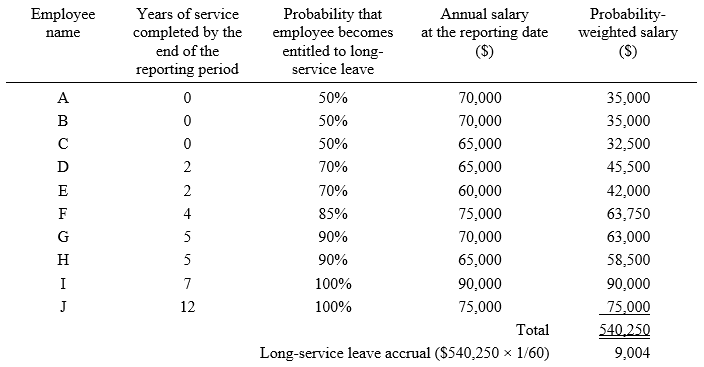
Charity D accrues long-service leave for the reporting period at 1/60th of each employee’s probability-weighted annual remuneration at the reporting date, being $9,004.
In addition to the accrual for services rendered during the period, Charity D also reassesses its opening long-service leave liability and accrues further amounts as necessary to reflect changes in the probability of the leave becoming available to employees and changes in salary since the beginning of the period. For example, because Employee I is still employed by Charity D at the end of the reporting period, the probability that Employee I is entitled to the leave benefit has increased from 95 per cent to 100 per cent. Contrastingly, if Employee I had resigned during the period and before completing the required period of service, the opening leave accrual relating to Employee I would need to be reversed.
Besides payments to employees, entities will often incur employment-related costs such as workers’ compensation insurance premiums and payroll taxes. Liabilities and expenses for employee on-costs are recorded when required by this Standard. For example, if Charity D is subject to payroll tax, it determines whether a liability should be recorded for payroll tax associated with its future long-service leave obligations at the same time as recording the leave accrual.
Recording revenue
IE4
Examples E–I illustrate the requirements in Section 20 for revenue arising from:
(a) fundraising activities;
(b) grants to provide specified services;
(c) grants that management has designated to fund particular services;
(d) grants to construct assets; and
(e) donations to an emergency appeal.
Example E – Fundraising activities
Charity E generates revenue through two main fundraising activities: selling chocolates for cash throughout the year and an annual gala event at which attendees receive entertainment and a meal. The next gala event will be held on 15 July 20X0. The ticket to the gala event, as publicised on Charity E’s website and printed on the ticket, provides an entry to the gala event, dinner and an evening of entertainment. As at 30 June 20X0 (Charity E’s reporting date), Charity E has received $50,000 from the sale of 250 tickets for $200 each.
In accordance with paragraph 20.3(a), Charity E records revenue from the sale of chocolates when the chocolates are transferred to customers, as the parties’ common understanding of Charity E’s commitment in the transaction (to deliver chocolates in exchange) is fulfilled at this time. Where chocolates are transferred immediately at the time of a sale, Charity E will record revenue at the same time as it records the cash receipts from the sales. Charity E discloses revenue from the sales of chocolates in accordance with paragraph 20.21(d) in its financial statements for the reporting period ending 30 June 20X0.
In accordance with paragraphs 20.3(a) and 20.4, in its financial statements for the reporting period ending 30 June 20X0, Charity E records the $50,000 proceeds from sales of tickets to the gala event as a deferred revenue obligation (liability). This is because Charity E and purchasers of the tickets to the gala event have a common understanding, evidenced by information on Charity E’s website and the tickets that in return for the ticket price Charity E will host, after the end of the reporting period, a gala event that includes entertainment and a meal. That common understanding exists regardless of whether there is an enforceable obligation against Charity E to run the gala event that includes all the publicised aspects.
As at 30 June 20X0, the entire amount of the sales proceeds is deferred as a current liability until the gala event is held, since the gala event is to be held within the next 12 months (ie 15 July 20X0). As required by paragraph 20.24, Charity E discloses that it has a deferred revenue obligation of $50,000 that will be satisfied on hosting the gala event.
In accordance with paragraphs 20.5 and 20.8, the deferred revenue obligation is reduced to nil (and revenue is recorded in profit or loss) when the gala event is held on 15 July 20X0.
Example F – Grant to provide specified services
Community Centre F applies for a grant to fund the delivery of IT training sessions for community members. The training sessions will be conducted at regular intervals on the centre’s premises over a two-year period commencing 1 July 20X1. The number of sessions that will be delivered depends on the amount of the grant received.
A grant of $45,000 is received on 15 May 20X1. Community Centre F estimates that each IT training session will cost $2,500 to run. This would allow Community Centre F to deliver 18 IT training sessions for community members during the two-year period. In accordance with paragraph 20.3(a), a deferred revenue obligation (liability) is recorded for the entity’s unsatisfied commitment to provide training sessions on becoming entitled to the grant monies. This is because Community Centre F and the grantor have a common understanding, evidenced by the approved grant application, that Community Centre F will use the received grant monies to provide training sessions (ie perform in a particular manner). That common understanding exists regardless of whether there is an enforceable obligation against Community Centre F to use the funds to provide training sessions.
In accordance with paragraph 20.4, the liability recorded in accordance with paragraph 20.3(a) is measured at $45,000, being the same amount as the asset (grant monies). In accordance with paragraph 20.5, the liability is reduced only when, or as, the commitment is satisfied.
Having regard to paragraph 20.8, Community Centre F determines that its commitment is to deliver training sessions, which will be satisfied as it delivers each IT training session. As at 30 June 20X1, Community Centre F continues to reflect a liability of $45,000 attributable to the grant, because the provision of training sessions had not yet commenced. As Community Centre F expects to deliver the training sessions at regular intervals over the two-year period, in accordance with paragraph 20.25 it classifies $22,500 of the deferred revenue obligation as a current liability and the remaining $22,500 as a non-current liability. In accordance with paragraph 20.5, the deferred revenue obligation is reduced and revenue is recorded as the training sessions are provided.
As at 30 June 20X2, Community Centre F had delivered nine IT training sessions. Accordingly, in its financial statements for the reporting period ending 30 June 20X2, it records revenue of $22,500 and a remaining current liability of $22,500 for the unperformed portion of the commonly understood commitment (being the nine IT training sessions yet to be delivered). As required by paragraph 20.24, Community Centre F discloses that its deferred revenue obligation will be satisfied as it delivers the remaining nine IT training session.
Example G – Grant internally designated to fund particular activities
Community Centre G receives a general purpose grant of $40,000 on 5 May 20X1. The general purpose grant does not specify a time period over which the grant must be spent. Community Centre G’s management decides before the end of its reporting period on 30 June 20X1 to expend the grant monies on a two-year financial literacy training program to be conducted on the Centre’s premises for its beneficiaries. The program will commence on 1 July 20X1.
Community Centre G and the grantor do not have a common understanding that, in return for the grant, Community Centre G will perform in a particular manner that would result in the related transfer or using up of the grant monies or other assets. This is because an entity’s internal expectations or decisions by those charged with governance about how or when an entity expects to use funds received are, by themselves, not sufficient to establish whether the parties have a common understanding that the entity will perform in a particular manner (see paragraph 20.13). In this example, the grantor is not aware that the grant monies are to be spent on delivering a two-year financial literacy training program.
Therefore, in accordance with paragraph 20.3, a deferred revenue obligation is not recorded on receipt of the grant asset (cash) on 5 May 20X1. Rather, in accordance with paragraphs 20.3(b) and 20.4, on 5 May 20X1 Community Centre G records revenue at the same time as it records its receipt of the grant monies, for the same amount ($40,000). As required by paragraph 20.21(c), Community Centre G discloses the grant revenue of $40,000 grouped with other similar grants and donations.
Example H – Grant to construct an asset
Community Centre H applies for a grant of $180,000 to fund most of the cost of constructing an extension to its community hall building, with the remainder of the cost to be met using the Centre’s accumulated funds. The grant of $180,000 is received on 30 June 20X2 and separately identifiable from other funds.
In accordance with paragraph 20.3(a), a deferred revenue obligation (liability) is initially recorded to reflect the entity’s unsatisfied commitment to use the grant monies towards the construction of a building extension. This is because Community Centre H and the grantor have a common understanding, evidenced by the approved grant application, that Community Centre H will apply the grant monies received towards the construction of the specified building extension (ie perform in a particular manner). That common understanding exists regardless of whether there is an enforceable obligation against Community Centre H to use the grant monies only to construct the building extension.
In accordance with paragraph 20.4, the liability recorded in accordance with paragraph 20.3(a) is initially measured at the same amount as the amount recorded for the grant money ($180,000). In accordance with paragraph 20.3, the grant is deferred as a liability until the commitment is satisfied. The liability is reduced in a manner that faithfully represents the amount and pattern of the entity’s satisfaction of its commitment.
On consideration of the terms and conditions of the grant, Community Centre H decides that its commitment to the grantor will be satisfied as the grant money is applied towards the construction of the building extension, rather than on the delivery of a completed extension or as the extension is built. In its financial statements for the reporting period ending 30 June 20X2, Community Centre H records a liability for $180,000 for the grant for the extension of its community hall building in accordance with paragraph 20.3, because it had not yet spent any of the funds received on activities relating to the construction of the building extension. Community Centre H expects it will use up forty percent of the grant monies within twelve months after the reporting date and the balance in the subsequent year. Accordingly, Community Centre H classifies $72,000 of the grant as a current liability, and the remaining $108,000 as a non-current liability.
By 30 June 20X3, Community Centre H had spent $90,000 of the grant monies on the building extension. Accordingly, in its financial statements for the reporting period ending 30 June 20X3, Community Centre H records revenue (categorised as grants for the construction of long-lived assets in accordance with paragraph 20.21(b)) of $90,000. In accordance with paragraph 20.24, the remaining carrying amount of the liability of $90,000 – representing the remaining grant money to be applied towards the community hall building – is classified as a current liability as Community Centre H expects to spend the remaining grant money within the next twelve months after 30 June 20X3.
Alternative scenario 1: Grant is given towards future building works
Assume instead that Community Centre H is provided with a grant to help fund the purchase of a site and construction of a new building, but that an appropriate site had not yet been identified or acquired at the time the grant was made and the grant funds transferred to Community Centre H. In this scenario, Community Centre H has a common understanding with the grantor that the monies are to be used for capital works. In accordance with paragraph 20.3, Community Centre H will record the grant as a deferred revenue obligation because Community Centre H and the grantor have a common understanding that the grant funds will be applied to purchasing a site and constructing a new building.
In accordance with paragraph 20.5, the carrying amount of the deferred revenue obligation will be reduced and revenue would be recorded once (or as) the commitment is satisfied. Community Centre H will need to apply judgement, having regard to the terms and conditions of the grant, to determine when and how its commitment is satisfied, for example whether this is from when the search for a site begins or only from when a site is identified and purchase activity has commenced. The pattern of the entity’s satisfaction of the commitment might be determined to be as ringfenced grant funds are expended, evenly over the acquisition and build period, by reference to the stage of completion of any building works or when the building is completed.
Assume instead that Community Centre H is provided with a grant to help fund the purchase of a site and construction of a new building, but that an appropriate site had not yet been identified or acquired at the time the grant was made and the grant funds transferred to Community Centre H. In this scenario, Community Centre H has a common understanding with the grantor that the monies are to be used for capital works. In accordance with paragraph 20.3, Community Centre H will record the grant as a deferred revenue obligation because Community Centre H and the grantor have a common understanding that the grant funds will be applied to purchasing a site and constructing a new building.
In accordance with paragraph 20.5, the carrying amount of the deferred revenue obligation will be reduced and revenue would be recorded once (or as) the commitment is satisfied. Community Centre H will need to apply judgement, having regard to the terms and conditions of the grant, to determine when and how its commitment is satisfied, for example whether this is from when the search for a site begins or only from when a site is identified and purchase activity has commenced. The pattern of the entity’s satisfaction of the commitment might be determined to be as ringfenced grant funds are expended, evenly over the acquisition and build period, by reference to the stage of completion of any building works or when the building is completed.
Alternative scenario 2: Grant is given after the building extension is complete to help alleviate the costs of capital works
Assume instead that Community Centre H has funded the building extension works itself by taking out a bank loan. After the building extension is complete, Community Centre H receives a grant intended to help alleviate the impact of the costs of these capital works so that these costs do not detract from Community Centre H’s ability to deliver programs. Community Centre H intends to apply the grant monies received to pay down some of its outstanding bank loan.
In this scenario, Community Centre H has a common understanding with the grantor that the monies are to be used towards easing the financial burden of the costs of the building extension. In accordance with paragraphs 20.3 and 20.5, the entity has a deferred revenue obligation and should reduce that obligation in a manner that faithfully represents the amount and pattern of the entity’s satisfaction of its commitments. However, the building works are already completed and the entity’s decision to apply the funds to loan repayments is an internal management decision. Even though the parties share a common understanding about the purpose of the grant, the grant was given to, in effect, support the entity’s operations over an unspecified period of time. For example, Community Centre H might prefer to use these monies to fund a new program that it would not otherwise have been able to run due to the need to fund the loan repayments. Therefore, per paragraph 20.12, Community Centre H records grant revenue simultaneously with receiving the grant monies.
Assume instead that Community Centre H has funded the building extension works itself by taking out a bank loan. After the building extension is complete, Community Centre H receives a grant intended to help alleviate the impact of the costs of these capital works so that these costs do not detract from Community Centre H’s ability to deliver programs. Community Centre H intends to apply the grant monies received to pay down some of its outstanding bank loan.
In this scenario, Community Centre H has a common understanding with the grantor that the monies are to be used towards easing the financial burden of the costs of the building extension. In accordance with paragraphs 20.3 and 20.5, the entity has a deferred revenue obligation and should reduce that obligation in a manner that faithfully represents the amount and pattern of the entity’s satisfaction of its commitments. However, the building works are already completed and the entity’s decision to apply the funds to loan repayments is an internal management decision. Even though the parties share a common understanding about the purpose of the grant, the grant was given to, in effect, support the entity’s operations over an unspecified period of time. For example, Community Centre H might prefer to use these monies to fund a new program that it would not otherwise have been able to run due to the need to fund the loan repayments. Therefore, per paragraph 20.12, Community Centre H records grant revenue simultaneously with receiving the grant monies.
Example I – Donations to an emergency appeal
Charity I announced an appeal for donations to provide emergency relief to victims of a cyclone on 20 February 20X2 and raised $200,000 in response. On its website, Charity I indicated that if greater funds are raised than needed for its cyclone emergency relief efforts, the excess funds will be redirected to another current, specific program of the charity – to assist victims of a recent earthquake in the same region.
On 15 June 20X2, Charity I announced that its emergency relief program for the cyclone is complete. Charity I spent $150,000 of the donated funds on that program. At 30 June 20X2, none of the remaining $50,000 donated funds had been spent by Charity I.
In its financial statements for the reporting period ending 30 June 20X2, Charity I records donation revenue of $150,000 in accordance with paragraph 20.5 for the expenditure of that amount in providing emergency relief to victims of the cyclone, resulting from the reduction in the deferred revenue obligation initially recorded in accordance with paragraph 20.3 when the donated funds were received. The charity continues to record the remaining deferred revenue obligation (liability) of $50,000 relating to the unspent donations that are to be redirected towards the earthquake assistance program. Charity I expects it will use the unspent donations within twelve months after the reporting date. Accordingly, Charity I classifies the deferred revenue obligation of $50,000 as a current liability.
The fact that Charity I will no longer spend funds donated primarily to provide emergency relief for victims of the cyclone on these efforts does not mean that there is no longer an unsatisfied common understanding between the donors and Charity I on 30 June 20X2 regarding the use of the funds. This is because, as evidenced by the communicated appeal terms, Charity I and the donors have a common understanding that Charity I will use the donations received to provide charitable assistance to victims of either the cyclone or the earthquake (ie perform in a particular manner). That common understanding exists regardless of whether there is an enforceable obligation against Charity I to expend the donated funds on either of the stated programs.
In accordance with paragraphs 20.5 and 20.8, the deferred revenue obligation of $50,000 is reduced and revenue recorded as the remaining donated funds are expended under the specific earthquake assistance program.
If Charity I did not indicate how it would spend any excess funds raised, then there would not be a common understanding between the parties as to how any monies not directed towards the cyclone efforts must be spent. In this scenario, in accordance with paragraphs 20.3–20.5, Charity I would record the entire $200,000 received as revenue of the reporting period ending 30 June 20X2. There would be no deferred revenue obligation at that date in this case.
Contingent assets
IE5
Example J illustrates the application of Section 19 to contingent assets in the form of pledges.
Example J – Pledges
Before the end of the reporting period, Charity J received written pledges from corporate donors of $200,000 to fund the building of water wells to provide clean drinking water in developing countries in response to an appeal for donations for that explicit purpose. Based on its previous experience with pledged donations, Charity J estimates it will receive only $120,000 of the pledged $200,000.
As at the end of the reporting period, no cash had been received. Charity J does not have an enforceable right to the pledged amounts.
In accordance with paragraph 20.18, Charity J does not record the pledged donations as an asset because it has not yet received the promised cash. However, Charity J determines the pledges meet the definition of a contingent asset, because those amounts are possible assets arising from past events (receipt of the written pledges), the existence of which will only be confirmed by the occurrence of one or more uncertain future events (cash transfers to Charity J) not wholly within Charity J’s control.
Based on its experience with previous appeals, Charity J concludes that the receipt of an inflow from the pledged donations is probable even if some pledges are not honoured. Accordingly, in accordance with paragraph 19.17, Charity J discloses that it has received pledges totalling $200,000 and that at least 60 per cent of these pledges are expected to be honoured.
(When received, the donations that were pledged are recorded as revenue only as the wells are built. This treatment recognises that because the donations were made in response to the specific appeal, Charity J and its donors have a common understanding that Charity J will only use these amounts for the building of the water wells, consistent with paragraphs 20.3(a) and 20.6–20.10 of this Standard.)