
Appendix B -- Application guidance
This appendix is an integral part of the Standard. It describes the application of paragraphs 1–83 and has the same authority as the other parts of the Standard.
B1
This appendix provides application guidance on:
(a) enforceable present rights and enforceable present obligations (see paragraphs B2–B10);
(b) differences in timing (see paragraphs B11–B58);
(c) recognition of regulatory assets and regulatory liabilities arising from regulatory depreciation of a regulatory capital base (see paragraphs B59–B72);
(d) the boundary of a regulatory agreement (see paragraphs B73–B87);
(e) uncertain future cash flows (see paragraphs B88–B91);
(f) application of this Standard with Interpretation 12 Service Concession Arrangements (as identified in AASB 1048 Interpretation of Standards) (see paragraphs B92–B94); and
(g) disclosure – aggregation and disaggregation (see paragraphs B95–B97).
Enforceable present rights and enforceable present obligations
B2
This section covers:
(a) assessing enforceability (see paragraphs B3–B7); and
(b) identifying the regulator (see paragraphs B8–B10).
Assessing enforceability
B3
Paragraph 8 requires an entity to assess whether it has an enforceable present right or enforceable present obligation to add or deduct an amount in determining a regulated rate to be charged to customers in future periods.
B4
An entity assesses whether an enforceable present right or enforceable present obligation exists by using judgement and considering all reasonable and supportable information that is available without undue cost or effort. Such information might relate to:
(a) the legal and regulatory framework (see paragraph B5); or
(b) a specific difference in timing (see paragraph B6).
B5
Whether rights and obligations created by a regulatory agreement are enforceable is a matter of law. An enforceable present right or enforceable present obligation need not be explicitly specified in a regulatory agreement. An entity shall consider whether enforceable present rights or enforceable present obligations exist in the context of the applicable legal and regulatory framework that ensures a party’s rights and obligations are upheld. Applicable regulatory decisions or court rulings might provide evidence about the existence of enforceable present rights or enforceable present obligations. The entity shall consider any applicable laws or legal precedents that could supplement or override the terms of the regulatory agreement. Other factors might provide evidence in specific jurisdictions.
B6
Facts or circumstances that might provide evidence of the existence of an enforceable present right or enforceable present obligation in relation to a specific difference in timing include:
(a) confirmation from a regulator of amounts to be added to or deducted from future regulated rates;
(b) explicit requirements or guidelines in a regulatory agreement;
(c) evidence that allowable expenses have been incurred;
(d) direct precedents – an entity’s experience with its regulator’s interpretation of the regulatory agreement in similar circumstances;
(e) indirect precedents – such as (i) the experience of other entities regulated by the same regulator, (ii) the decisions of other regulators in the same jurisdiction or (iii) court rulings in similar circumstances in the same jurisdiction;
(f) preliminary views expressed by a regulator; and
(g) advice from qualified and experienced legal or other advisers.
B7
In assessing whether an enforceable present right or enforceable present obligation exists, an entity shall consider the overall balance of the evidence. The presence of an individual fact or circumstance described in paragraph B6 might not be sufficient to enable an entity to determine whether a regulatory asset or regulatory liability exists. The weight given to each fact or circumstance in the assessment might depend on the legal and regulatory framework within which the entity operates and the effectiveness of the enforcement processes (see paragraph B5).
Identifying the regulator
B8
A regulator is a body that is required by law or regulation to apply a regulatory agreement to determine a regulated rate (or a range for the regulated rate). For a regulatory asset or a regulatory liability to exist, a regulator needs to be a party to the regulatory agreement (see paragraph 9(a)).
B9
Only situations in which a rate is determined by a regulator give rise to regulatory assets or regulatory liabilities. For example, a parent entity might determine the rate that a subsidiary charges its customers for goods or services supplied to them. However, the parent entity is not a body that is required by law or regulation to determine the rate the subsidiary is required to apply in its contracts with customers. Accordingly, the parent entity is not a regulator for the purposes of this Standard and, as a consequence, the agreement between the parent entity and its subsidiary is not a regulatory agreement that can create regulatory assets or regulatory liabilities.
B10
Examples of when regulatory assets or regulatory liabilities might arise include when:
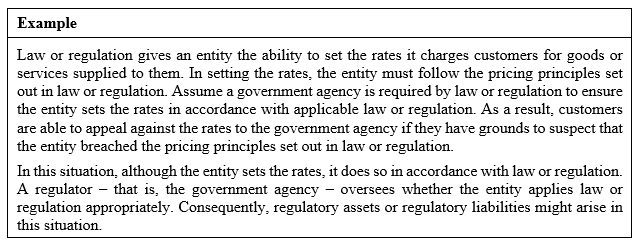
(a) an entity or a related party of the entity sets rates in accordance with a specified legal and regulatory framework and the application of that framework is subject to oversight or approval by a body that is required to do so by law or regulation.
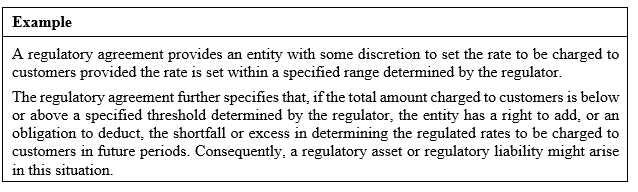
(b) a regulatory agreement permits some flexibility in the rates charged to customers, with an entity being allowed some discretion to set the rate within a range of rates determined by the regulator.
Differences in timing
B11
Paragraph 19 sets out the most common types of compensation provided or deductions made by regulatory agreements. This section describes differences in timing that might arise from such compensation or deductions:
(a) differences in timing arising from compensation for allowable expenses and deductions for chargeable income (see paragraphs B13–B29);
(b) differences in timing arising from a regulatory return on an entity’s regulatory capital base (see paragraphs B30–B40);
(c) differences in timing arising from performance incentives (see paragraphs B41–B50); and
(d) differences in timing arising from compensation relating to inflation (see paragraphs B51–B54).
B12
This section also describes differences in timing that arise from the under-recovery or over-recovery of allowed revenue (see paragraphs B55–B58).
Differences in timing arising from compensation for allowable expenses and deductions for chargeable income
B13
This section describes:
(a) differences in timing arising from compensation for allowable expenses (see paragraphs B14–B19);
(b) differences in timing arising from deductions for chargeable income (see paragraphs B20–B22);
(c) differences in timing arising from compensation or deductions for income taxes (see paragraphs B23–B25); and
(d) the distinction between differences in timing and measurement differences (see paragraphs B26–B29).
Differences in timing arising from compensation for allowable expenses
B14
An allowable expense is an item of expense, as defined in Australian Accounting Standards, for which a regulatory agreement provides compensation by adding an amount in determining a regulated rate to be charged by an entity. The regulatory agreement might determine the compensation for an allowable expense at an amount that differs from the expense recognised by applying Australian Accounting Standards (see paragraphs B26–B29).
B14
An allowable expense is an item of expense, as defined in Australian Accounting Standards, for which a regulatory agreement provides compensation by adding an amount in determining a regulated rate to be charged by an entity. The regulatory agreement might determine the compensation for an allowable expense at an amount that differs from the expense recognised by applying Australian Accounting Standards (see paragraphs B26–B29).
B15
As stated in paragraph 19, compensation for an allowable expense forms part of the total allowed compensation for the reporting period in which an entity recognises the allowable expense by applying Australian Accounting Standards. Therefore, a difference in timing arises if the regulator includes compensation for an allowable expense in determining the regulated rates charged in a period that differs from the reporting period in which the entity recognises the allowable expense by applying Australian Accounting Standards.
B16
Compensation for an allowable expense is provided through either regulatory depreciation of an entity’s regulatory capital base or a component of compensation separate from regulatory depreciation.
Compensation for allowable expenses provided through regulatory depreciation
B17
Differences in timing might arise from compensation for allowable expenses provided through regulatory depreciation (see paragraphs B59–B72). For example:
(a) for depreciation or amortisation expense – a difference in timing arises if there is a difference between:
(i) the recovery period or recovery pattern of the items included in the regulatory capital base related to depreciable or amortisable assets; and
(ii) the useful lives or depreciation or amortisation method for those assets determined by applying Australian Accounting Standards; or
(b) for an allowable expense other than depreciation or amortisation expense – a difference in timing arises if an entity recognises an allowable expense in a reporting period by applying Australian Accounting Standards and the compensation for that allowable expense is included in the regulatory capital base, and hence is recovered through regulatory depreciation in future periods.
Compensation for allowable expenses provided separately from regulatory depreciation
B18
Compensation for allowable expenses might be provided through a component of compensation separate from regulatory depreciation. For example, compensation for pension costs, income taxes or provisions is often provided through a separate component of compensation included in the regulated rates.
B19
Examples of differences in timing that arise from compensation provided through a component of compensation separate from regulatory depreciation include:
(a) differences in timing that arise if compensation for an allowable expense is included in determining the regulated rates charged to customers either earlier or later than an entity recognises the allowable expense by applying Australian Accounting Standards. For example:
(i) an entity recognises depreciation expense or amortisation expense as an asset is used to supply regulatory goods or services. However, the regulatory agreement provided compensation for the depreciation expense or amortisation expense in advance, separately from regulatory depreciation (see paragraph B59).
(ii) an entity recognises an allowable expense in a period by applying Australian Accounting Standards. However, the regulatory agreement provides compensation for the allowable expense in determining the regulated rates charged to customers only when an entity settles the related liability in cash, or soon after that (see paragraphs 58 and 60–61).
(iii) an entity recognises expected credit losses in a period by applying AASB 9 Financial Instruments. However, the regulatory agreement provides compensation for such losses in determining the regulated rates charged to customers only when the regulator determines that there is no reasonable expectation of the entity receiving the related cash (see paragraphs 59–61).
(iv) an entity recognises an allowable expense in a period. However, the regulatory agreement provides compensation for that allowable expense by applying another accounting framework used to prepare financial statements. The timing of the compensation determined by applying that accounting framework differs from the timing of the recognition of the allowable expense determined by applying Australian Accounting Standards (see paragraph B29).
(b) differences in timing that arise from differences between the estimated and actual compensation. For example, the regulatory agreement determines compensation for an allowable expense to be added in determining the regulated rates charged to customers based on estimated amounts. However, the regulatory agreement specifies that any difference between the estimated and actual amounts is added or deducted in determining the regulated rates to be charged to customers in future periods.
Differences in timing arising from deductions for chargeable income
B20
Chargeable income is an item of income, as defined in Australian Accounting Standards, for which a regulatory agreement makes a deduction of an amount in determining a regulated rate to be charged by an entity. The regulatory agreement might determine the deduction for chargeable income at an amount that differs from the income recognised by applying Australian Accounting Standards (see paragraphs B26–B29).
B20
Chargeable income is an item of income, as defined in Australian Accounting Standards, for which a regulatory agreement makes a deduction of an amount in determining a regulated rate to be charged by an entity. The regulatory agreement might determine the deduction for chargeable income at an amount that differs from the income recognised by applying Australian Accounting Standards (see paragraphs B26–B29).
B21
As stated in paragraph 19, a deduction for chargeable income reduces the total allowed compensation for the reporting period in which the entity recognises the chargeable income by applying Australian Accounting Standards. Therefore, a difference in timing arises if the entity recognises chargeable income by applying Australian Accounting Standards in a reporting period that differs from the period in which the regulatory agreement makes the deduction for that chargeable income in determining the regulated rates charged to customers.
B22
As with compensation for allowable expenses, deductions for chargeable income are either:
(a) deductions for chargeable income made by reducing regulatory depreciation (see paragraphs B59–B72). For example, an entity’s regulatory capital base might be reduced by a deduction for a gain on disposal of a depreciable asset recognised by applying Australian Accounting Standards. A difference in timing will arise because the deduction will be made in determining the regulated rates charged to customers in future periods.
(b) deductions for chargeable income made separately from regulatory depreciation in determining the regulated rates to be charged to customers. For example, a regulatory agreement might make a deduction in determining the regulated rates for a gain arising from a commodity futures contract. A difference in timing arises if the entity recognises the gain by applying Australian Accounting Standards in a reporting period that differs from the period in which the deduction is made in determining the regulated rates charged to customers.
Differences in timing arising from compensation or deductions for income taxes
B23
An entity recognises tax expense or tax income by applying AASB 112 Income Taxes. Such tax expense or tax income might be an allowable expense or chargeable income. A difference in timing arises if part or all of the compensation or deduction for such tax expense or tax income is included in determining the regulated rates charged to customers in a different period from when the tax expense or income is recognised.
B23
An entity recognises tax expense or tax income by applying AASB 112 Income Taxes. Such tax expense or tax income might be an allowable expense or chargeable income. A difference in timing arises if part or all of the compensation or deduction for such tax expense or tax income is included in determining the regulated rates charged to customers in a different period from when the tax expense or income is recognised.
B24
For example, a difference in timing arises if a regulatory agreement provides compensation or makes a deduction in determining the regulated rates charged in a reporting period for current tax expense or income but not for deferred tax expense or income for that period.
B25
An entity shall also apply AASB 112 to account for differences between the carrying amount of a regulatory asset or regulatory liability and its tax base. Applying AASB 112, the entity might recognise a deferred tax liability or deferred tax asset related to a regulatory asset or regulatory liability. Further, the recognition of a deferred tax liability or deferred tax asset – and its related deferred tax expense or deferred tax income – in a reporting period might give rise to another regulatory asset or regulatory liability, which in turn results in the recognition of further deferred tax. In such cases, the measurement of the regulatory asset or regulatory liability related to the deferred tax reflects that iterative process, resulting in an amount for the regulatory asset or regulatory liability that includes the compensation or deduction for its own tax effect.
Measurement differences
B26
In some cases, the total amount of compensation for an allowable expense or a deduction for chargeable income determined by a regulatory agreement over all periods differs from the total amount of the expense or income an entity will recognise over all periods by applying Australian Accounting Standards. Such differences are measurement differences that do not reverse over time.
B26
In some cases, the total amount of compensation for an allowable expense or a deduction for chargeable income determined by a regulatory agreement over all periods differs from the total amount of the expense or income an entity will recognise over all periods by applying Australian Accounting Standards. Such differences are measurement differences that do not reverse over time.
B27
A measurement difference might arise from compensation for an allowable expense or a deduction for chargeable income without that compensation or deduction giving rise to a difference in timing. For example, a regulatory agreement might determine the compensation for an allowable expense recognised in a reporting period based on an estimate, and not adjust future regulated rates to be charged to customers to reflect any difference between the estimate and the actual expense recognised. Such a difference is a measurement difference, not a difference in timing. The measurement difference is reflected in the statement(s) of financial performance in the reporting period through the recognition of AASB 15 revenue, which includes compensation based on the estimate, and the recognition of the expense for the actual amount.
B28
In other cases, a difference in timing and a measurement difference might occur concurrently. In the example described in paragraph B27, assume that the regulatory agreement specifies that compensation based on an estimate for the allowable expense recognised in a reporting period is added in determining the regulated rates to be charged to customers in the future. A difference in timing – a regulatory asset – arises from the delayed compensation. There is also a measurement difference arising from any difference between the compensation based on the estimate and the actual expense recognised. The future cash flows arising from the regulatory asset – and hence its measurement – are determined by the amount of the compensation, not by the amount of allowable expense recognised by applying Australian Accounting Standards. The measurement difference is reflected in the statement(s) of financial performance in the reporting period through the recognition of regulatory income for the compensation based on the estimate, and the recognition of the expense for the actual amount.
B29
A regulatory agreement might determine compensation for an allowable expense or a deduction for chargeable income for a reporting period by using the related expense or related income that would be recognised in the period by applying an accounting framework other than Australian Accounting Standards. As a result, the amount of compensation or deduction that is included in determining the regulated rates charged in the period might differ from the related expense or related income recognised in that period by applying Australian Accounting Standards. However, such differences are not measurement differences if the total amount of the compensation or deduction over all periods equals the total amount of the expense or income an entity recognises over all periods by applying Australian Accounting Standards. Instead, these differences are differences in timing because part or all of the compensation or deduction for the expense or income the entity recognises in a reporting period is included in determining the regulated rates charged in a different period.
Differences in timing arising from a regulatory return on an entity’s regulatory capital base
B30
Regulatory agreements generally apply a rate of return to an entity’s regulatory capital base for a period, resulting in a regulatory return to which the entity is entitled for the period.
B31
Regulatory agreements might provide regulatory returns on a nominal or a real basis. A nominal regulatory return includes compensation for inflation (see paragraph B51(a)). Regulatory returns might include only a debt return, only an equity return or both a debt and equity return.
B32
A regulatory capital base might include both assets available for use and assets not yet available for use. In some cases:
(a) an entity has separate regulatory capital bases for assets available for use and for assets not yet available for use; and
(b) the rate of return applied to assets available for use differs from the rate of return applied to assets not yet available for use.
B33
Except in the circumstances specified in paragraph B35, a regulatory return forms part of the total allowed compensation for the reporting period in which the regulatory agreement applies the rate of return to a regulatory capital base.
B34
Differences in timing arise if a regulatory agreement includes part or all of a regulatory return in determining the regulated rates charged to customers in a different reporting period from the period in which the agreement applies the rate of return to the regulatory capital base. For example, a regulatory agreement might determine a regulatory return for a period based on an estimate of an entity’s regulatory capital base. A difference in timing arises if the regulatory agreement provides compensation or makes a deduction for differences between the estimated and actual amounts of the regulatory return for the reporting period in determining the regulated rates to be charged to customers in a future period.
A regulatory return on assets not yet available for use in specific circumstances
B35
This section specifies requirements for differences in timing arising from a regulatory return on assets not yet available for use if:
(a) the entity capitalises borrowing costs related to those assets by applying AASB 123 Borrowing Costs;
(b) the regulatory return is only a debt return or both a debt and equity return; and
(c) the entity’s regulatory capital base has a direct relationship with those assets (see paragraphs B59–B72).
B35
This section specifies requirements for differences in timing arising from a regulatory return on assets not yet available for use if:
(a) the entity capitalises borrowing costs related to those assets by applying AASB 123 Borrowing Costs;
(b) the regulatory return is only a debt return or both a debt and equity return; and
(c) the entity’s regulatory capital base has a direct relationship with those assets (see paragraphs B59–B72).
B36
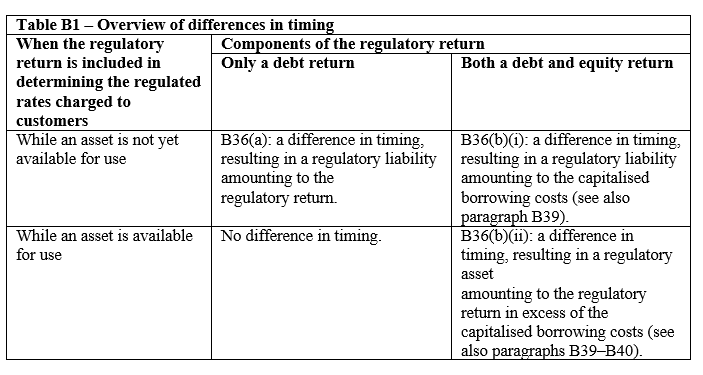
In the circumstances described in paragraph B35, the entity shall treat part or all of the regulatory return as compensation for an allowable expense – that is, the capitalised borrowing costs:
(a) if the regulatory return comprises only a debt return, the regulatory return forms part of the total allowed compensation for the reporting periods in which the entity recognises the borrowing costs as an expense, in accordance with paragraph 19 – that is, for the periods in which the assets are available for use; and
(b) if the regulatory return comprises both a debt and equity return, the regulatory return is treated as two parts:
(i) the regulatory return amounting to the entity’s capitalised borrowing costs forms part of the total allowed compensation for the reporting periods in which the entity recognises the borrowing costs as an expense, in accordance with paragraph 19 – that is, for the periods in which the assets are available for use; and
(ii) the regulatory return in excess of the entity’s capitalised borrowing costs forms part of the total allowed compensation for the reporting period in which the regulatory agreement applies the rate of return to the regulatory capital base, in accordance with paragraph B33 – that is, for the periods in which the assets are not yet available for use.
B37
Table B1 provides an overview of the regulatory assets and regulatory liabilities that might arise from differences in timing relating to the regulatory returns described in paragraph B36. The requirements set out in paragraph B66 for the determination of individual differences in timing apply to the differences in timing described in paragraph B36. However, an entity is permitted to determine individual differences in timing described in paragraph B36 using the disaggregation of the capitalised borrowing costs the entity uses to calculate depreciation or amortisation expense related to those costs.
B38
The effect of the differences in timing described in Table B1 in the statement of profit or loss differs because of the different reporting periods in which the regulatory return forms part of total allowed compensation as set out in paragraph B36:
(a) if the regulatory return comprises only a debt return – any difference between the regulatory return and the capitalised borrowing costs is a measurement difference that is recognised in profit or loss in the periods in which the assets are available for use (see paragraphs B26–B29); and
(b) if the regulatory return comprises both a debt and equity return – the regulatory return in excess of the capitalised borrowing costs is recognised in profit or loss in the periods in which the rate of return is applied to the regulatory capital base (that is, the periods in which the assets are not yet available for use).
B39
In some cases, a regulatory return that comprises both a debt and equity return on an asset not yet available for use is determined on a real basis (see paragraph B52). In such cases, an entity shall determine any regulatory asset or regulatory liability that might arise from the regulatory return described in paragraph B36(b) by applying a real interest rate to the inflation‑adjusted borrowings related to the assets not yet available for use.
B40
Applying paragraph 8, an entity is required, during the period in which the asset is not yet available for use, to assess whether it has an enforceable present right for the regulatory return accrued to date to be added in determining the regulated rates to be charged in future periods. To make this assessment for the regulatory assets that arise from the regulatory returns described in paragraph B36(b)(ii), an entity shall consider what rights it would have if the regulator or another party were to terminate the regulatory agreement at the end of the reporting period for a reason other than the entity’s failure to perform as specified in the agreement. The entity shall apply paragraphs B4–B7 to assess whether, in those circumstances, it would have an enforceable present right to receive an amount that reflects the regulatory return accrued to date.
Differences in timing arising from performance incentives
B41
A regulatory agreement might reward or penalise an entity with performance incentives for meeting or failing to meet performance criteria. These criteria could include, for example, targeted levels of service quality, reliability or customer satisfaction. Alternatively, these criteria might relate to an entity’s efficiency in incurring capital and operating expenditure or performance in constructing an item of property, plant or equipment.
B42
Performance incentives form part of the total allowed compensation for the reporting period in which an entity’s performance occurs. To determine that period, the entity shall consider the regulatory agreement’s terms relating to the performance incentives, together with other facts and circumstances.
B43
A difference in timing arises if the period in which a performance incentive is included in determining the regulated rates charged to customers differs from the reporting period in which an entity’s performance occurs.
B44
A regulatory agreement might determine a performance incentive in several ways. For example, a performance incentive might be determined using a fixed monetary amount (such as CU100) or a formula (such as 1% of the amounts charged to customers during a specified period), or by using a rate of return (such as an additional 1%) applied to the regulatory capital base for a specified period. When a performance incentive is determined by using a rate of return, an entity shall account for the performance incentive by applying paragraphs B41–B50, not by applying paragraphs B30–B40 as if it were part of the regulatory return.
Performance incentives relating to an entity’s performance beyond the reporting period
B45
A performance incentive might relate to an entity’s performance over a period that extends beyond the reporting period. In such cases, at the end of the reporting period, applying paragraph 8 an entity shall assess whether it has an enforceable present right to add, or an enforceable present obligation to deduct, an amount that reflects its performance to date in determining the regulated rates to be charged in future periods. The amount that reflects performance to date shall be determined as described in paragraph B47.
B45
A performance incentive might relate to an entity’s performance over a period that extends beyond the reporting period. In such cases, at the end of the reporting period, applying paragraph 8 an entity shall assess whether it has an enforceable present right to add, or an enforceable present obligation to deduct, an amount that reflects its performance to date in determining the regulated rates to be charged in future periods. The amount that reflects performance to date shall be determined as described in paragraph B47.
B46
To make the assessment required by paragraph 8, an entity shall consider what rights and obligations it would have if the regulator or another party were to terminate the regulatory agreement at the end of the reporting period for reasons other than the entity’s failure to perform as specified in the agreement. The entity shall apply paragraphs B4–B7 to assess whether, in those circumstances, it would have an enforceable present right to receive or an enforceable present obligation to pay an amount that reflects its performance to date.
B47
The entity shall estimate the total amount of the performance incentive using either the most likely amount method or the expected value method in accordance with paragraph 42, and determine the portion of that estimated amount that reflects performance to date using a reasonable and supportable basis.
Performance incentives depending on more than one performance criterion
B48
In some cases, a performance incentive depends on more than one performance criterion and the criteria apply over periods with different end dates. Some amounts of the performance incentive will remain conditional on future performance criteria after other amounts have become unconditional. In such cases, an entity shall assess whether the amounts that remain conditional relate only to an entity’s performance in future periods. For example, assume that a regulatory agreement provides an entity with a bonus of CU1,000 for reaching specified construction milestones but specifies that CU400 of that bonus is conditional on the asset continuing to operate at a specified level of capacity over a specified future period. The entity might assess that the bonus of CU1,000 comprises:
(a) an amount of CU600 that is related to the construction milestones – in which case this amount forms part of the total allowed compensation for the reporting period(s) in which the entity constructs the asset; and
(b) an amount of CU400 that is related to the entity maintaining a specified level of capacity over a specified future period – in which case this amount forms part of the total allowed compensation for the specified future reporting period(s) in which the asset operates at the specified level.
B48
In some cases, a performance incentive depends on more than one performance criterion and the criteria apply over periods with different end dates. Some amounts of the performance incentive will remain conditional on future performance criteria after other amounts have become unconditional. In such cases, an entity shall assess whether the amounts that remain conditional relate only to an entity’s performance in future periods. For example, assume that a regulatory agreement provides an entity with a bonus of CU1,000 for reaching specified construction milestones but specifies that CU400 of that bonus is conditional on the asset continuing to operate at a specified level of capacity over a specified future period. The entity might assess that the bonus of CU1,000 comprises:
(a) an amount of CU600 that is related to the construction milestones – in which case this amount forms part of the total allowed compensation for the reporting period(s) in which the entity constructs the asset; and
(b) an amount of CU400 that is related to the entity maintaining a specified level of capacity over a specified future period – in which case this amount forms part of the total allowed compensation for the specified future reporting period(s) in which the asset operates at the specified level.
B49
The performance criteria might relate to an entity’s performance beyond the reporting period. For each such performance criterion, an entity shall apply paragraphs B45–B47.
Compensation or deduction for performance incentives through regulatory depreciation
B50
A regulatory agreement might specify that compensation or a deduction for a performance incentive related to an entity’s performance for a period is added to or deducted from the entity’s regulatory capital base. In such cases, differences in timing arise because the compensation or deduction for an entity’s performance for a period is provided or made through regulatory depreciation in future periods (see paragraphs B59–B72).
B50
A regulatory agreement might specify that compensation or a deduction for a performance incentive related to an entity’s performance for a period is added to or deducted from the entity’s regulatory capital base. In such cases, differences in timing arise because the compensation or deduction for an entity’s performance for a period is provided or made through regulatory depreciation in future periods (see paragraphs B59–B72).
Differences in timing arising from compensation relating to inflation
B51
Compensation for inflation arising in a reporting period might be provided:
(a) through a nominal regulatory return on a regulatory capital base, to which an entity shall apply paragraphs B30–B40;
(b) by inflation adjustments to a regulatory capital base recovered through regulatory depreciation (see paragraph B52); or
(c) through a component of compensation that is separate from regulatory depreciation (see paragraphs B53–B54).
B52
In some cases, a regulatory agreement applies a real rate of return to a regulatory capital base that is adjusted by inflation. Applying paragraph 20, an entity shall treat compensation provided by these inflation adjustments as forming part of the total allowed compensation for the reporting period in which the inflation is recovered through regulatory depreciation included in determining the regulated rates charged to customers. Accordingly, an entity shall not recognise any amounts for regulatory assets or regulatory liabilities for such compensation.
B53
A regulatory agreement might provide compensation for inflation arising in a reporting period separately from regulatory depreciation. Such compensation forms part of the total allowed compensation in that reporting period.
B54
Differences in timing could arise from such compensation for inflation. For example, a regulatory agreement might provide an entity with compensation for inflation for the current reporting period. That compensation might be based on the expected inflation rate for that period being applied to determine estimated costs or the entity’s allowed revenue for the period. The regulatory agreement might also require the entity to add or deduct differences between the estimated and actual inflation rates for the current reporting period in determining the regulated rates to be charged to customers in future periods. Differences between the estimated and actual inflation rates give rise to a difference in timing in the current reporting period (see paragraph B19(b)).
Differences in timing arising from allowed revenue
B55
Allowed revenue is the total amount of compensation that a regulatory agreement entitles an entity to charge customers through regulated rates in a period. A regulatory agreement typically:
(a) determines an entity’s allowed revenue for a period by considering different types of compensation or deductions, primarily those described in paragraph 19; and
(b) determines the regulated rates for a period by dividing the allowed revenue for the period by the estimated quantity of goods or services to be supplied to customers in that period.
B56
Differences in timing arise from paragraph B55(a) if allowed revenue for a reporting period includes amounts that form part of total allowed compensation in a different period, as discussed in paragraphs B13–B54.
B57
Differences in timing can also arise from paragraph B55(b), if:
(a) the entity charges customers less or more than the allowed revenue for a reporting period because, for example, it supplies less or more goods or services than were estimated when the regulated rate was determined (volume variances); and
(b) the regulator adds the under‑recovered allowed revenue or deducts the over‑recovered allowed revenue for a reporting period in determining the regulated rates to be charged in a future period.
Compensation or deduction for under‑recovery or over‑recovery of allowed revenue through regulatory depreciation
B58
A regulatory agreement might specify that compensation or a deduction for an under‑recovered or over‑recovered amount of allowed revenue for a period is added to or deducted from the entity’s regulatory capital base. In such cases, differences in timing arise because the compensation or deduction for an entity’s under‑recovered or over‑recovered amount of allowed revenue for a reporting period is provided or made through regulatory depreciation in future periods (see paragraphs B59–B72).
B58
A regulatory agreement might specify that compensation or a deduction for an under‑recovered or over‑recovered amount of allowed revenue for a period is added to or deducted from the entity’s regulatory capital base. In such cases, differences in timing arise because the compensation or deduction for an entity’s under‑recovered or over‑recovered amount of allowed revenue for a reporting period is provided or made through regulatory depreciation in future periods (see paragraphs B59–B72).
Recognition of regulatory assets and regulatory liabilities arising from regulatory depreciation of a regulatory capital base
Scope of requirements in paragraph 29
B59
Paragraph 29 sets a criterion for the recognition of regulatory assets and regulatory liabilities arising from regulatory depreciation of an entity’s regulatory capital base. In some cases, a regulatory agreement provides compensation for amounts that will arise from depreciable or amortisable assets separately from regulatory depreciation. Such compensation reduces the regulatory depreciation that would otherwise be provided. If such separate compensation does not relate specifically to capitalised borrowing costs and is provided while the assets are not yet available for use, an entity shall treat any regulatory liabilities arising from the compensation as arising from regulatory depreciation of an entity’s regulatory capital base for the purposes of paragraph 29.
Relationship between a regulatory capital base and a related item or items
B60
The regulatory capital base comprises assets and other items that a regulatory agreement entitles an entity to recover by adding an amount for regulatory depreciation in determining a regulated rate to be charged to customers. That regulatory depreciation provides compensation or makes a deduction for amounts arising from related items. Examples of related items are:
(a) items recognised by an entity as depreciable or amortisable assets by applying Australian Accounting Standards;
(b) an allowable expense added to, or chargeable income deducted from, the regulatory capital base other than expenses or income arising from the assets described in (a); and
(c) other amounts added to, or deducted from, the regulatory capital base – for example, performance incentives (see paragraph B50) and the under‑recovery or over‑recovery of allowed revenue (see paragraph B58).
B61
The regulatory capital base could comprise parts that have a direct relationship with a related item or items and a part that does not have such a relationship. An entity shall apply paragraphs 30 and B62–B70 to identify whether any part of its regulatory capital base has a direct relationship with a related item or items. To apply these paragraphs and the disclosure requirements in paragraphs 82–83, an entity shall read the references in those paragraphs to the ‘regulatory capital base’ as being to ‘a part of the regulatory capital base’.
B62
When applying paragraph 30, an entity determines whether its regulatory capital base has a direct relationship with a related item or items. In making that determination, the entity shall use its judgement and consider all reasonable and supportable information that is available without undue cost or effort. Such information includes the regulatory methodology underlying the determination of its regulatory capital base, the determination of the regulatory depreciation, and how the regulator monitors whether regulatory depreciation provides compensation or makes a deduction for amounts arising from a related item or items.
B63
Paragraphs B67–B70 set out indicators of whether a regulatory capital base has a direct relationship with a related item or items. These indicators are not exhaustive. An entity might give more weight to some indicators than others in determining whether its regulatory capital base has a direct relationship with a related item or items. Nonetheless, an entity is permitted to presume its regulatory capital base does not have a direct relationship with depreciable or amortisable assets if neither of the indicators described in paragraph B67 are present.
Direct relationship with depreciable or amortisable assets
B64
A depreciable or amortisable asset is an asset that is depreciable or amortisable in accordance with Australian Accounting Standards – for example, AASB 116 Property, Plant and Equipment, AASB 138 Intangible Assets or AASB 16 Leases. An asset class is a group of assets as described in paragraph 37 of AASB 116, paragraph 119 of AASB 138 or paragraph 8 of AASB 16.
B64
A depreciable or amortisable asset is an asset that is depreciable or amortisable in accordance with Australian Accounting Standards – for example, AASB 116 Property, Plant and Equipment, AASB 138 Intangible Assets or AASB 16 Leases. An asset class is a group of assets as described in paragraph 37 of AASB 116, paragraph 119 of AASB 138 or paragraph 8 of AASB 16.
B65
Paragraph 30 states that an entity’s regulatory capital base has a direct relationship with a related item or items if the entity is able to track, by amount and reporting period, how regulatory depreciation provides compensation or makes a deduction for the amounts arising from the related item or items. An entity shall determine whether its regulatory capital base has a direct relationship with its depreciable or amortisable assets by considering the smallest aggregation of assets for which the entity is able to do the tracking specified in paragraph 30. The aggregation shall be no larger than an asset class. For example:
(a) if an entity is able to track such compensation or deductions for individual assets – the regulatory capital base has a direct relationship with the individual assets;
(b) if an entity is not able to track such compensation or deductions for individual assets, but can track such compensation or deductions by disaggregating an asset class – the regulatory capital base has a direct relationship with the assets in the disaggregated part of the asset class for which the entity is able to track the compensation or deductions;
(c) if an entity is not able to track such compensation or deductions for any disaggregation of an asset class, but can track such compensation or deductions for the asset class – the regulatory capital base has a direct relationship with the assets in the asset class; and
(d) if an entity is not able to track such compensation or deductions for any asset class – the regulatory capital base does not have a direct relationship with its depreciable or amortisable assets.
B66
An entity shall determine an individual difference in timing as required by paragraph 25 for each aggregation of assets with which the regulatory capital base has a direct relationship.
B67
Indicators that an entity’s regulatory capital base has a direct relationship with its depreciable or amortisable assets include:
(a) the assets or classes in the regulatory capital base are sufficiently similar to the depreciable or amortisable assets or asset classes for the entity to be able to track any differences between assets or classes in the regulatory capital base and the related assets or asset classes; or
(b) the regulator determines an amount of regulatory depreciation to provide compensation for the depreciation or amortisation expense determined by applying Australian Accounting Standards.
B68
Indicators that an entity’s regulatory capital base does not have a direct relationship with its depreciable or amortisable assets include:
(a) the regulator determines the regulatory capital base by using information that differs significantly from information about the entity’s depreciable or amortisable assets accounted for by applying Australian Accounting Standards; or
(b) the regulator determines regulatory depreciation by considering factors unrelated to the depreciation or amortisation of depreciable or amortisable assets.
Direct relationship with related items other than depreciable or amortisable assets
B69
Indicators that an entity’s regulatory capital base has a direct relationship with related items other than depreciable or amortisable assets (see paragraph B60(b)–(c)) include:
(a) the regulatory capital base has a direct relationship with the entity’s depreciable or amortisable assets; or
(b) the regulator monitors how regulatory depreciation provides compensation or makes a deduction for the amounts arising from the related items separately from the rest of the regulatory capital base. For example, the regulatory monitoring might provide the entity with the information necessary to track, by amount and reporting period, how items in the regulatory capital base that relate to allowable expenses arising in a reporting period are recovered through regulatory depreciation.
B69
Indicators that an entity’s regulatory capital base has a direct relationship with related items other than depreciable or amortisable assets (see paragraph B60(b)–(c)) include:
(a) the regulatory capital base has a direct relationship with the entity’s depreciable or amortisable assets; or
(b) the regulator monitors how regulatory depreciation provides compensation or makes a deduction for the amounts arising from the related items separately from the rest of the regulatory capital base. For example, the regulatory monitoring might provide the entity with the information necessary to track, by amount and reporting period, how items in the regulatory capital base that relate to allowable expenses arising in a reporting period are recovered through regulatory depreciation.
B70
An indicator that an entity’s regulatory capital base does not have a direct relationship with related items other than depreciable or amortisable assets is that the entity is unable – using a reasonable and supportable basis – to allocate to related items adjustments to the regulatory capital base or regulatory depreciation. This situation might arise if the regulator determines regulatory depreciation by considering the regulatory capital base as a whole.
Reassessment
B71
An entity shall reassess whether its regulatory capital base has a direct relationship with a related item or items:
(a) if facts or circumstances change or new information becomes available – for example, a change in the regulatory agreement; and
(b) if that change or new information could alter that relationship.
B71
An entity shall reassess whether its regulatory capital base has a direct relationship with a related item or items:
(a) if facts or circumstances change or new information becomes available – for example, a change in the regulatory agreement; and
(b) if that change or new information could alter that relationship.
B72
If an entity determines that the relationship between its regulatory capital base and a related item or items has:
(a) ceased to be a direct relationship – the entity shall derecognise any affected regulatory assets and regulatory liabilities and recognise any related regulatory expense or regulatory income in accordance with paragraph 33; and
(b) started to be a direct relationship – the entity shall start to recognise any affected regulatory assets and regulatory liabilities in accordance with paragraph 29, and any resulting regulatory income or regulatory expense.
Boundary of a regulatory agreement
B73
Paragraph 35 states that cash flows within the boundary of a regulatory agreement comprise:
(a) cash flows from amounts added or deducted in determining the regulated rates to be charged to customers in future periods (see paragraphs B74–B80); and
(b) cash flows from compensation on termination of the regulatory agreement (see paragraphs B81–B85).
Regulated rates charged to customers in future periods
B74
Cash flows from amounts added or deducted in determining the regulated rates to be charged to customers in the future are within the boundary of a regulatory agreement if an entity has:
(a) an enforceable present right or enforceable present obligation to supply regulatory goods or services at the future date (see paragraphs B75–B78); and
(b) an enforceable present right to recover a regulatory asset, or an enforceable present obligation to fulfil a regulatory liability, through regulated rates to be charged to customers in the future (see paragraphs B79–B80).
Enforceable present right or enforceable present obligation to supply regulatory goods or services
B75
An entity’s enforceable present right or enforceable present obligation to supply regulatory goods or services at a future date might be affected by a right, held by any party, to renew the regulatory agreement or to terminate it. For example, an entity might have an enforceable present right to renew a regulatory agreement. Such a right would give the entity an enforceable present right to supply regulatory goods or services at a future date covered by that renewal if no other party has an enforceable present right to prevent the renewal.
B75
An entity’s enforceable present right or enforceable present obligation to supply regulatory goods or services at a future date might be affected by a right, held by any party, to renew the regulatory agreement or to terminate it. For example, an entity might have an enforceable present right to renew a regulatory agreement. Such a right would give the entity an enforceable present right to supply regulatory goods or services at a future date covered by that renewal if no other party has an enforceable present right to prevent the renewal.
B76
Rights to renew or terminate a regulatory agreement might be explicit or implicit. In assessing whether such a right affects an entity’s enforceable present right or enforceable present obligation to supply regulatory goods or services at a future date, the entity shall disregard a right held by any party if the party has no practical ability to exercise that right in any circumstances.
B77
The holder of a right might have no practical ability to exercise the right if, for example:
(a) the economic consequences of exercising the right are significantly more adverse for the holder than the consequences of not exercising it;
(b) exercising a right held by an entity would lead to that entity being liquidated or ceasing to trade; or
(c) exercising a right held by a regulator would lead to major disruption in the provision of an essential public service.
B78
In some cases, an entity might conclude that it has an enforceable present right or enforceable present obligation to supply regulatory goods or services for an indefinite period. An entity might reach this conclusion if:
(a) the entity operates through a legal and regulatory framework that entitles the entity to supply regulatory goods or services for an indefinite period; or
(b) the entity operates through renewable agreements for which the renewal is viewed as an administrative procedure – for example, renewal occurs unless the agreement is significantly breached and the direct costs of renewal are insignificant.
Enforceable present right to recover a regulatory asset or enforceable present obligation to fulfil a regulatory liability through regulated rates
B79
Paragraph B4(a) requires an entity to consider the features of its legal and regulatory framework when assessing whether it has an enforceable present right to recover a regulatory asset, or an enforceable present obligation to fulfil a regulatory liability, by adding or deducting an amount in determining the regulated rates to be charged to customers. Examples of situations in which the entity might determine that such an enforceable present right or enforceable present obligation exists include when:
(a) the regulatory process for determining the regulated rate is set out in law and guarantees that the entity will recover its costs and earn a return on amounts included in the regulatory capital base; or
(b) the regulator has historically applied a consistent approach to cost recovery in determining the regulated rates and there is no indication of uncertainty about this approach or potential changes in it.
B79
Paragraph B4(a) requires an entity to consider the features of its legal and regulatory framework when assessing whether it has an enforceable present right to recover a regulatory asset, or an enforceable present obligation to fulfil a regulatory liability, by adding or deducting an amount in determining the regulated rates to be charged to customers. Examples of situations in which the entity might determine that such an enforceable present right or enforceable present obligation exists include when:
(a) the regulatory process for determining the regulated rate is set out in law and guarantees that the entity will recover its costs and earn a return on amounts included in the regulatory capital base; or
(b) the regulator has historically applied a consistent approach to cost recovery in determining the regulated rates and there is no indication of uncertainty about this approach or potential changes in it.
B80
There might be uncertainty about the existence of an enforceable present right to recover a regulatory asset or an enforceable present obligation to fulfil a regulatory liability by adding or deducting an amount in determining the regulated rates to be charged to customers during the life of the regulatory asset or regulatory liability. If such uncertainty exists, cash flows within the boundary of a regulatory agreement are those for which the entity determines it is more likely than not that such a right or obligation exists.
Compensation on termination of a regulatory agreement
B81
The term ‘compensation on termination of a regulatory agreement’ refers to cash flows arising from an enforceable present right to receive compensation relating to regulatory assets that have not yet been recovered or an enforceable present obligation to pay compensation relating to regulatory liabilities that have not yet been fulfilled. Such compensation could arise in a variety of situations (for example, cancellation of a regulatory agreement, non-renewal of a regulatory agreement or termination of a regulatory agreement by mutual consent).
B82
Cash flows from compensation on termination of a regulatory agreement are within the boundary of a regulatory agreement to the extent that an entity has:
(a) an enforceable present right to receive compensation for unrecovered regulatory assets; or
(b) an enforceable present obligation to pay compensation for unfulfilled regulatory liabilities.
B83
In assessing whether such an enforceable present right or enforceable present obligation exists, an entity shall consider what rights and obligations it would have if the regulator or another party were to terminate the regulatory agreement at the end of the reporting period for reasons other than the entity’s failure to perform as specified in the agreement. The entity shall apply paragraphs B4–B7 to assess whether, in those circumstances, it would have an enforceable present right to receive compensation for unrecovered regulatory assets or an enforceable present obligation to pay compensation for unfulfilled regulatory liabilities to date.
B84
There might be uncertainty about the existence of an enforceable present right to receive compensation or an enforceable present obligation to pay compensation on termination of a regulatory agreement. If such uncertainty exists, cash flows within the boundary of the regulatory agreement are those for which the entity determines it is more likely than not that such a right or obligation exists.
Exercise of a termination right
B85
If a termination right has been exercised so that a contractual right to receive cash or an obligation to pay cash has been created, that right or obligation is a financial asset or financial liability. In such cases, an entity shall apply the derecognition requirements in paragraph 32 and recognise and measure the financial asset or financial liability by applying AASB 9, recognising any resulting difference in profit or loss.
B85
If a termination right has been exercised so that a contractual right to receive cash or an obligation to pay cash has been created, that right or obligation is a financial asset or financial liability. In such cases, an entity shall apply the derecognition requirements in paragraph 32 and recognise and measure the financial asset or financial liability by applying AASB 9, recognising any resulting difference in profit or loss.
Reassessment of and changes in the boundary
B86
At the end of each reporting period, an entity shall reassess the boundary of a regulatory agreement.
B87
If this reassessment changes the cash flows within the boundary of a regulatory agreement, the entity shall update the carrying amount of any affected regulatory assets or regulatory liabilities. Paragraphs 73(f) and 74 require an entity to disclose changes in the carrying amount of a regulatory asset or regulatory liability caused by a change in the boundary of a regulatory agreement, and an explanation for that change in the boundary.
Uncertain future cash flows
B88
Future cash flows arising from a regulatory asset or regulatory liability might be subject to risks that create uncertainty about the amount or timing of those cash flows. Such risks include:
(a) credit risk – the risk that some customers will not pay the amounts charged.
(b) demand risk – the risk that arises from changes between the estimated and actual demand for goods or services an entity supplies to customers in a period. Demand risk might give rise to volume variances (see paragraph B57(a)).
B89
An entity bears a risk to the extent that the regulatory agreement does not compensate the entity for the outcome of an uncertainty. In such cases, an entity shall include the effects of the uncertainty in the range of possible cash flows when estimating the future cash flows arising from a regulatory asset or regulatory liability. For example, if an entity bears credit risk, the credit risk affects the amounts receivable from customers. These amounts include the net amount from the recovery of regulatory assets and from the fulfilment of regulatory liabilities. To avoid overstating the effect of credit risk, the entity shall estimate the uncollectible amounts by considering the net cash flows that are expected to arise in the same period from regulatory assets and regulatory liabilities that are created by the same regulatory agreement. An entity shall allocate the estimate of uncollectible amounts to regulatory assets only.
B90
Customers bear a risk to the extent that a regulatory agreement provides compensation to an entity for the outcome of an uncertainty in determining future regulated rates. In such cases, an entity shall include the effects of the uncertainty and the compensation for the outcome of the uncertainty in the range of possible cash flows when estimating the future cash flows arising from a regulatory asset or regulatory liability.
B91
For example, assume an entity expects to be unable to collect some amounts from customers in a future period but the regulatory agreement provides compensation for such uncollected amounts in a period after they have not been collected. When measuring a regulatory asset, the entity will include in the estimated future cash flows for a period the expectation that some amounts will be uncollected and include the expectation of compensation for such amounts in the estimated cash flows for the later period in which the regulatory agreement provides the compensation.
Applying this Standard with Interpretation 12 Service Concession Arrangements
B92
Interpretation 12 Service Concession Arrangements (as identified in AASB 1048) applies to public-to-private service concession arrangements if the grantor controls or regulates the price at which the operator must provide services, and if other specified conditions are met (see paragraph 5 of Interpretation 12). Service concession arrangements within the scope of Interpretation 12 might create regulatory assets or regulatory liabilities. In such arrangements, the regulator is typically the grantor as described in Interpretation 12. This Standard refers to the grantor as the regulator and the operator as the entity. An entity shall first apply Interpretation 12 and other Australian Accounting Standards to account for rights and obligations arising from such arrangements before applying this Standard to any remaining rights and obligations that meet the definition of a regulatory asset or a regulatory liability.
B93
In service concession arrangements that might create regulatory assets or regulatory liabilities, an entity’s regulatory capital base includes items of infrastructure arising from the construction or upgrade services provided. In this section, the references to ‘assets’ refer to items of infrastructure that arise from the construction or upgrade services, and the references to ‘the regulatory capital base’ refer to a subset of the regulatory capital base that comprises these assets. Applying Interpretation 12, the entity might account for an intangible asset arising from the consideration it receives for those construction or upgrade services. A regulatory asset or regulatory liability might arise from regulatory depreciation of the regulatory capital base, which provides compensation for the amortisation expense of that intangible asset.
B94
In applying this Standard, an entity shall determine whether the regulatory capital base, or a part of the regulatory capital base, has a direct relationship with any intangible asset recognised by applying Interpretation 12 (see paragraphs B59–B72). The entity shall also determine whether a difference in timing arises from the regulatory depreciation. In particular, if the service concession arrangement gives rise to:
(a) only an intangible asset – the entity shall determine whether a difference in timing arises by considering any difference between:
(i) the recovery period or recovery pattern of the assets in the regulatory capital base; and
(ii) the useful life or amortisation method of the intangible asset.
(b) both an intangible asset and a financial asset – a portion of the assets in the regulatory capital base relates to the intangible asset and the remaining portion relates to the financial asset. In such cases, the entity shall determine whether a difference in timing arises by considering any difference between:
(i) the recovery period or recovery pattern of a part of the regulatory capital base – specifically, the portion of the assets in the regulatory capital base that relates to the intangible asset; and
(ii) the useful life or amortisation method of the intangible asset.
Disclosure – Aggregation and disaggregation
B95
Paragraphs 41–43 of AASB 18 Presentation and Disclosure in Financial Statements set out requirements relating to the aggregation and disaggregation of information. In applying these requirements to information about regulatory income, regulatory expense, regulatory assets and regulatory liabilities, an entity shall consider whether to use the same aggregation or disaggregation of such information provided for other purposes – for example, disclosures presented outside the financial statements, such as in regulatory reports.
B96
Examples of characteristics that might be appropriate as a basis to aggregate or disaggregate the information required by this Standard about regulatory income, regulatory expense, regulatory assets and regulatory liabilities include:
(a) type of rate‑regulated activity – for example, electricity distribution, gas distribution, water supply;
(b) geographical location;
(c) type of regulatory agreement – for example, service concession arrangements or contractual licensing agreements;
(d) type of items that the regulatory assets or regulatory liabilities relate to – for example, recovery of input cost variances, performance incentives, recovery of income taxes, recovery of pension costs; and
(e) exposure to substantially different risks or uncertainties.
B97
The appropriate aggregation or disaggregation might differ for different information and will also depend on the disclosure requirement and disclosure objective to which the information contributes.