
Regulatory assets, regulatory liabilities, regulatory income and regulatory expense
6
A regulatory asset is an enforceable present right, created by a regulatory agreement, to add an amount in determining a regulated rate to be charged to customers in future periods because part or all of the total allowed compensation for regulatory goods or services already supplied has not yet been included in AASB 15 revenue. A right to add an amount in determining a future regulated rate for any other reason is not a regulatory asset.
7
A regulatory liability is an enforceable present obligation, created by a regulatory agreement, to deduct an amount in determining a regulated rate to be charged to customers in future periods because part or all of the total allowed compensation for regulatory goods or services to be supplied in the future has already been included in AASB 15 revenue. An obligation to deduct an amount in determining a future regulated rate for any other reason is not a regulatory liability.
8
In determining whether a regulatory asset or a regulatory liability exists, an entity shall assess whether it has an enforceable present right to add, or an enforceable present obligation to deduct, an amount in determining a regulated rate to be charged to customers in future periods (see paragraphs B3–B7).
9
A regulatory asset or a regulatory liability can exist only if:
(a) an entity and a regulator are parties to a regulatory agreement that prescribes the regulated rate the entity charges for goods or services it supplies to customers (see paragraphs 11–13); and
(b) part or all of the total allowed compensation for regulatory goods or services supplied by the entity in a reporting period is charged to customers through regulated rates in a different period (past or future), creating a difference in timing (see paragraphs 14–23).
10
Regulatory income and regulatory expense are income or expense arising from changes in a regulatory asset or regulatory liability. Not all changes in regulatory assets or regulatory liabilities give rise to regulatory income or regulatory expense – for example, the acquisition of regulatory assets or assumption of regulatory liabilities in a business combination does not give rise to regulatory income or regulatory expense. In addition, exchange differences resulting from translation into a presentation currency in accordance with AASB 121 The Effects of Changes in Foreign Exchange Rates are not regulatory income or regulatory expense.
Regulatory agreement and regulator
11
A regulatory agreement is an agreement that creates a set of enforceable rights and enforceable obligations that prescribes how a regulator determines a regulated rate (or a range for the regulated rate) that an entity charges for goods or services supplied to customers in a period. A regulator is a body that is required by law or regulation to apply a regulatory agreement to determine a regulated rate (or a range for the regulated rate – see paragraphs B8–B10).
12
The legal forms of regulatory agreements vary by jurisdiction and industry. For example, a regulatory agreement might take the form of:
(a) a contractual licensing agreement;
(b) a service concession arrangement; or
(c) a set of rights and obligations specified by law or regulation.
13
A regulatory agreement might create only regulatory assets, only regulatory liabilities or both regulatory assets and regulatory liabilities.
Total allowed compensation and differences in timing
14
Total allowed compensation is the amount of compensation to which a regulatory agreement entitles an entity for regulatory goods or services supplied in a reporting period. The amount might be charged through regulated rates in either the same period as the entity supplies the regulatory goods or services, or a different period.
15
Regulatory goods or services are goods or services supplied by an entity to comply with a regulatory agreement. Regulatory goods or services supplied in a period might include, for example:
(a) supplying goods or services to customers;
(b) maintaining a network, including routine maintenance, and being ready to repair damage to the network;
(c) making changes to the capacity of a network (for example, additions and upgrades or decommissioning); and
(d) satisfying other objectives set by the regulator as part of the regulatory agreement (for example, improving the quality and efficiency of services supplied to customers, or decreasing or increasing customer usage).
16
The amount of AASB 15 revenue an entity recognises in a reporting period depends on the regulated rate charged for goods or services the entity supplies to customers in the period. In some cases, that amount of AASB 15 revenue differs from the total allowed compensation for regulatory goods or services supplied by the entity in the reporting period. Specifically, the amount differs if part or all of the total allowed compensation for regulatory goods or services supplied in the period is included in determining the regulated rates charged to customers in a different period (past or future). Such differences in timing might give rise to regulatory assets or regulatory liabilities.
| Example | |
To illustrate a difference in timing described in paragraph 16, assume that the regulated rate an entity charged for goods or services supplied to customers in 20X1 was based on estimated input costs of CU100.[1] However, the entity recognised actual input costs in that year of CU120. Assume also that the regulatory agreement gives the entity an enforceable present right to add the resulting CU20 under-recovery of those input costs in determining the regulated rate to be charged to customers in 20X2.[2] In this example, the entity’s AASB 15 revenue for 20X1 includes compensation of CU100 based on the estimated input costs. Compensation for the CU20 under-recovery of input costs in 20X1 will be added in determining the regulated rates to be charged to customers in 20X2, and hence will be included in AASB 15 revenue in 20X2. However, that compensation of CU20 forms part of the total allowed compensation for regulatory goods or services supplied in 20X1, not for those supplied in 20X2 – the total allowed compensation for regulatory goods or services supplied in 20X1 is CU120. |
17
Applying AASB 15 could also result in a difference between the period in which an entity supplies goods or services to customers and the period in which the revenue for those goods or services is recognised. For example, such a difference might arise if the entity supplies goods or services to a customer but, applying paragraph 56 of AASB 15, the entity constrains the estimates of variable consideration until the associated uncertainty is resolved. Such differences do not give rise to regulatory assets or regulatory liabilities.
18
To supplement the information an entity provides by applying AASB 15, this Standard sets out requirements for the recognition of regulatory income and regulatory expense. The definitions of a regulatory asset and a regulatory liability, and resulting definitions of regulatory income and regulatory expense, are based on the principle that an entity recognises the total allowed compensation for regulatory goods or services supplied by the entity in the same reporting period that the entity supplies those regulatory goods or services.
19
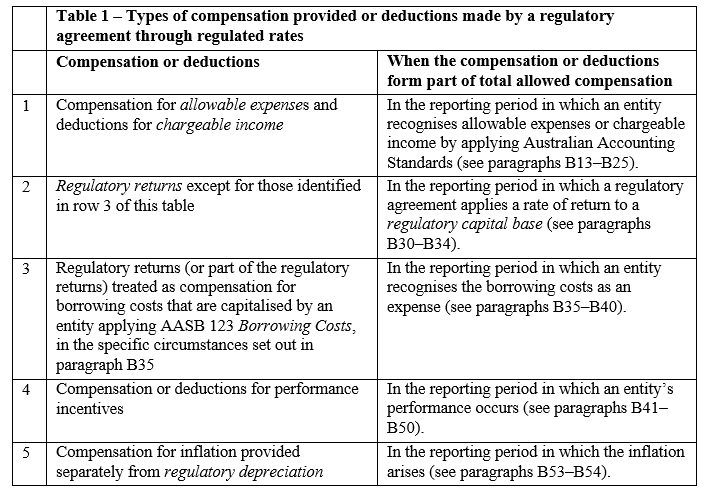
Table 1 sets out the most common types of compensation provided or deductions made by regulatory agreements through regulated rates, and establishes when the compensation or deductions form part of total allowed compensation.
20
In addition, for the purpose of applying this Standard, an entity shall treat compensation provided by inflation adjustments to the regulatory capital base as forming part of the total allowed compensation for the reporting period in which the inflation is recovered through regulatory depreciation included in determining the regulated rates charged to customers (see paragraph B52).
21
The terms of regulatory agreements vary by jurisdiction and industry. Accordingly, a regulatory agreement might not provide all the types of compensation or make all the types of deductions described in paragraphs 19–20, might provide other types of compensation or make other types of deductions or might use different terminology to refer to the types of compensation or deductions described in paragraphs 19–20. An entity shall use its judgement in analysing the terms and conditions of a regulatory agreement to determine what types of compensation or deductions the regulatory agreement provides or makes. If the regulatory agreement provides a type of compensation or makes a type of deduction other than those described in paragraphs 19–20, the entity shall use its judgement to determine when that compensation or deduction forms part of total allowed compensation.
22
Paragraphs B13–B54 describe when differences in timing might arise from the compensation or deductions described in paragraphs 19–20.
23
Differences in timing might also arise from the under‑recovery or over‑recovery of allowed revenue as described in paragraphs B57–B58.
Monetary amounts are denominated in ‘currency units’ (CU).
For simplicity, this example ignores the effect of regulatory interest.